Redemption of the Dragon
Act 2 – Prophesy or Conspiracy · Chapter 2: Return to Form
Vorys called the place a ludis.
Tom learned the word on his first morning there, from a man with a broken nose, a shaved head, and shoulders thick enough to make a doorframe look narrow. He had come into the cell yard at dawn with a stick in one hand and a bowl of grey porridge in the other. The porridge he gave to Tom. The stick he kept for everyone.
"Ludis," the man said when Tom looked past him at the high walls, the barred windows, the packed sand yard, and the iron gate at the far end. His common tongue was rough but serviceable. "School."
Jory sat on the bench beside Tom, one arm bound tight across his chest. "Looks like a prison."
The man showed yellow teeth. "Good. You learn fast."
His name was Boro.
Not Master Boro. Not Ser. Not captain. Boro had once been a fighter, which meant he had once been property with better food than other property. He walked with a limp that grew worse in the rain and carried scars across his belly like someone had tried to open him from hip to rib and lost interest halfway through. Vorys had made him trainer after his knee failed. Boro spoke of this as if it were a promotion. Tom understood it as a longer leash.
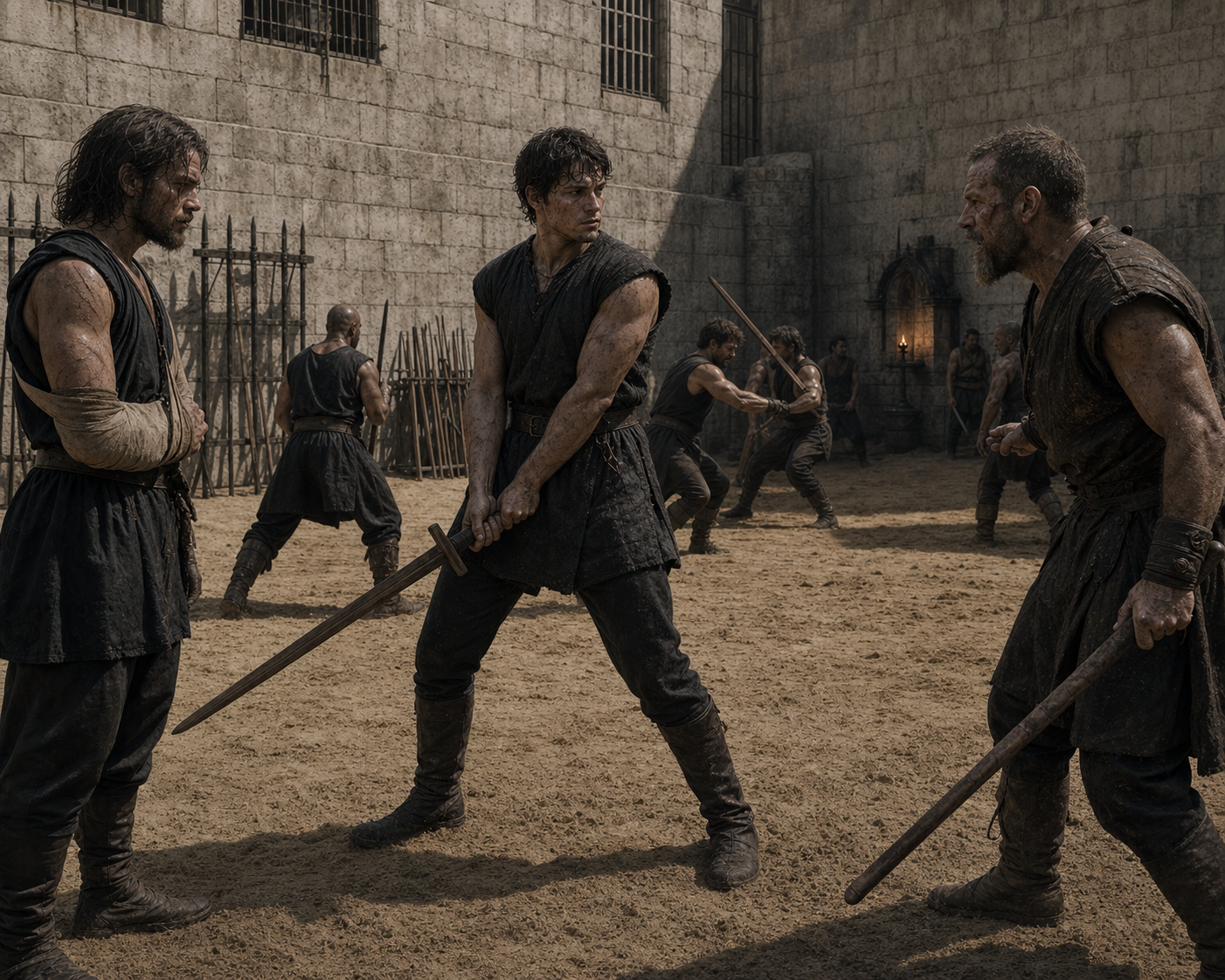
The ludis stood in the lower rise of Myr, away from the richest terraces but too far from the docks to smell of fish. Its outer wall was pale stone, sun-bright and plain, with no sign above the gate and no promise beneath it. Inside were sleeping cells, a kitchen, a covered training hall, a sand yard open to the sky, a small infirmary, weapon racks kept behind locked bars, and a shrine niche where a blackened lamp burned day and night before a god Tom did not know.
There were twenty-seven fighters when Tom and Jory arrived.
Men, mostly. A few women. Big men with soft hands who had been bought for size and beaten into shape. Small men quick enough to make size look foolish. A Summer Islander with skin dark as oiled wood who fought with a spear as if it were a thought leaving his body. A Tyroshi woman called Mera, though no one knew if that was the name she had been born with or the one she had chosen after killing the last man who tried to give her one. A Norvoshi with bells tattooed down his arms. Two Volantenes who hated each other until anyone else looked at them wrongly, whereupon they remembered blood was thicker than sense.
Tom and Jory were given a cell with one barred window high in the wall and two sleeping mats thin enough to insult straw.
"Better than the ship," Tom said.
Jory lowered himself onto a mat with care. "The ship moved."
"You miss it?"
"I miss having new reasons to hate things."
Tom sat opposite him and flexed his damaged hand. The fingers moved more than they had in the auction yard. Less than they should.
Jory watched.
"You will make it worse."
"Mayhaps."
"That is still not an answer."
"You keep saying that."
"You keep failing to give one."
For a moment they sounded like themselves.
Then the silence came back and brought Tor with it.
Tom looked toward the high window. A strip of blue showed beyond the bars. Myrish sky. Not northern grey. Not riverland rain. Not the color of any home worth naming.
"Boro says we heal before we fight," Tom said.
"Boro says many things."
"Some may be true."
"A man with a stick is rarely paid for truth."
Tom almost smiled.
Jory saw it and looked away first.
Vorys visited on the third day.
He did not come like a man inspecting a prison. He came as if he had been invited to a pleasant breakfast and found the company poor but interesting. Dark blue silk again, though this coat was lighter and embroidered at the cuffs with bronze thread. His cloudy eye seemed whiter in the sun. His good eye missed nothing.
The fighters were lined in the yard. Tom stood near the end beside Jory, because Boro had decided the new northmen needed to be seen and not trusted.
"How is my purchase?" Vorys asked.
Boro spat into the sand. "Broken. Not useless."
"All purchases are broken. The question is whether they mend into profit."
"The big one will. Hand bad, ribs bad. Head thick enough to save him."
"And the other?"
Boro looked at Jory. "Shoulder bad. Grief worse. Shoulder may heal first."
Jory's face did not change.
Vorys stepped closer. "Grief is not useless. It only needs direction."
"You have none to give me," Jory said.
Several fighters went still.
Boro's stick lifted slightly.
Vorys only smiled. "No? Then I shall rent you some until you find your own."
He moved on before Jory could answer, which was probably wise and certainly annoying.
For the first month, they were not given weapons.
That was Boro's mercy, if mercy could be delivered by a man who used a stick to correct posture. Tom hated him by breakfast on the first day and understood him by the second week. Boro did not waste motion. He did not rage. He did not strike for pleasure, or not often. He watched bodies the way a smith watched metal in a fire, seeing where heat had taken, where cracks hid, where pressure might shape and where it would only shatter.
"Walk," Boro said.
So they walked.
Around the yard, under the sun, through pain that began as complaint and became weather. Tom walked until his ribs stopped stabbing with each breath and settled into a deep ache. Jory walked with one arm bound and his jaw clenched, sweat running pale tracks through the dust on his face.
"Again," Boro said.
So they walked again.
After walking came stretching. After stretching came lifting stones. Not too heavy at first. Boro stopped Tom when pride reached for weight his hand could not hold.
"You break it again, I cut it off and sell you as half-price novelty."
"Would I still eat full portions?"
Boro stared at him.
Jory made a small sound.
Not a laugh.
Near enough that Tom remembered how one felt.
By the second month, Tom could close his right hand around a practice staff without wanting to vomit.
That was victory, though it looked like nothing.
There were many such victories. Bending his fingers at dawn and finding one knuckle less swollen. Sleeping through the night without waking to the music of the Twins. Taking a breath deep enough to fill his chest. Watching Jory lift his injured arm to shoulder height and hold it there while his face went white but his hand did not shake.
They did not celebrate them.
Celebration belonged to men with choices.
Still, Tom counted.
Jory did too, though he never said it.
Myr's heat deepened as weeks turned. The training yard became an oven by noon. Sweat dried white on skin. Sand stuck to every wound and fold of cloth. The fighters rose before dawn, trained until the sun made fools of them, rested in the shade through the worst heat, then trained again when shadows lengthened.
They ate better than dock slaves.
That was another insult shaped like a kindness.
Beans. Onions. Flatbread. Goat when Vorys expected bouts soon. Fish stew. Figs so ripe they split in the hand. Weak wine watered until it offended both thirst and drunkenness. Enough food to mend muscle. Not enough to forget ownership.
The collars came off inside the yard.
The gates stayed locked.
"Why?" Tom asked Boro once, touching the bare skin at his throat.
"Crowd likes collar in street," Boro said. "Crowd hates collar in fight."
"Why?"
"Because crowd likes to pretend fighter chooses."
Tom thought of Westeros then. Men cheering young lords who rode to war because songs said glory waited. Men shouting for kings while smallfolk bled in fields they did not own. The collar was different. The lie was not.
The first red priest came in the seventh week.
Tom noticed him because red did not belong in the training yard.
The ludis had colors, but they were hard colors. Sand, stone, sweat, old blood gone brown in cracks, black iron, pale linen, blue sky too bright to trust. The man's robe cut through all of it. Not bright scarlet like a tourney cloak, but deep red, the color of banked coals. He stood beneath the upper gallery beside Vorys, hands folded in his sleeves, head shaved smooth, beard oiled to a point.
Tom was working a staff drill with Boro.
"Again," Boro said.
Tom shifted his grip.
The red priest leaned forward.
Not much.
Enough.
Tom felt it as surely as he felt the staff in his hands.
"Again," Boro snapped.
Tom moved.
The drill was simple: step, turn, strike low, recover, strike high, move back before the counter. Simple did not mean easy. His hand ached by the twentieth pass. His ribs pulled by the thirtieth. By the fortieth, sweat ran into his eyes and the priest had not looked away once.
When Boro finally let him stop, Tom turned toward the gallery.
The priest was speaking to Vorys.
Vorys was watching Tom.
That night, Tom told Jory.
"A buyer?" Jory asked.
"Mayhaps."
"For what?"
Tom flexed his hand, feeling the day's work in every joint. "That is the question."
Jory lay on his mat, staring up at the ceiling. "Red priests buy slaves."
"Everyone buys slaves here."
"Not everyone watches like that."
No.
They did not.
The next red priest was a woman.
She came three weeks later, when Tom and Jory were first permitted to spar with padded sticks. Her robe was brighter than the man's had been, red silk belted with black cord. Her hair was hidden beneath a hood despite the heat. She wore a ruby at her throat that caught sunlight and held it too long.
Tom saw her before the bout began.
Jory saw him see her.
"Again?" Jory murmured.
"Aye."
"Same one?"
"No."
Boro slapped his stick against his palm. "Talk later. Hit now."
Jory struck first.
He had always been cleaner than Tom. Not faster, not stronger, but clean. Even injured, even half a world from home, he moved with that same hard economy. No wasted flourish. No anger where edge should be. The padded stick cracked against Tom's shoulder before Tom's feet had decided what the rest of him knew.
"Slow," Jory said.
Tom gave ground. "Old."
"Big."
"That too."
Jory came again.
Tom caught the strike on his own stick and stepped inside. Before the Twins, he might have used strength. Shoulder. Hip. Weight. Drive through the man and end it. His ribs still disliked that answer. His hand disliked most answers. So he turned instead, let Jory's momentum pass, and hooked his ankle with the chain of motion rather than iron.
Jory hit the sand with a grunt.
The yard went quiet.
Tom lowered the stick.
Jory looked up at him.
For one heartbeat, Tom feared he had done something wrong. Not in the spar. Somewhere deeper. Some trespass against grief or memory or the place where Tor should have been laughing.
Then Jory reached up with his good hand.
Tom pulled him to his feet.
"Better," Jory said.
"You fell."
"I noticed."
"You said better."
"You listened to your wounds instead of pretending you had none."
Tom looked toward the gallery.
The woman in red was gone.
Vorys remained.
He applauded once, softly, as if only for himself.
By the third month, Tom could strike hard again.
Not as he had before. That man had died somewhere between the Frey camp and the auction block. This was not return to what had been. This was return to form the way beaten iron returned to usefulness under hammer and heat: changed, marked, but less brittle than before.
Boro changed their work.
Wooden swords. Blunted spears. Shields with wicker frames. Nets. Tridents. Short axes. Curved blades too light for Tom's taste. A hooked Myrish knife that seemed designed by someone who hated cloth, flesh, and fairness in equal measure.
"Arena has stories," Boro said, tossing weapons onto the sand. "Crowd likes story. Big man with little knife. Small woman with big spear. Two brothers against beast. Old enemy forced to guard back. Noble savage. Silent killer. Mad dog. Gentle giant. You learn all."
"We are not brothers," Jory said.
Boro shrugged. "Vorys sells what crowd buys."
Tom picked up a shield. "What does he call us?"
"Northmen."
"That all?"
Boro's mouth twitched. "For now."
Names mattered in the arena, the fighters told them. Names made crowds remember. Crowds who remembered came back. Crowds who came back brought coin. Coin kept a fighter fed if he pleased the right men and alive if he pleased enough of the wrong ones.
Mera had a name: the Laughing Knife.
She never laughed.
The Summer Islander was called Tall Spear, which offended him because he had a name and because the spear was of ordinary length. The Norvoshi was called Bellhand. One Volantene had once been Fire-Eater until a torch trick went badly and left his beard permanently patchy. The other called him Cinders when he wanted a fight.
"What would they call you?" Mera asked Tom one evening while they wrapped practice cuts in the infirmary shade.
Tom looked at her. "Tom."
"Crowd hates small names."
"Good."
"They will give you a larger one."
"I have no need of it."
She tied a strip of linen around her forearm using teeth and one hand. "Need has nothing to do with gifts from owners."
Jory sat nearby while an old healer named Sello rubbed foul-smelling oil into his shoulder. His face had gone blank in the way men went blank when pain was being endured by force of pride alone.
"They will call him Stubborn," Jory said.
Mera tilted her head. "Too plain. Crowds pay less for plain."
"Fool, then."
"Too common."
Tom leaned back against the wall. "You are both kind."
Jory's mouth twitched.
Sello pressed two fingers into his shoulder. Jory stopped twitching and started breathing through his teeth.
The third red-robed observer came near the end of that month.
This one was old.
Or looked old. Tom had learned that Essosi men aged in unfamiliar ways, some with oils and powders, some with sun, some with sorrow. The old priest had a white beard down to his chest and a face lined like dried leather. His robe was simple wool, red faded almost brown at the hem. He stood alone at the gallery rail. No Vorys beside him. No guard close.
Tom was not training when he noticed him.
Jory was.
That made Tom look twice.
Jory faced Tall Spear in the sand, wooden sword against blunted spear. It was a poor match for Jory, which was why Boro had chosen it. The spear kept him out. His shoulder still slowed high cuts. Tall Spear moved with a grace that made other men look assembled from leftover parts.
Jory lost the first exchange.
Then the second.
On the third, he stopped trying to win quickly.
Tom saw the change. So did Boro. So did the priest.
Jory let the spear touch him twice more. Arm. Thigh. Glancing blows, but blows. He learned the reach not by measuring it, but by paying for it. When Tall Spear lunged again, Jory stepped wrong on purpose, made himself look late, then took the spear haft under his arm, trapped it against his side, and drove forward with his shoulder into the other man's chest.
Both went down.
Jory came up with the wooden sword at Tall Spear's throat.
Tall Spear laughed.
"Ugly," he said.
Jory's face went still.
Tom's hand tightened.
Tall Spear must have seen something in both of them, because his smile faded. "I meant the move. Mostly."
Jory lifted the sword away. "Aye."
But he left the yard after that and did not speak through supper.
That night he woke from a dream with one hand around Tom's throat.
Tom did not fight him.
That was harder than fighting.
Jory came awake all at once and recoiled as far as the cell allowed.
"Tom."
"Aye."
"I did not-"
"I know."
Jory stared at his own hand as if it belonged to someone else.
Tom sat up slowly. His throat hurt. Not badly. Enough to remember.
"He used to call every good thing ugly," Jory said.
Tom said nothing.
"A horse. A knife. A girl who smiled at him in Barrowton. The sky once. We were boys. Red sunset over the sea. My mother said it was beautiful. Tor said beautiful was a southron word and the sky was ugly enough to be worth looking at."
The cell held its breath around them.
Jory's hand closed. Opened. Closed again.
"I forgot that," he said.
"No."
Jory looked at him.
"You remembered," Tom said.
For a long while, Jory did not answer.
Then he lay back down with his face to the wall.
After that, his training changed.
Not all at once. Men did not heal like songs said they did, with a single dawn and a clear road. Some days Jory was cold enough to frost the stones. Some days he fought as if death were an appointment he meant to keep early. But more often, he fought to win and live after. He worked the shoulder. He let Sello hurt him. He stopped refusing extra food when Tom pushed it toward him.
"I am not a child," he said the first time.
"No."
"Then stop feeding me like one."
"Eat like a man and I will."
Jory glared.
He ate.
By the fourth month, Vorys began letting them watch arena bouts.
Not fight. Watch.
They were taken under guard through Myr's evening streets to a smaller arena set in a hollow between two warehouse rows. It had no grand marble front, no royal boxes, no glory except the kind men bought by the cup. Lamps burned along the walls. Vendors shouted. The crowd smelled of wine, oil, sweat, and appetite.
Tom stood behind an iron screen with the other fighters and watched two men nearly kill each other while strangers cheered every mistake.
"Lesson?" Boro asked after.
"Crowd likes blood," said one of the Volantenes.
Boro hit him with the stick. "Crowd always likes blood. That is not lesson. Lesson is when they expect it."
Mera said, "Crowd likes thinking it knows what will happen."
Boro pointed at her. "Better."
Tall Spear said, "Winner nearly died because he listened to them. Crowd noise is a bad shield."
"Better."
Jory watched the sand below, where slaves were raking blood into dark streaks. "The crowd is a weapon."
Boro looked pleased enough to be ugly. "Best answer."
Tom looked over the faces beyond the screen. Merchants. Sailors. Slaves standing behind owners. Children perched on shoulders. Women with painted eyes. Men with wine cups and soft mouths. And there, beneath an arch near the far passage, another red robe.
Younger this time.
Barely older than Tom, perhaps, with copper skin and dark hair braided with red thread. He did not watch the fighters in the arena.
He watched the screen.
No.
Tom followed the line of his gaze.
He watched Tom and Jory.
"Jory," Tom said under the crowd noise.
"I see him."
"How many is that?"
"Four."
"Five," Tom said. "The first man came twice."
Jory's jaw tightened. "Vorys selling us?"
"Maybe."
"To red priests?"
"Maybe."
"For what?"
Tom looked at the red-robed youth, at the way lamplight caught in his eyes and made them seem brighter than they were.
"Maybe they do not know yet."
The first time Tom heard the red priests mentioned in Myr, it was not meant for him.
He was carrying water jars across the ludis yard at dawn, part of Boro's belief that fighters who thought themselves above chores deserved more chores. Two guards stood near the gallery stairs, speaking lazily in Myrish. Tom understood little of it, but some words sat close enough to the trade Low Valyrian used by slave handlers that meaning could be guessed by bruises if not by grammar. Pain taught languages quickly when orders came attached to consequences.
One guard said red priest.
The other said Vorys.
Then northmen.
Tom nearly missed a step.
The jar water sloshed over his hand.
The guards laughed at something else and moved on.
Northmen.
He disliked hearing the word in their mouths. It sounded less like a people than a line in an account book.
At supper, he told Jory.
Jory listened with his hands wrapped around a bowl of beans.
"Could be about anyone," he said.
"Aye."
"This place is full of men who think gods speak to them because silence would leave them alone with themselves."
"Aye."
"Still."
"Aye."
Jory looked across the eating hall. Fighters sat in clusters beneath low lamps, laughing, arguing, chewing, staring. Boro stood near the door with his stick tucked under one arm. Sello dozed in a corner. A guard picked his teeth. Above them, the night pressed black against barred windows.
"Tom."
"What?"
"If red priests try to buy us, we go carefully."
"I had meant to leap through fire and ask questions after."
Jory's mouth tightened.
Then, unexpectedly, he laughed.
It was small. Rusted. More breath than sound.
But it was there.
Several fighters turned to look.
Tom did not.
He stared into his beans as if they held every secret in the world and let Jory have the moment unobserved.
By the fifth month, Tom returned to form.
Boro said it first, which ruined the phrase and gave it weight at once.
Tom had been sparring three men in sequence. Not because he was better than three men. Because Boro wanted him tired enough to stop pretending strength was plan enough. The first man made him work. The second cut his cheek with a wooden blade hard enough to draw blood. The third was Mera.
She smiled before they began.
That was never good.
Mera fought close, which Tom disliked because she did it better than he did. She came in under his guard, struck ribs, thigh, wrist, ribs again. Tom gave ground until the yard wall neared his back and Boro shouted something unhelpful about dying in corners.
Tom stopped moving backward.
Mera saw it and changed angle.
Tom let her.
Her practice knife touched his side. In a real bout, it might have opened him. In this one, it cost her position. Tom trapped her wrist, turned, and used his hip carefully, not with old brute force but with the new measure pain had taught him. Mera left the ground and hit the sand on her back.
Tom had the wooden blade at her throat before his hand remembered to hurt.
The yard went quiet.
Mera looked up at him.
Then she smiled again. "There he is."
Boro grunted. "Return to form."
Tom stepped back and offered Mera a hand.
She took it. "Do not look so pleased. I let you have one because your face is tragic."
"My face?"
"Deeply tragic."
Jory, from the shade, said, "Always has been."
Tom looked at him.
Jory looked back, perfectly calm.
The fighters laughed.
Tom did not know what to do with that, so he drank water and pretended it had not happened.
On the gallery above, Vorys stood beside a red-robed man Tom had never seen before.
This one wore his hood up.
No face showed beneath it, only a dark beard and the red glimmer of some jewel at his throat.
Vorys leaned close to him and spoke.
The hooded man did not look at Vorys.
He looked at Tom.
Then at Jory.
Then at Tom again.
Tom's good mood cooled.
That evening, Vorys summoned them.
Not to the yard. Not to the infirmary. To his counting room.
It lay above the front gate, with shuttered windows overlooking the street and walls painted blue to make men forget they were inside a cage. Carpets covered the floor. A bronze brazier smoked with sweet resin. On one table lay ledgers, coin scales, letters sealed in colored wax. On another rested weapons too fine for practice.
Vorys sat with wine in hand.
Boro stood near the door.
The hooded red priest was gone.
"My northmen," Vorys said.
"We are not yours," Jory said.
Vorys smiled. "Legally, poetically, and financially, you are. Spiritually, perhaps not. I leave that to men in red who charge more for certainty than I do."
Tom said, "They keep watching us."
"Many people watch fighters."
"Not like that."
Vorys sipped his wine. "How do they watch?"
"Like buyers."
"Everyone is a buyer."
"Not everyone knows what he wants to buy."
For once, Vorys looked genuinely amused. "Very good."
Jory shifted beside Tom. His shoulder no longer dragged the way it had. He could stand square again.
"Why?" Jory asked.
"Why do red priests do anything? Fire. Fate. Fear. The usual trade."
"You know."
"I know many things. Which is why I live comfortably."
Tom stepped closer before Boro's stick tapped once against the floor. A warning. Not fear, exactly. Shape.
Tom stopped.
Vorys watched the exchange with interest. "They asked to see you train. I allowed it."
"For coin?"
"For courtesy. Coin comes later, if courtesy proves wise."
"Are you selling us?"
"I sell all things at the right price."
Jory's face hardened.
Vorys lifted one finger. "But no, not yet. Do not look so wounded. You are not ready."
"For what?"
"For a proper first bout."
The room held still around that.
Tom heard the street beyond the shutters. Cart wheels. A woman calling prices. Hooves on stone. A city alive and indifferent.
"What do they want?" he asked.
Vorys leaned back. Firelight touched the cloudy eye and made it seem briefly red.
"That, Tom of the North, is what makes them interesting. They will not say."
Boro's stick stopped moving.
Jory glanced at Tom.
Vorys smiled as if he had given them a gift instead of another chain.
"They ask questions with their eyes and pay for the privilege of asking them," he said. "For now, that is enough."
Jory said nothing.
Tom felt his hand close at his side. All five fingers now. Not without pain. Not perfectly. But closed.
"And what do you think?" Tom asked.
"I think red priests make excellent repeat customers."
"That all?"
"No." Vorys set down his cup. "I think men who are watched by priests are more valuable than men who are watched only by crowds. I think value should be cultivated. I think you will both fight soon."
Jory's voice was flat. "Arena?"
"A small bout first. Private crowd. Controlled pairings. Enough danger to make them lean forward, not enough to waste my investment."
"Against who?"
Vorys smiled.
"Not each other, if that is what tightens your faces. I am not crude."
Boro snorted softly.
Vorys ignored him. "You will fight together."
Tom did not like the relief that came. Relief could become leash faster than fear.
"Why tell us about the priests?" he asked.
"Because mystery sharpens men. Too much dulls them, but a little?" Vorys made a small turn of his hand. "A little makes the blood listen."
"You talk too much," Jory said.
Vorys laughed. "And you too little. Between us, perhaps, balance."
They were dismissed.
Outside, the night air felt cooler than the counting room, though Myr had not learned true cold. Tom and Jory crossed the yard under torchlight. The fighters had settled into cells and shadows. Somewhere Mera was singing badly in Tyroshi. Somewhere Boro cursed a guard for leaving a gate bar loose. The shrine lamp burned in its niche, small and stubborn.
Tom stopped beside it.
The god in the niche had no face. Only a black stone shape, half-melted by generations of smoke.
Jory stood beside him, watching the little flame struggle in its cup.
"Could be they only want to see two northmen bleed," he said.
"Could be."
"You believe that?"
"No."
For a moment, Tom thought of home. Not as a place he might reach soon, but as proof that the world had once been larger than walls. Fields under cold sky. Ironrath's yard. Rodrik Forrester telling a strong boy that strength was a stupid beast unless a man put reins on it.
Tom flexed his hand.
Reins, then.
He had strength again.
Not freedom. Not safety. Not answers.
But strength.
Jory rolled his shoulder once, slow and deliberate. It no longer made him go pale. That was new too.
"We fight together," Tom said.
"Aye."
"We live."
"Aye."
"We listen."
Jory's eyes moved to the shrine lamp, then to the high gallery where red robes had stood too often.
"And when we know what they want?" he asked.
Tom watched the little flame bend and right itself.
"Then we decide what it costs them."
Jory considered that.
Then he nodded once.
In the cell that night, Tom slept without dreaming of the Twins.
Not because the dead had left him.
They had not.
Tor was still there, in the silence after every laugh, in the space beside Jory, in the moment before every blow when Tom's body remembered someone else stepping between him and death.
But the dream did not come.
Instead he woke before dawn to the sound of Boro's stick striking the cell bars.
"Up," Boro barked. "Return to form does not mean return to sleep."
Jory groaned into his mat.
Tom opened his eyes.
His ribs ached. His hand hurt. His body was scarred, owned, and tired.
But when he stood, he stood straight.
Previous Chapter | Chapter List | Next Chapter
Disclaimer: Frostfyre is a non-commercial fan fiction project inspired by a Realm of Thrones campaign for Mount & Blade II: Bannerlord and set in the world of A Song of Ice and Fire. All rights to those original settings and characters remain with their respective owners.
Join the Forge
Receive new Frostfyre chapters and Aodh Forge updates as they are released.