Redemption of the Dragon
Act 2 – Prophesy or Conspiracy · Chapter 1: All That Money Can Buy
The first three days at sea taught Tom that chains had moods.
Sometimes they hung heavy and still, cold against the wrist, content to remind a man of what he was without effort. Sometimes they snapped tight with the ship's roll and bit like teeth. Sometimes they sang. Not loudly. A scrape here, a dull clink there, iron speaking to iron in the dark while men tried to sleep through pain, sickness, and fear.
By the fourth day, Tom knew the sound of his own chains from all the others.
That seemed a poor sort of learning.
Rain hammered the deck above them. The ship lurched hard to starboard, and half the hold answered with groans. Somewhere in the dark, a man retched until there was nothing left in him but noise. The bilge stank worse after storms. Everything did. Wet wood. Old straw. Piss. Vomit. Blood that had gone sour in bandages. Salt water leaking down through seams and dripping cold onto faces raised too slowly to avoid it.
Tom sat with his back against the planks and his knees drawn as close as his ribs allowed.
He breathed in.
Pain.
He breathed out.
Pain again, but smaller.
That was how he counted the days at first. Not by sun, for the hatch stayed closed when weather turned foul and opened only long enough for buckets, bread, water, and curses. Not by meals, because the food came when the crew remembered or when the captain decided living cargo was worth feeding. He counted by pain. The sharp place beneath his ribs where a boot had found him. The ache in his jaw. The hot swelling at his wrist. The dull thunder inside his skull.
On the first day after waking, pain had ruled him.
On the second, he learned where it ended.
On the third, he learned what parts of him would still obey.
His right hand was the worst. Two fingers bent. One would not close all the way. The knuckles had swollen into ugly knots where the Bolton's boot had crushed them into the mud. Tom worked them when no one watched, opening and closing, opening and closing, until sweat stood cold on his neck.
Jory noticed, of course.
Jory noticed everything he could use to hurt himself.
"You'll tear something," he said.
Tom flexed the hand again. "Likely."
"Then stop."
"No."
Jory leaned his head back against the wall. His bad arm was lashed across his chest in wrappings that had once been pale. The shoulder beneath had taken the mace badly. He could move the fingers. He could not lift the arm without his face losing color.
"Stubborn fool," Jory said.
"Aye."
"That was not praise."
"No."
The ship dropped beneath them. For one strange moment Tom's stomach rose into his throat and the chains lifted light from the floor. Then the hull struck water with a crash that shook a cry from half the hold. Jory's jaw clenched. Tom heard the breath hiss between his teeth.
"Shoulder?" Tom asked.
"Still attached."
"That was not an answer."
"It is the only one worth giving."
Tom almost smiled.
Almost.
There had been fewer almost-smiles since the Twins.
Tor had taken most of them with him.
The thought came without warning, as thoughts of Tor often did. Not as memory proper, with shape and order, but as a sudden absence made sharp. Tor reaching for half a sausage. Tor grumbling at wet boots. Tor laughing with blood on his cheek. Tor stepping where no man should have stepped and staying there until death had spent itself.
Tom looked at the chain around his wrist.
Iron could break.
He had told himself that when the hold was dark and the ship first carried them east. It had sounded almost like a promise then.
After four days, it sounded like work.
Work was better.
Work gave grief a place to put its hands.
There were thirty-one souls in the hold when Tom began counting properly. Some he knew by name. Most by shape. A Pentoshi boy with both ears pierced and no tongue. Three river men taken from somewhere south of Maidenpool, if their muttering could be believed. A woman from the Fingers who had stopped speaking after the second storm. Two brown-skinned sailors whose own ship had been taken by pirates before they were sold onward to men who dealt in such things. A Lysene girl with pale hair shaved close to the skull because the crew had feared lice. A big Tyroshi with green-dyed beard roots growing back black, who sang whenever the sea was calm and wept whenever it was not.
There had been thirty-three when they left whatever hidden cove or rotten river mouth had first taken them from Westeros.
One old man died on the fifth night.
One boy died on the seventh morning.
The crew carried them up wrapped in nothing. The hatch opened, hands came down, chains were unfastened from wall rings, bodies dragged away. Tom heard the splash after the old man. He did not hear it after the boy. The storm was too loud.
Jory heard it.
Tom saw that he had.
Neither of them spoke.
Speaking used water.
Lew came when the weather allowed. The young sailor brought buckets, stale bread, sour fish, sometimes a handful of olives hard as knucklebones. He tried not to look at the dead and failed. He tried not to look at Tom and Jory and failed at that too.
On the sixth day, Tom said, "Where are you from?"
Lew froze with the cup in his hand. "Here and there."
"That is no place."
"It is for sailors."
Jory gave a dry sound. "He has you there."
Lew looked offended and pleased in equal measure, which told Tom the boy had not yet been a sailor long enough to have both feelings beaten into one.
"Myrish father," Lew said after a moment. "Mother from Gulltown."
"You speak common well."
"Mother did."
"Did?"
Lew glanced up toward the hatch.
Tom let it pass.
That was another thing the sea taught him. A man did not need to pry at every wound to know it hurt.
On the eighth day, the storm grew teeth.
The ship climbed black water and fell down its other side with such force that one of the wall rings tore halfway loose and left a man screaming until the crew came below. Not from kindness. From fear the ring would fail entirely and leave property loose in bad weather.
Tom watched how they worked.
Four men came down. Two with clubs. One with keys. One with a short sword and a face bored by misery. They moved poorly in the hold, knees bent against the roll, shoulders turning sideways between chained bodies. The key man kept the ring of keys looped twice around his wrist, but his hands shook when the ship pitched. The man with the sword stayed near the ladder. He trusted the clubs to do the close work.
Tom watched their boots.
Jory watched their hands.
Later, when the hatch closed and the storm swallowed the world again, Jory said, "You see it?"
"Aye."
"They fear the dark down here."
"They should."
"Not enough."
Tom rested his head against the planks and shut his eyes. "No. Not enough."
That night, he dreamed of the Red Wedding, except the Twins had become a ship and the music came from under the water. Tor stood on deck with a spear in his belly and rain pouring from the hole in his throat. Still ugly? he asked, but no sound came. Only bubbles.
Tom woke with his hands locked around his chain.
Jory was awake too.
He did not ask.
By the tenth day, the sea calmed enough that the hold began to stink less of terror and more of waiting.
Waiting had its own stink.
Men whispered plans. Most were fever dreams dressed as sense. Break the chains. Take the ship. Swim west. Kill the captain. Bribe the crew. Pray to the Seven. Pray to R'hllor. Pray to whatever god owned the sea and hope he hated slavers more than drowned men.
Tom listened.
So did Jory.
"No ship," Jory said quietly when one river man finished describing how he would take the deck with a bucket handle and a broken tooth.
The river man glared. "You got better?"
"No ship," Jory repeated. "You get loose, maybe you kill one. Maybe two. Then the crew bolts the hatch and waits. Or smokes us out. Or cuts the throat of every man below and throws the lot overboard. They still reach Myr with enough bodies to sell."
"You sound eager to be sold."
Jory's good hand moved faster than Tom expected. The chain snapped taut before he could reach the man, but the sound of iron was enough to end the argument.
"We bide," Tom said.
The river man spat near his foot. "Bide for what?"
"Ground."
That word settled differently.
Ground meant a place where feet could push. Where men could run. Where walls did not move and death did not wait on both sides in black water.
Ground meant chance.
Small, mayhaps.
But not none.
On the twelfth morning, Lew opened the hatch and sunlight came down after him.
Real sunlight.
Not storm-grey. Not lantern-yellow. Bright enough that men raised hands to their faces and hissed like things dug out from under stones.
"Myr," Lew said.
The hold changed with the word.
Not hope.
Hope was too clean for what moved through them.
Fear with a new shape, perhaps.
The crew brought them up in pairs.
Tom had thought he remembered the sun. He had been wrong. It struck him like a mailed fist and filled his eyes with white fire. He stumbled on the ladder, chains dragging at wrists and ankles, and nearly fell before a sailor shoved him hard between the shoulders.
"Move, ox."
Tom moved.
The deck rolled beneath him, but less than the world did. For a moment all he could do was stand bent under light, blinking through tears he refused to call tears, with salt wind cutting across his face.
Then Myr came clear.
It rose from the shore in pale tiers and colored stone, a city of domes, towers, terraces, and walls that seemed to have been built by men who feared flatness more than enemies. Roofs shone red and green beneath the sun. Slender minarets speared upward beside squat merchant houses. Balconies hung over narrow streets. Blue tiles flashed like pieces of sky broken and set into walls. The harbor curled around the city in a crowded half-moon, thick with ships from everywhere Tom had ever heard named and places he had not.
There were swan-bellied cogs from Westeros, striped sails from Tyrosh, narrow galleys with painted eyes, fat merchant hulks that smelled of spice before they came near the docks, fishing boats darting between them like minnows, and slave ships flying no pride at all.
The water inside the harbor was green and shining, filmed with oil, flower petals, and refuse.
The air smelled impossible.
Salt. Tar. Fish. Hot stone. Horse dung. Frying oil. Strange spices that burned sweet in the nose. Perfume. Sweat. Smoke from a hundred cookfires. Something sharp and clean from workshops near the water, like glass being born.
Men shouted in a dozen tongues.
Bells rang from somewhere high in the city.
Jory stood beside Tom, swaying only a little. His face had gone still.
"Far from Bear Island," Tom said.
"Far from everything."
Tom looked toward the harbor mouth. Beyond it lay the Narrow Sea, and beyond that Westeros, rain, mud, the Twins, the dead.
Far, aye.
Not gone.
Never gone.
The crew forced them into a line with the others. The captain came down from the stern to inspect them before they were taken ashore. He was a broad man with a trimmed black beard, rings in both ears, and eyes that counted faster than fingers. His coat was too fine for the stink of his ship.
"That one walks badly," he said, pointing at Jory.
Lew stood near the rail with a coil of rope in hand. He did not look at them.
"Shoulder," said the key man.
"Bad?"
"Bad enough."
The captain's eyes moved to Tom. "And the big one?"
"Ribs. Hand. Head. But strong."
Tom said nothing.
The captain stepped closer. He smelled of cloves and old wine. "Open your mouth."
Tom looked at him.
The captain sighed as if disappointed by an animal too stupid to know market courtesy. The clubman struck Tom behind the knee. Pain cut upward. Tom dropped to one leg, chains clattering. A hand seized his jaw and squeezed until his mouth opened.
"Teeth mostly good," the captain said. "Scars might please some buyers. Northern stock. Big frame."
Stock.
The word slid under Tom's skin and found anger waiting.
"Not arena," the key man said. "Too battered."
"No," the captain agreed. "Labor, perhaps. Quarry. Road crews. Mines if no one else is foolish enough."
Tom felt Jory shift beside him.
Labor camp.
There were many ways to die after being sold. Some sounded slower than others.
The captain moved on.
They were taken ashore beneath guard.
Myr's docks were a world of hard edges and moving colors. Men pushed carts loaded with amphorae, carpets, cages of birds, barrels of olives, bundles of dye cloth, crates marked in curling letters. Women in bright veils walked beneath awnings with slaves carrying parasols behind them. A dwarf with gold rings through his beard argued with a spice seller over a scale. A priest in orange robes sprinkled water over a sailor's hands while a boy beat a little drum beside him. Everywhere there were slaves. Slaves with collars. Slaves with shaved heads. Slaves carrying burdens, sweeping steps, holding reins, pouring wine, kneeling in doorways, standing silent behind men whose hands were soft from owning other hands.
In Westeros, men lied about bondage by giving it different names.
Smallfolk. Servants. Men-at-arms sworn by hunger. Girls given to houses not their own. Boys dragged to wars because lords called and fields could not answer.
Here, the lie had been stripped away.
The collars made it honest.
Tom hated that most of all.
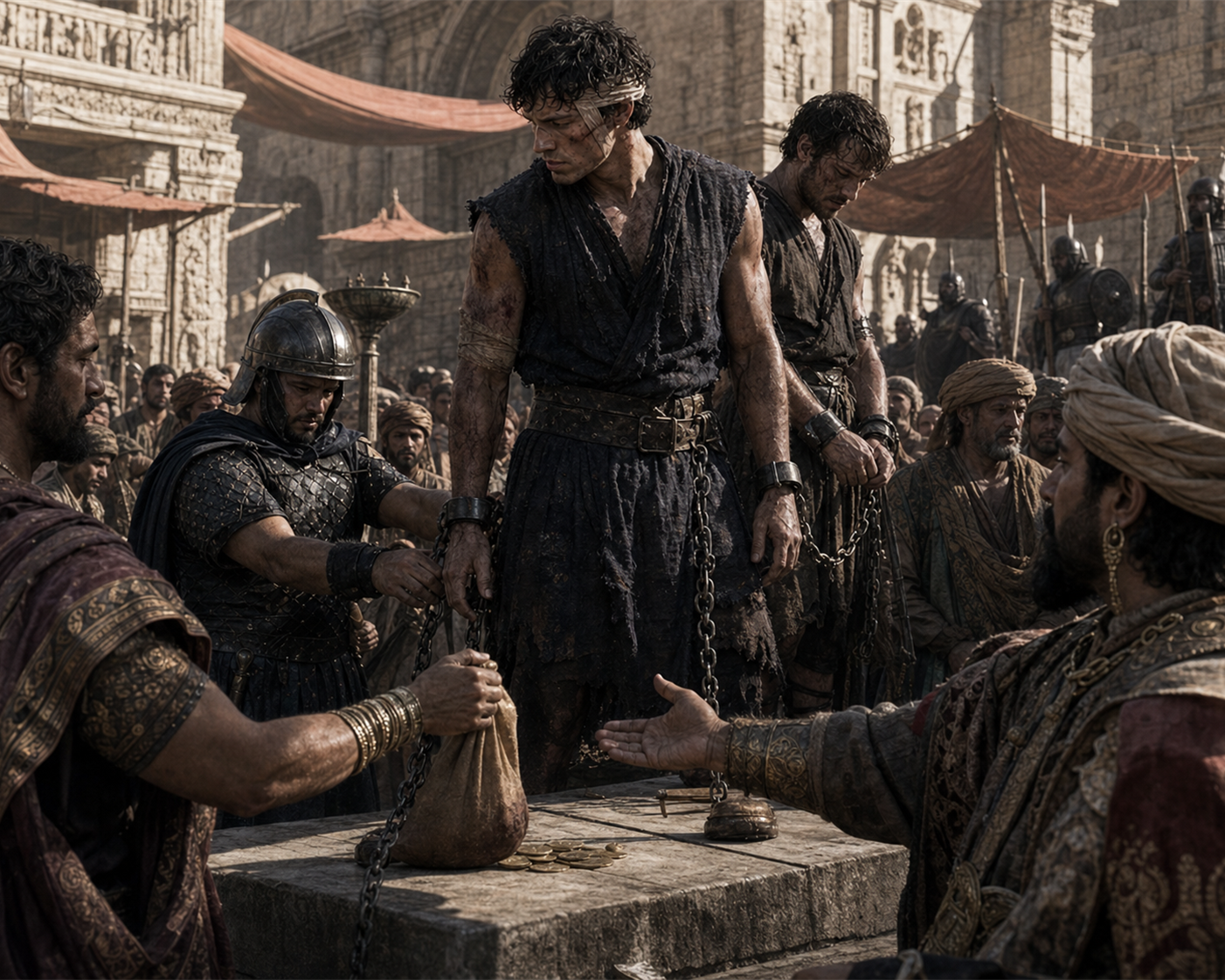
The auction yard stood beyond the fish market, where the city climbed toward richer streets. It was built of pale stone around a square of packed sand. An awning stretched over the buyers' benches. A raised block stood in the center, stained by years of bare feet and fear. On one side were holding pens with iron gates. On the other, a table where scribes sat with inkpots, wax tablets, and faces bored by the buying of lives.
Tom and Jory were shoved into a pen with the rest.
The sand underfoot did not move.
Ground.
Tom breathed.
Jory saw him do it.
"Not yet," Jory murmured.
"No."
The auction began before midday.
They sold the healthy first.
That was another sort of lesson.
A Volantene woman who spoke three tongues went to a merchant with soft hands. Two boys were bought together by a perfumer after their teeth and backs were inspected. The Tyroshi singer brought laughter from the crowd when he cursed the auctioneer in three languages, then a blow from a guard when he tried for a fourth. He sold anyway. Men liked spirit when they believed they owned it.
The Lysene girl sold for more than any of them.
Tom did not look away.
Jory did.
Neither choice helped.
By the time Tom and Jory were brought out, the sun had shifted and the buyers had grown lazy. Men fanned themselves. Women sipped watered wine. A dog slept beneath a bench. The auctioneer's voice had become a bright, polished thing with no feeling beneath it.
"Two northmen," he called in the common tongue first, then in Myrish. "Taken after battle in the Riverlands. Strong blood, hard country, used to cold, hunger, and command. This one large enough for three men if he heals. This one leaner, older, trained with blade and axe."
Tom stood on the block with chains at wrists and ankles.
Jory stood beside him, pale but upright.
A buyer in a yellow robe leaned toward a scribe. "Wounded."
"All men heal," the auctioneer said cheerfully.
"Dead men don't."
Laughter ran along the benches.
The auctioneer smiled wider. "Then buy before they die and profit from the bargain."
"Hand's bad," said another man.
"Shoulder's worse," said the yellow-robed buyer. "Look at that binding."
A thick-necked man near the front spat a date pit into the sand. "Road gang. Six silver honors for both."
"Six?" the auctioneer cried, wounded to the heart. "For northern fighters?"
"For northern cripples."
More laughter.
Tom looked at the thick-necked man.
Road gang.
Quarry.
Mines.
Labor camp.
All that money could buy, and here was the measure of him now: two wounded men, discounted beneath an awning while strangers drank wine.
The guard behind him jabbed a club into his back. "Eyes down."
Tom lowered his eyes.
Not from obedience.
To look at the guard's feet.
There were four on the block. Two behind. One to the left near Jory's bad side. One at the steps. The key man stood below, sweating, the key ring at his belt now rather than his wrist. The auctioneer was no danger unless words could kill, and if they could, every man in the yard would already be dead.
Jory shifted one inch closer.
That was all.
Enough.
The thick-necked buyer lifted one hand. "Seven."
"Seven silver honors," the auctioneer called. "Do I hear eight?"
The guard behind Tom leaned in. "Smile, ox. Maybe a pretty buyer wants a pet."
Tom moved.
Not fast, perhaps. Not as fast as he had been before the Twins. But chains had taught him their length, and pain had taught him what movements mattered.
He twisted left, wrapped both chained wrists over the guard's club arm, and dropped his weight.
Bone snapped.
The guard screamed.
Tom took the club as he fell with him.
Jory struck at the same time. He could not use his bad arm, so he used his shoulder instead, driving it into the guard on his left and knocking the man off balance. His chain came up under the man's chin, hard and ugly. The guard stumbled backward off the block steps and went down into the sand with Jory after him.
For one heartbeat, no one understood what had happened.
Then the auction yard exploded.
Buyers shouted. Slaves surged against pen gates. Guards ran. The auctioneer shrieked for order in three languages and found none in any of them.
Tom came up with the club in both hands.
The chain between his wrists shortened his swing. He had known it would. So he did not swing wide. He drove the club forward like a hammer at close work, into the second guard's face. Teeth broke. The man went down.
The guard at the steps drew a sword.
Tom threw himself at him.
The sword cut across his upper arm, hot and shallow. Tom hit the man chest to chest and bore him backward off the block. They landed in the sand hard enough to drive breath from both. The guard tried to bring the sword up between them. Tom pinned the wrist with one knee and smashed his forehead into the man's nose.
Once.
Twice.
The third time, the guard stopped fighting the sword.
Tom rolled away before the next club took him in the skull. It struck his shoulder instead, and white pain burst down his side. He nearly dropped. Hands grabbed him from behind. He slammed his head backward and felt something crack against the back of his skull, not his own bone, thank the gods.
Jory was on his knees with a guard's throat caught in the chain between his wrists.
His face was calm.
That frightened Tom more than fury would have.
"Jory!" Tom shouted.
Jory heard him. He released the guard before the man died, or perhaps because dying men were no longer useful. Then another guard kicked him in the injured shoulder.
Jory folded.
Tom saw red.
Not fire. Not madness. Something colder and worse.
He drove forward, chains dragging at his ankles, and caught the guard low. They both went down. Tom's broken hand screamed as it struck sand and stone beneath it. He ignored it. He got his forearm across the man's throat and pressed until a sword point touched the back of his neck.
"Enough!" someone shouted in the common tongue.
Not the auctioneer.
Not a guard.
The voice carried because it expected to be obeyed.
Tom froze.
The sword point pressed harder. A bead of blood slid down his neck.
"Enough," the voice said again, amused now.
Tom lifted his eyes.
A man stood at the front of the buyer benches where others had scattered away. He was not large. He did not need to be. He wore dark blue silk belted with bronze, and his beard was trimmed to a sharp point beneath a mouth that looked made for private jokes. His hair was black threaded with silver. One eye was brown. The other had gone cloudy white, though it seemed to see well enough. Two bodyguards stood behind him with curved blades drawn.
The man's gaze moved from Tom to Jory, then to the guards bleeding in the sand.
He smiled.
"How much?" he asked.
The auctioneer blinked sweat from his lashes. "Master Vorys?"
"How much for the pair?"
The thick-necked buyer stood, angry now that another man's interest had made his bargain look better. "They are damaged goods."
"All interesting goods are damaged," Master Vorys said.
"They attacked the yard."
"Yes," Vorys said. "I saw. Did you?"
A few buyers laughed carefully, testing whether laughter was permitted.
Vorys stepped closer to the block, ignoring the blood in the sand. His good eye fixed on Tom.
"You fight poorly," he said.
Tom said nothing.
"Do not sulk. Poorly is not uselessly. Poorly is what wounded, chained men do when they have no room. Still, you understood the chain. You did not try to swing as if free. You used what held you." His eye shifted. "And your friend there knows when a throat is worth more closed than opened."
Jory pushed himself upright with his good hand. His face was grey.
"We are not friends," he said.
Tom looked at him.
Jory spat blood into the sand. "Brothers, near enough."
Vorys smiled again, wider this time. "Better."
The auctioneer had found his voice. "Master Vorys, the yard cannot encourage-"
"The yard encourages profit," Vorys said. "I am profit."
That ended the protest more neatly than any sword.
The key man hurried up with fresh chains and more guards, but Vorys lifted one hand.
"Do not club them unless you wish to lower my price."
"They killed no one," the key man muttered, offended by this as much as anything.
"Then they show restraint. Add it to the description."
The buyers laughed for real this time.
Tom hated him.
Not because Vorys was cruel. Cruelty was common. It needed no talent. He hated him because the man looked at them and saw not men, not even labor, but possibility. A different cage, polished and named opportunity by the hand that locked it.
"Twelve gold honors," Vorys said.
The yard quieted.
The auctioneer's mouth parted.
The thick-necked buyer sat down.
"For both?" the auctioneer asked.
"For both. Before one of your guards grows brave and ruins them."
The auctioneer recovered quickly. Money healed more shock than mercy ever had. "Twelve gold honors for the northern pair. Do I hear thirteen?"
No one spoke.
Tom felt the sword at his neck tremble slightly. The guard holding it was angry enough to want blood and frightened enough to wait for permission.
"Thirteen?" the auctioneer called.
Silence.
Vorys looked bored.
"Sold," the auctioneer said.
Just like that, Tom changed hands.
Not free.
Not dead.
Bought.
The guards hauled him up. This time there were six around him and no one put a hand near his mouth. Jory was dragged upright beside him, breathing hard enough that Tom could hear each pull.
"You should have let him kill me," Jory muttered.
"Which one?"
"Any."
"No."
Jory's good eye cut toward him. "No?"
"Tor spent too much dying keeping us alive. I will not waste it because you are in a mood."
For a moment, Jory looked as if Tom had struck him.
Then his face closed.
"Do not use him cheaply."
"I am not."
They stared at one another in the middle of a Myrish auction yard, chained, bleeding, sold, and too tired for the quarrel both of them wanted.
At last Jory looked away.
"Good."
Master Vorys approached with his bodyguards.
"Touching," he said. "Truly. I do enjoy men who bring tragedy with them. Crowds can smell it."
Tom looked at him. "Crowds?"
Vorys tilted his head. "Did no one tell you? How rude. I do not buy quarry men."
Jory's mouth tightened.
"I buy fighters," Vorys said. "Pit fighters, arena fighters, beasts with names when they earn them and numbers until they do. My little arenas are not the grand sands of Meereen, but Myr has appetite enough for blood. More than enough, on festival nights."
Tom heard Lew's voice in the dark of the hold.
Auction.
He had thought that was the danger.
Fool.
The auction had only been the door.
Vorys stepped close enough that Tom could smell mint on his breath.
"Heal well, northern ox. Learn quickly. Give the crowd a reason to shout, and you may live longer than the mines would have allowed."
"And if we refuse?"
Vorys laughed softly. "Men always ask that first. They think refusal is a sword. It is not. It is a cup with no water in it."
His good eye moved between them.
"You will fight because pain persuades. Because hunger is eloquent. Because your brother-near-enough will be standing across from something with teeth one day, and you will discover how obedient love can make a man."
Tom's chains felt very light then.
Light enough, almost, to lift.
Vorys saw it and smiled like a man watching the first spark catch.
"Yes," he said. "That. Keep that. It sells beautifully."
He turned away, already speaking to the auctioneer about papers, fees, damages, guards' blood, and whether broken teeth counted as yard expense or buyer's fortune.
Tom looked past him at Myr rising beyond the auction walls: domes bright under the sun, towers clean against the sky, balconies heavy with flowers, bells ringing over streets built by coin and held up by chains.
All that money could buy.
Bodies.
Names.
Pain.
A little more time.
Tom flexed his ruined hand. Two fingers bent. One still did not.
Jory stood beside him, swaying but upright.
Ground beneath them. Sun above. Blood in the sand.
Not freedom.
Not yet.
But not a mine. Not a quarry. Not a nameless death under stone.
An arena was a cage men watched.
Watched cages had doors.
Tom held that thought carefully, the way a starving man held bread.
Behind him, guards tightened the chains.
Ahead, Master Vorys paid gold.
Somewhere far across the sea, the Twins stood closed over the dead, and Tor's hand lay forever just beyond reach.
Tom breathed in.
Pain.
He breathed out.
Purpose.
That was new.
Previous Chapter | Chapter List | Next Chapter
Disclaimer: Frostfyre is a non-commercial fan fiction project inspired by a Realm of Thrones campaign for Mount & Blade II: Bannerlord and set in the world of A Song of Ice and Fire. All rights to those original settings and characters remain with their respective owners.
Join the Forge
Receive new Frostfyre chapters and Aodh Forge updates as they are released.