Redemption of the Dragon
Act 1 – Survival · Chapter 18: The Storming of the Crag
The king did not call them to a tent.
That told Tom something before any man spoke.
Robb Stark stood in an open field with the wind pulling at his cloak and the grass flattened around him by boots, hooves, and hurry. No map table had been raised. No stools. No brazier. No cup in any hand. The nobles and captains gathered in a rough half-circle because there had been no time to make a better shape.
The sun was already going west.
That told Tom more.
Dacey Mormont stood to his left, helm tucked beneath one arm. Maron Locke stood to his right with his hands clasped behind his back and his mouth set in the expression of a man already offended by the road. Smalljon Umber loomed near the front of the gathering, broad as a gatepost and twice as restless. Beside him stood Black Walder Frey, lean, dark, and sharp-faced, with eyes that seemed to enjoy finding the weak place in a thing before his knife did.
Tom knew the type.
He trusted useful men before good ones.
He trusted neither easily.
Grey Wind paced near Robb's horse, silent and low, his grey shape cutting through men without touching them. Where he moved, soldiers gave space as if remembering urgent duties elsewhere.
Robb did not wait for full silence.
"We take the Crag tonight," he said.
That found silence well enough.
Men looked west, though the castle was still beyond hills and distance.
"Their scouts know we are near," Robb continued. "Mayhaps they know more than that. If we make camp here and give them the night, they will bar every gate, fill every wall, and send ravens if they have not already. We do not give them the night."
Greatjon Umber grinned like the words had been meat thrown to him.
Maron did not grin.
Tom did not either.
He looked at the sun and counted what little day remained.
"The full vanguard marches double time," Robb said. "Smalljon leads. Black Walder Frey is second until I arrive with the main host. Dacey, Maron, Tom, you follow their orders and keep your thirds tight. I want no glory chase, no broken spacing, no men strung across the hills because they thought speed meant disorder."
"Aye, Your Grace," Dacey said.
Maron gave a curt nod.
Tom said, "Aye, Your Grace."
Smalljon rolled his shoulders. "We will have the gate open before you see the walls."
"You will have the castle taken if the gods are bored and generous," Robb said. "If not, you will have the walls held until I come."
The Smalljon laughed.
Black Walder smiled without warmth. "The Freys brought ladders."
Greatjon looked at him. "Did you, now?"
"Some men like being prepared."
"Some men like talking about it."
Robb cut through the edge of the quarrel before it grew teeth. "Ladders go forward. No fires unless ordered. No horns unless the fight is already awake. If the gate is open when you reach it, take it. If it is barred, scale. If you are forced off, regroup and wait for the ram. Do not waste men proving stone is hard."
Tom heard that last part and knew it was meant for more than one man.
Mayhaps for every man there.
Robb's eyes moved over them, young and hard in the lowering light.
"The Crag sits on high stone and thinks that makes it patient. We will teach it haste."
No cheer followed.
This was not that kind of order.
Men turned to their commands.
The field broke apart into motion.
Double time was a pretty phrase for ugly work.
It meant men moving faster than armor liked. It meant breath burning under ribs while officers hissed at them to save enough for fighting. It meant shields knocking knees, spear butts catching in grass, bowmen cursing quivers, ladder teams sweating before the first wall was in sight. It meant the road becoming too narrow, then the fields beside it becoming road by force of need.
Smalljon led from the front as if the hill owed him money.
Frey men carried the ladders in pairs and fours, long dark shapes over shoulders, ropes creaking, boots striking hard. Black Walder moved near them with his sword loose in its scabbard and his eyes everywhere. He spoke little. When one of his men stumbled, he snapped a word sharp enough to stand the man upright quicker than kindness would have managed.
Tom kept the center tight.
That was harder than fighting some days.
Men wanted to spread when tired. They wanted to find their own breath and their own footing and pretend a line was only a thing captains cared about. Tom rode no horse. He marched with them, because no horse had appeared and because part of him still distrusted being seen above men who had to stumble in the same ruts.
Tor stayed near his right shoulder.
Jory rode behind and to the side, pale but straight, watching the gaps between files more than the road ahead.
"Left side lagging," Jory called.
Tom looked.
He saw it then. One file dragging by half a pace where two ladder teams had crossed too close and forced men wide.
"Close it," Tom said.
The order moved down through serjeants.
The gap narrowed.
Dacey's left vanished and reappeared over low ground as her riders and foot bent around a stand of wind-torn trees. Maron's right kept nearer the road, suspicious of every wall, ditch, and fold of land. Runners passed between them, breathless and mud-spattered. No one wasted words.
Twilight came while they marched.
The Crag appeared at last as a dark shape against darker hills.
It did not look large from the first rise.
That meant nothing.
Castles lied with distance. A low wall became tall when a man stood beneath it with arrows coming down. A small gate became the whole world when it was shut.
"There," Tor said.
"Aye."
"Looks unfriendly."
"Most castles do from the wrong side."
"What is the right side?"
"Inside."
Tor grinned. "Then we should go there."
Smalljon's forward men saw the gate still open.
For one breath, hope ran faster than the vanguard.
Men leaned into the ground. Ladder teams cursed and quickened. Hooves struck sparks from stone. Someone ahead shouted for speed, then another voice shouted for silence, then silence became impossible because every man had seen the same thing.
The gate was open.
The gate was open.
The gate was closing.
Men were running inside the castle yard, small shadows against torchlight. A bar was being hauled. Tom could not see the men at it, but he could hear the iron and wood as the gates began to swing.
Smalljon roared.
The sound hit the walls before the men did.
The first northern runners reached the outer ditch as the gate slammed shut.
The bar fell inside with a heavy crack.
Too late.
Not by much.
Enough.
Arrows came from the wall.
The vanguard broke into its trained pieces.
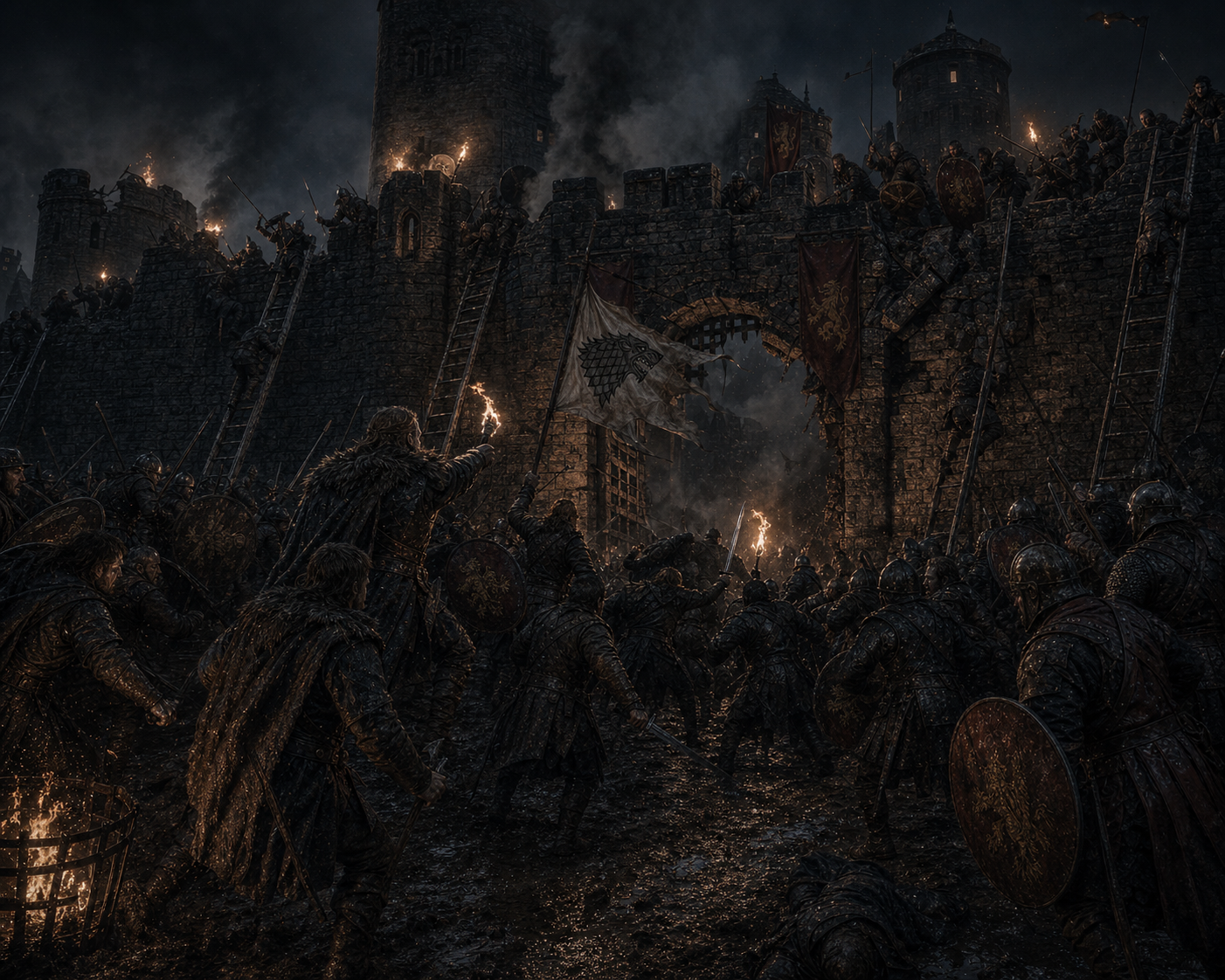
Shields went up. Bowmen scattered for angles. Ladder teams drove forward under cover, Frey men bending beneath weight and fear, northern shields closing around them when the first arrows struck. Smalljon ran with them, not behind, not beside, but ahead enough that any man who slowed had to look at his back and feel shame.
Black Walder came after with the second ladder line, face bright with something that was not fear.
"Forward!" he shouted. "Up before they wake proper!"
That was the truth of it.
The castle was waking unevenly. Men on the wall had bows, but not all had helms. Torches flared in wrong places. Orders came from too many throats. The defenders had barred the gate, but barring a gate was not the same thing as being ready for a wolf at every wall.
Smalljon's first ladder struck stone with a slap and bounce.
Two men died setting it.
The third held it anyway.
Smalljon went up first.
Of course he did.
He climbed as if ladders had been made for men half his size and he meant to punish them for it. Arrows struck around him. One caught in his shield. One scraped sparks from his helm. A spear stabbed down, missed, stabbed again. Smalljon caught the shaft, yanked, and the man above vanished from the parapet with a cry swallowed by the noise.
Then Smalljon was on the wall.
The first defender to meet him went down beneath an axe blow Tom felt more than saw.
"Center forward," Tom said.
His men moved.
Not the whole center. Not all at once. That was how men clogged ladders and died waiting for space. Tom sent the first shield group to the base, then the next to hold behind them, then bowmen to keep the nearest crenels honest. Maron's right was already feeding men toward another ladder. Dacey's left had found a lower stretch near a broken angle of wall and was driving there hard.
Tom reached the ladder after four of his men had gone up.
Tor grabbed his shoulder.
"Not first," Tor said.
Tom looked back.
Tor's face was not joking.
An arrow struck a shield beside them hard enough to split painted wood.
"I am going," Tom said.
"Aye. Not first."
"I am not first."
"You are thinking of becoming first."
Jory's voice came from behind them. "He is right."
"You are both inconvenient."
"Alive men often are," Jory said.
Tom waited three breaths.
They were long breaths.
Then he climbed.
The ladder shook under boots above and below. Stone filled his sight. Torch smoke dragged sideways in the wind. Someone screamed at the top. Someone fell past him, struck the wall once, and vanished into dark below. Tom did not look after him. Looking after falling men was for later, if later allowed it.
The parapet was slick when he reached it.
Blood, rain from earlier in the week, spilled oil, or all three. His boot slipped. A hand grabbed his belt and hauled.
Tor.
Somehow already there.
"Not first," Tor said, and shoved him into the fight.
The wall was narrow and full of men trying to make it wider by killing everyone else on it.
Smalljon's party had taken a bite of the parapet and held it through strength more than order. Frey men climbed behind him. Northern shields came after. Defenders pushed from a tower to the left and a stair to the right. Torches threw light in pieces: steel, teeth, eyes, stone, smoke, Smalljon's axe rising, Black Walder's sword sliding under a man's guard and out again red.
Tom did not command the wall so much as survive enough of it to make command possible.
"Spears right," he shouted. "Shields to the stair. Hold the stair."
Men heard or did not.
Enough did.
A defender came at him with a short sword and panic for strength. Tom caught the blade on his shield, drove forward, and felt the man hit the crenel behind him. Donnel would have broken him. Tor would have thrown him. Tom did what the press allowed. Hilt to face. Knee to thigh. Sword under ribs when the man folded.
Then the man was weight underfoot.
Tom stepped over him and looked for the next place breaking.
There were many.
That was battle from above: every part looking almost lost until suddenly one held.
Dacey's men came over the broken angle with a roar that had no wasted notes. Her bear women drove along the wall walk from the left, shields high and axes low. Maron's men climbed more slowly but cleaner, and when they reached the parapet they brought order with them like a punishment. Frey men fought hard near the ladders, not gently, not prettily, but hard. Black Walder laughed once when a defender slipped and died before he fell.
Tom heard it.
He remembered it.
The gate below shuddered.
Once.
Twice.
The ram had arrived.
Robb's main force came behind it like the night had grown teeth and banners. Men in the yard beyond the gate shouted. Men on the wall looked back. That was always dangerous. Fear behind a man made him turn. Fear before him killed him if he did.
"Gate!" someone shouted below.
The ram struck again.
Wood boomed through stone.
The vanguard on the wall pressed harder. Not because Tom ordered it. Because every man there felt the gate weakening beneath them and knew the castle had become a bowl with the bottom about to break.
Smalljon drove toward the gatehouse tower.
Black Walder followed.
Tom's center held the stretch behind them, feeding men up, dragging wounded down if they still had enough life to curse. Jory stayed below near the ladder bases, turning chaos into lanes, sending fresh shields where Tom signaled and sending wounded back before they became dead men in other men's way.
That was command too.
Better command than most songs knew how to praise.
The ram hit.
The gate cracked.
Men shouted from both sides.
Another hit.
One leaf of the gate buckled inward, iron bands twisting around split oak. A defender above the gate leaned out with a bow, close enough now that Tom saw his pale face under the helm.
He was not aiming at Tom.
Tom followed the line.
Robb Stark had ridden too near.
Of course he had.
The king was in front of the ram line, grey cloak thrown back, sword drawn, shouting men forward as if kings were made to be easy targets.
"Robb!" Tom shouted, though the word vanished under the ram.
The arrow flew.
It struck Robb beneath the shoulder, high and hard enough to turn him in the saddle.
For a heartbeat the whole night narrowed to that.
The king did not fall.
His horse sidestepped. A guard grabbed at the reins. Robb's hand went to the shaft. Men around him surged in three directions at once: toward him, away from him, toward the gate. Panic tried to become a living thing.
Grey Wind killed it.
The direwolf launched from below with a sound that was not a bark and not a growl but something older than either. He hit the stair near the gatehouse like grey death, claws scraping stone, jaws closing on the archer before the man had time to understand what had come for him. The archer's bow fell first. Then the archer.
Grey Wind shook him once.
Only once.
Then the wolf turned back toward Robb.
No chase.
No frenzy.
Protection.
He bounded down from the wall path and vanished toward the king through men who suddenly remembered to move.
"Gate!" Smalljon roared.
The ram struck again.
The broken leaf gave.
Northern men poured through.
That saved the moment from fear.
The castle fell quickly after that.
Not easily.
Easy was a word men used afterward when they did not have to count the bodies.
But quickly.
The gate yard became a crush of shields and torchlight. Robb's infantry drove straight through the broken gate while vanguard men held the walls above them. Dacey's left cleared the western walk. Maron's right took the stair tower. Smalljon and his men forced the gatehouse from within. Frey ladders kept men climbing until there was no more wall worth taking.
Defenders threw down weapons in knots.
Some did not.
They died in knots too.
Tom saw less than he understood. That was the strange thing. A battle could be too large to see and still clear in its shape. The walls were held. The gate was broken. The yard was taken. The defenders had nowhere to gather, nowhere to rally, nowhere to become more than men losing separate fights in the dark.
Robb's army had arrived fast enough.
The vanguard had held long enough.
The ladders had done their work.
The ram had done the rest.
By the time the moon cleared a torn edge of cloud, the direwolf banner rose above the gatehouse.
Men cheered then.
Some because the castle was taken.
Some because Robb had not fallen.
Some because cheering was easier than shaking.
Tom stood on the wall walk with one hand braced against stone and watched the yard below fill with order.
Not peace.
Order.
There was a difference.
Prisoners were gathered near the stables. Wounded were carried into the hall and under the lee of the inner wall. Frey men dragged ladders aside and counted their own. Umber men laughed too loudly, which meant some of them had been afraid enough to resent it. Dacey's bear women moved in pairs, checking corners. Maron's men posted guards before anyone asked.
Jory found Tom after the worst of it.
He climbed the stair slowly, one hand on the wall, his face grey beneath the dirt.
"You look terrible," Tom said.
"I climbed stairs to hear that?"
"You should not have."
"Aye. Yet wisdom failed."
Tor came behind him, carrying a torn shield and someone else's helm.
"King lives," Tor said.
Tom looked at him too quickly.
Tor nodded. "Arrow under the shoulder. Bad, mayhaps. Not dead. They took him inside."
Tom let out a breath he had not known he was holding.
"Grey Wind?" Jory asked.
"With him," Tor said. "Would not let half the guards close until Robb spoke."
That sounded right.
Below, men were bringing Robb through the yard.
He was still mounted, but only just. Two guards rode close. One held the reins. Robb sat upright because kings did foolish things when men watched them, but his face was pale in torchlight and his cloak was dark around the arrow shaft. Grey Wind moved beside the horse, bloody-mouthed and silent, yellow eyes cutting at any man who came too near.
The yard parted.
No one ordered it.
Men simply moved.
Robb looked up once toward the wall.
Tom could not have said whether the king saw him.
He bowed anyway.
Then Robb was taken into the keep.
The work continued because wounds did not excuse armies from work.
Camp spread in and around the captured castle. Men filled the yard, then the outer ground, then the slopes below where fires could be hidden from distant roads. Horses were led inside first, then out again when someone decided the stables would not hold half enough. Wagons came slow under guard. The ram was left by the broken gate like a tired beast. The ladders lay stacked near the wall, longer and thinner than they had seemed while men were dying beneath them.
Tom's center made camp where ordered.
Not by a fire. Not yet.
There were counts to make.
Jory took names from serjeants. Dead. Wounded. Missing, though missing inside a captured castle rarely stayed a hopeful word for long. Tor walked the line with a strip of cloth tied around one hand and denied being cut until the cloth turned red enough to make the lie insulting. Tom sent men to help clear the gate passage, then to carry water, then to relieve the Freys at one ladder where tempers had begun to sharpen.
"Do we trust them?" Tor asked when he came back.
"Tonight?"
"Aye."
"Enough to stand where we can see them."
Tor considered that. "That is not trust."
"It is tonight."
Inside the walls, the Crag became less a castle than a body being searched for wounds.
Cellars. Armory. Well. Storerooms. Gatehouse. Ravens. Every door mattered. Every dark corner could hold a man with a knife or a child with a kitchen blade or nothing at all but fear waiting to make a fool of the first soldier through. Orders passed, broke, were remade. Names were shouted. Torches burned low and were replaced. Somewhere a woman cried out and was quickly hushed. Somewhere a northern man laughed and was struck silent by his serjeant.
Tom saw Smalljon in the yard, helm gone, hair plastered to his head, arguing with Black Walder over the count of men first across the wall.
"First over was me," Smalljon said.
"First ladder was mine," Black Walder said.
"Then it was improved by better feet."
Black Walder smiled. "Your feet nearly broke it."
Smalljon laughed and clapped him on the shoulder hard enough that another man might have taken it for an attack.
Black Walder did not.
He only smiled more thinly.
Tom watched them for a moment, then looked away.
Useful men.
Not easy ones.
Near midnight, word came that the king's wound was being tended inside.
No one said how bad.
That made men say it for themselves.
By then, the castle was taken, the walls held, the prisoners bound, the gates guarded despite one leaf hanging broken from its iron. It should have felt finished. Men wanted finished after battle. They wanted a line drawn between danger and rest.
But the king was inside with an arrow wound, and that made every fire burn strangely.
Tom stood near the broken gate and looked back at the road they had come by.
The main army still moved in pieces toward the Crag. Torches marked wagons. Men. Horses. More men beyond them. A whole host drawn through dark because Robb Stark had chosen speed over sleep and won a castle before it could become ready.
That was the thing worth remembering.
Not Tom's ladder.
Not Smalljon's roar.
Not Black Walder's sharp smile.
Not even the arrow, though men would remember that whether it deserved center or not.
The army had moved like one hand.
Vanguard first. Ladders. Wall. Ram. Gate. Main force. Yard. Keep. Camp.
One motion made of thousands of men, each doing a piece.
Tom had done his piece.
Well enough.
That would have to do.
Jory came to stand beside him, cloak wrapped tight against the wind.
"Counts are nearly done," he said.
"Bad?"
"Bad enough."
"Always is."
"Aye."
They watched men drag a broken beam away from the gate. Beyond it, Grey Wind's shape appeared in the yard near the keep doors. The direwolf stood with his head low, guarding a threshold no enemy remained bold enough to approach.
Tor joined them, chewing something he had no right to have found.
"Bread," he said before either could ask.
"Where?" Jory asked.
"Castle."
"That explains nothing."
"Explains bread."
Tom almost smiled.
Then the keep doors opened long enough for a man to pass inside carrying clean linen, and the smile went away before it became anything.
Robb lived.
For now.
That was enough for the army to stand on.
Not enough to sleep easy.
Tom looked at the broken gate, the raised direwolf banner, the tired men building fires inside and outside stone that had belonged to their enemies before nightfall.
The Crag was taken.
The west had lost another stronghold.
The king had paid blood for it.
That, too, was how castles changed names.
Previous Chapter | Chapter List | Next Chapter
Disclaimer: Frostfyre is a non-commercial fan fiction project inspired by a Realm of Thrones campaign for Mount & Blade II: Bannerlord and set in the world of A Song of Ice and Fire. All rights to those original settings and characters remain with their respective owners.
Join the Forge
Receive new Frostfyre chapters and Aodh Forge updates as they are released.