Redemption of the Dragon
Act 1 – Survival · Chapter 17: Life in the Van
After a while, days stopped keeping their own names.
There was the day of the burned mill, though Tom could not have sworn whether it came before or after the fight at the stone bridge. There was the day rain returned for half a morning and left again before men had finished cursing it. There was the day Tor broke a man's helm with the flat of his axe because Robb wanted prisoners, and the man complained more about being spared than some men did about dying.
There was the day Tom forgot to eat until Jory put bread in his hand and waited beside him like a mother with a switch.
That one may have happened more than once.
The vanguard moved before the army.
That sounded simple when spoken in a tent.
On the road it meant waking in dark while the main camp still slept warm under canvas. It meant scouts gone ahead before the cookfires were ash. It meant men chewing oats while walking, boots not yet dry from yesterday's ditch, shields lifted before shoulders had remembered they were part of bodies. It meant seeing the enemy first, or seeing the empty places where the enemy had just been, or seeing nothing and fearing that most.
Dacey Mormont held the left.
Maron Locke held the right.
Tom held the center.
That, too, sounded simple.
The center was never only the center. It was spears on the road, axes in the hedges, bowmen placed where banks gave height, runners between all three captains, scouts coming in with mud to the thigh and news that changed everything. It was Jory with lists tucked under one arm and a face that told quartermasters they would lose before the argument began. It was Tor at Tom's shoulder whenever arrows were near and not near enough whenever Tom wanted him elsewhere.
"You are hovering," Tom told him on the second morning.
Tor looked down at him. "I am protecting."
"You are blocking my view."
"Then stand taller."
Jory did not look up from his tablet. "He has no column for that."
Tom should have laughed.
He did not.
The first fight came before noon.
Not a battle. Men called too many things battles because the word made blood feel less wasteful. This was thirty Westermen holding a low wall beside an orchard, with two carts turned sideways across the lane and archers among winter-bare branches. They meant to slow Robb's host long enough for wagons behind them to reach higher ground.
Tom's scouts saw the carts before the arrows came.
That saved six men, mayhaps more.
He sent shields forward low and bowmen to the right bank. He had no time to be clever. Clever men died while drawing neat lines in dirt. He needed the wall fixed, the archers pressed, and the wagons taken before they vanished into the hills.
"Center holds them," he told his serjeants. "No charge until the bowmen are placed."
One man nodded.
One spat.
One looked as if he wished Harl Tanner had been assigned to Tom instead.
Tom remembered Maron's advice and learned from each.
The arrows came. Shields took them. One man screamed because his foot had been careless beneath the rim. Tom felt the line flinch.
"Hold," he said.
The word was smaller than fear.
It worked anyway.
Osric's scouts had found a goat path around the orchard and brought Dacey's riders through it like a knife through cloth. The Westermen at the wall turned at the sound of hooves. Tom saw the moment their courage became arithmetic. Men were brave until there were too many directions to die from.
"Now," he said.
The center went over the wall.
It was done before the main army arrived.
That became the shape of many days.
Find.
Hold.
Break.
Wait for the king's host to come up and make the small victory useful.
Sometimes Tom's men did not break the enemy.
Sometimes they only pinned them like a hand over a snake's head.
At a ford three days later, a larger force of Lannister men held the western bank behind sharpened stakes and two lines of shields. The river was narrow there, but fast. Stones slick under brown water. A good place to make men pay for crossing. A bad place to be proud.
Tom looked at the ford and did not like it.
"They want us to rush," Jory said.
"Aye."
"So we do not."
"No."
Tor frowned at the water. "I dislike plans that begin with standing still under arrows."
"Then stand behind something."
"There is water."
"Stand behind that."
Tor looked at him. "You have grown cruel with rank."
Tom put shields along the near bank and had bowmen answer only when they had targets worth string. Men hated that. Men always wanted to loose back. An arrow in the air felt like doing something, even when it only stuck in mud. Tom held them still.
Maron's right moved upstream out of sight.
Dacey's left made show enough downstream to draw half the enemy's eyes.
Tom's center stayed in the open and took the insult of it.
Three men died before Robb's main force reached the ford.
Seven more were wounded.
Tom remembered each face because he had ordered them to stand where arrows could find them.
When Greatjon's infantry came up, the Lannister line had been watching three directions too long. The king's men crossed with shields locked. Dacey struck from downstream. Maron appeared above the bend with men who had waded through water to the chest and looked ready to murder the river itself.
The western bank fell.
Men cheered when it did.
Tom did not.
One of his serjeants saw that and misread him. "We held them, Captain."
"Aye."
"Would have cost twice as many if we rushed."
"Aye."
The man looked at him, then shut his mouth.
That was another lesson.
Some truths did not comfort even when they were useful.
Robb's army moved deeper into the west.
Castles that had been names around noble tables became work for men with mud to the knee. A tower house surrendered when its lord saw the direwolf banners on three sides and no road left on the fourth. A mine hold above a grey cut in the hills fought until its gate burned. A lesser keep with yellow roses carved over its hall tried to bargain after hiding grain under chapel stones. Robb took the grain, took the hostages, left men enough to guard the road, and moved on before the ashes cooled.
The west was richer than the Riverlands.
That made its wounds look different.
In the Riverlands, war had chewed through poor places until bones showed. Burned cottages. Empty wells. Fields drowned or trampled. Children looking at armed men as if all banners were teeth.
In the west, villages had stone walls around sheepfolds. Barns had tile roofs. Mills had iron fittings worth stealing. Mines cut black mouths into hillsides, and the roads below them bore the scars of heavy carts. Even ruin seemed better fed.
That angered some men.
It made others greedy.
Tom feared the second more.
Robb's token order spread through the foraging parties after the first week.
Not cleanly. Nothing spread cleanly through an army. Some captains used it because the king ordered it. Some because it kept villagers from hiding every sack of grain and wasting time. Some hated it because writing down what was taken made theft look like theft again. Jory watched the rolls with the sharp satisfaction of a man who had built a small trap and caught larger beasts than expected.
"This will make us enemies," he said one evening.
Tom looked at the marked scraps drying beside the fire. "Among whom?"
"Men who liked being believed."
"Good."
"That was almost cheerful."
"I am tired."
"You are always tired."
"Then mayhaps I am always cheerful."
Jory's mouth twitched.
Tor, lying with his head on a rolled cloak, opened one eye. "I hate both of your jests."
"Good," Jory said. "They were not for you."
"All good things should be for me."
No one answered because no one needed to.
There were fewer quiet fires as the weeks passed.
Tom's old men came when they could, but war had stretched them farther than friendship could easily follow. Harl was seen more often across a yard than beside a fire. Pate had a new scar under his chin and claimed he had earned it falling over a dead man, which meant something worse had happened. Donnel carried a better shield now, taken from a westerman who had no further use for it. Willam's arm healed crooked-stiff but strong enough to hold a spear. Mikken vanished into every captured forge and emerged with repaired buckles, stolen nails, and soot in places no sensible man could reach.
Garrel brought news more often than conversation.
Osric brought neither unless asked.
That was all right.
Men did not need to sit close to remain close.
Tom told himself that until he believed it some nights.
Other nights he did not.
The vanguard learned its own rhythm.
Maron complained before every march and was usually right about whatever he complained of. Dacey spoke less, moved faster, and once held a ridge against twice her number long enough for Tom's center to turn a retreat into a trap. Her bear women fought like men who had never been told fear was meant to be private.
Tom's center became known for steadiness.
That sounded dull.
Tom treasured it.
Steady men reached walls with ladders still in their hands. Steady men did not chase fleeing riders into gullies. Steady men kept shields high after the first volley because they knew the second was already coming. Steady men hated orders and obeyed them anyway.
The first time a noble captain called Tom's center reliable, Tor repeated it all night in increasingly grand tones until Jory threatened to list every reliable thing Tor had failed to do since dawn.
"Name one," Tor said.
"You left your whetstone in a ditch."
"That ditch needed it."
"You forgot to collect your ration."
"I was giving it a chance to miss me."
"You told a mounted knight his horse looked disappointed in him."
Tor sat up. "The horse did."
Tom had laughed then.
It startled him.
The sound felt strange in his chest, as if something unused had cracked open and not broken.
Then the next morning came.
A mine road.
A narrow defile.
Smoke ahead before dawn.
Enemy crossbowmen above them on a ledge, too high for easy arrows, close enough for bolts to make ugly work. Two carts had been tipped and fired to block the track. Beyond them, men were moving crates from a mine mouth into wagons under guard.
The west loved its gold, men said.
It loved silver too, and iron, and whatever else men dragged from dark earth while other men killed to own the dragging.
Tom saw the ledge and thought of Raventree walls.
For one cold breath, he saw a large man in plate raising a sword.
Then the breath passed.
Not gone.
Never gone.
Passed.
"Shields left," he said. "Bowmen low, do not waste shafts. Runners to Dacey. Tell her the ledge can be climbed from the south if her scouts find goat tracks. Runner to Maron. I want his men seen on the north road even if they do nothing but shout."
The runners went.
"And us?" Tor asked.
Tom looked at the burning carts.
"We wait."
Tor groaned.
"Then we push."
"Better."
Waiting cost blood.
Pushing cost more.
Command was often choosing which wound had a chance to close.
Dacey's scouts found the goat track because Dacey's scouts seemed personally offended by ground that thought it could hide. Maron's men made enough noise on the north road to draw half the crossbows. Tom's shields advanced in steps, kneeling and rising, kneeling and rising, while bolts struck wood like hard rain.
When Dacey's men hit the ledge, Tom sent the center forward.
Tor and four axe men dragged one burning cart aside with hooks and chains. Smoke folded around them. A horse screamed beyond the flames. Tom's eyes watered so badly he saw the world in pieces. Shield rim. Fire. Dark mine mouth. A man with a yellow cloak. Jory's voice somewhere behind, counting wagons, counting crates, counting wounded because someone had to count what mattered.
They took the mine before the main host arrived.
Robb came up as prisoners were being bound.
His horse was mud to the belly. Grey Wind moved beside him like smoke that had learned teeth. The king looked at the captured carts, the mine mouth, the dead laid in two rows because Jory had started that habit and Tom had kept it.
"How many?" Robb asked.
"Ours?" Tom said.
Robb nodded.
"Six dead. Seventeen wounded. Two may not last the night."
"Theirs?"
"More."
Robb looked at him.
Tom looked back.
After a moment, the king nodded. "You held long enough."
"Aye, Your Grace."
That was praise now.
Held long enough.
Reached before they ran.
Burned the stores before the enemy carried them off.
Kept the road closed until the main army came up.
Took the tower before ravens flew.
Drove their horsemen south.
Cut the wagons loose.
Held.
Reached.
Burned.
Kept.
Took.
Drove.
Cut.
Days became verbs.
Tom's body learned them before his mind did. His feet woke sore and walked anyway. His hand checked sword, belt, shield strap, water skin, knife, helm, then did it again because habit was cheaper than regret. He ate what Jory handed him. He slept when Tor sat close enough that anyone trying to wake him with a blade would have to explain himself first.
Sometimes Robb called him to council.
Most times he did not.
When called, Tom gave what he had. Road width. Mine guards. Whether villagers had lied from fear or from loyalty. How long hungry men could march before order became hope. Which captured westermen looked like levies and which looked like men paid for ugly work.
When not called, he drilled his center.
He had stopped resenting the difference.
Mostly.
There was too much to do for resentment to eat a full meal.
The army took another castle after three days of rainless heat.
Not stormed. Starved into sense. Its lord had thought Robb would not pause long enough to choke him. Robb paused. Dacey's left cut the hill path. Maron's right took the stream. Tom's center held the road and stopped three attempts to bring food through by night. On the fourth morning, the castle gate opened and men came out with swords reversed.
Tom watched from the road.
Tor yawned. "I prefer gates that do not make us work so long."
"This one killed fewer men," Jory said.
"I did not say I preferred better gates."
"Only easier ones."
"Aye."
Jory looked at Tom. "He is a philosopher."
"Do not tell him."
"Too late," Tor said. "I feel wise."
Inside the castle yard, Robb accepted surrender with a face that gave little away. Hostages were named. Stores counted. The garrison disarmed. A Stark banner went up where a lion had hung that morning. Men cheered because men liked banners changing when theirs was the one rising.
Tom looked at the walls.
Stone did not care who owned it.
Men died teaching it new names.
The weeks wore on.
Sometimes the enemy fought.
Sometimes they ran.
Sometimes they ran well enough that Tom respected them and hated them for it. A commander with a sense of roads could do more damage fleeing than a fool could do standing. Mines were emptied before Robb reached them. Stores burned rather than captured. Bridges were cut. Wells fouled. Messages flew west and south and mayhaps east, though Osric took one raven with an arrow and brought it to Tom with the look of a man presenting a dead rat to a lord's pillow.
"Message?" Tom asked.
"Tied to the leg."
"You read it?"
"I shoot better than I read."
Jory took the scrap.
Tor looked disappointed. "I hoped the bird had confessed."
"It said little," Jory told them after reading. "Only that the wolves have taken the lower mines and that more men are needed before the gold road is pinched shut."
Tom looked west.
"Then we are hurting them."
"Aye."
No one smiled.
Hurting Tywin Lannister did not make dead men stand.
It did make the war lean differently.
Robb's army moved like a hand closing.
Castles behind them held northern garrisons. Mines stopped feeding coin and metal into Lannister hands. Roads that had carried gold, iron, grain, and riders now carried Robb's orders, Robb's wounded, Robb's prisoners. Every small victory became part of something larger than the men who won it.
Tom understood that better each day.
He liked it less each day.
A man in a small fight could see what he had bought. A wall taken. A friend saved. A road cleared. A bandit hanged. In a larger war, men died for shapes on maps and pressure on lords they would never see. It was not wrong. Tom knew that. He could feel the sense of it. Tywin weakened. Robb strengthened. The west bled where it had thought itself safe.
Still, when he sent men into arrows, he wanted the reason close enough to touch.
Jory said that was why Robb kept asking him things.
"Kings have many men who can speak of maps," Jory said one night while changing the dressing on Tom's upper arm.
"And I cannot?"
"You can. Badly."
"Kind."
"Accurate. You speak better of mud."
Tor nodded from across the fire. "No man speaks of mud like Tom."
Tom looked at both of them. "I command fools."
"Aye," Jory said. "But larger numbers now."
The wound in Tom's arm was shallow, but the cleaning still burned. He watched Jory wrap it. Jory's hands were steadier than his walking. He had healed enough that he no longer looked ready to fold at every breath, but some pains remained like old debts.
"Does it trouble you?" Tom asked.
Jory did not look up. "Your arm?"
"Being kept with me."
Tor's face changed.
Jory tied the bandage neatly. "No."
"You could have gone back to the infantry. Or scouts. Or Bear Island men."
"Aye."
"You did not want to?"
Jory finally looked at him. "I am where I am useful."
That was not soft.
It was better.
Tor cleared his throat. "I am also useful."
"You are large," Jory said.
"Still counts."
"Some days."
They slept badly that night and marched before dawn.
The next day had no fight.
That made men nervous.
A road without enemies let thoughts catch up. Men remembered letters not answered. Boots not mended. Friends buried in shallow ground behind them. The way each captured hold meant some lord's son was now hostage and some mother's hall was quieter. They remembered they were tired.
Tom kept them moving.
Not hard. Just steady.
He had learned that men could be marched through fear if the pace gave them no room to sit in it.
By afternoon, they reached a ridge overlooking another valley, another road, another curl of smoke beyond trees.
The scouts found no enemy.
Maron did not trust that.
Dacey did not trust Maron trusting nothing, so she sent her own riders.
Tom trusted both enough to keep shields close.
Nothing came.
The army came up near dusk.
Robb's banners crested the road in waves. Direwolf first among them. Men cheered when they saw the valley clear. Wagons groaned down the slope. Cooks began arguing over where fires would be placed. Horses lowered heads to crop what grass had survived the passage of war. Someone shouted for tent lines.
Camp began to make itself.
That was what armies did when left alone. They became camps.
Tom's center started its own work without waiting for him. Pickets marked. Fires placed. Wounded set near the road where healers could find them. Shields stacked. Spears checked. Men who had once watched him for every order now knew the first six things before he spoke.
That pleased him.
It also made him feel strangely unnecessary for three breaths.
"Good," Jory said beside him.
Tom looked over. "I did not speak."
"You looked troubled because men were doing correctly what you taught them to do. That is good."
"You read faces too well."
"Yours is not a difficult book."
Tor snorted. "Short words. Large print."
Tom was deciding whether rank allowed him to throw something at Tor when a horn sounded from the main road.
Not alarm.
Herald.
Men turned.
A rider in Stark colors came down through the settling camp, cloak dusty, horse lathered from a short hard ride rather than a long one. He passed the first cookfires without slowing and came straight toward Tom's line.
Jory's expression sharpened.
Tor stood.
Tom felt the army's evening rhythm falter around him.
The rider reined in before Tom and swung down at once. Young, but not green. Robb's badge sat on his breast. His face had the tight look of a man carrying words that were not his to understand.
"Captain Tom," he said.
"Aye."
"From the king."
Tom waited.
The herald glanced at the men beginning to raise canvas. "You are not to make camp."
Tor looked toward the sky as if personally offended by it.
Jory did not move.
Tom kept his eyes on the herald. "The vanguard?"
"Your center, at least. Orders may follow for the others. You are to hold ready."
"Ready for what?"
"I was told only that you are to present yourself to the king at once."
Around them, men listened without pretending not to.
The day had been quiet.
Quiet days often saved their teeth for evening.
Tom handed his helm to Tor.
"Keep them standing," he said.
Tor's jaw set. "Aye."
Tom looked at Jory.
Jory already had the wax tablet tucked away and his cloak fastened. "I am coming."
"No."
"Yes."
The herald shifted, uncertain whether he was meant to interrupt.
Tom looked at Jory's face and saw the argument already armed.
"Fine," he said. "But if this is only a council, you sit before I have to hear about it."
"Your concern warms me."
"Move."
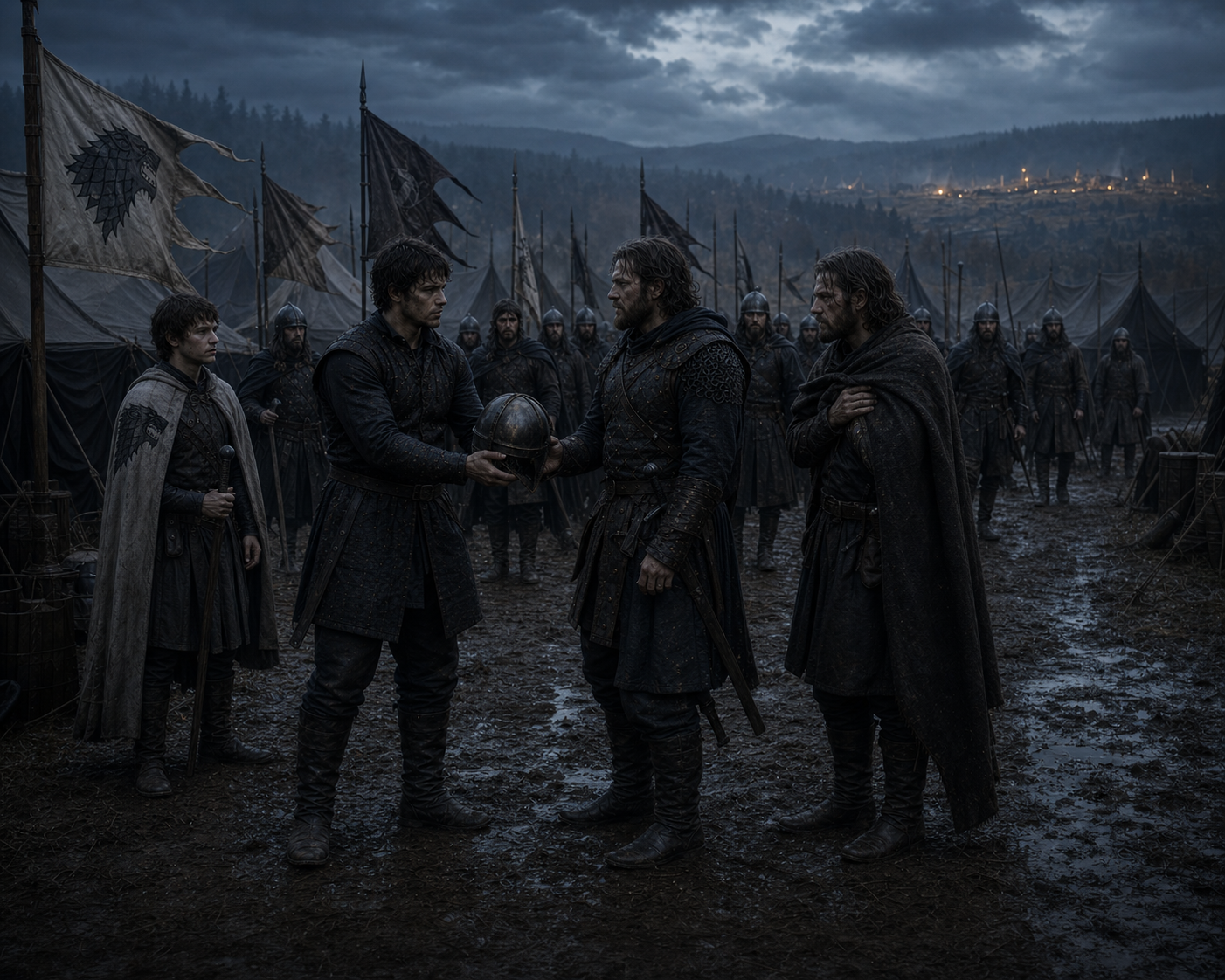
They followed the herald toward the king's camp while behind them the vanguard remained standing in the dusk, tents half-raised and fires unlit, waiting to learn what kind of night had found them.
Previous Chapter | Chapter List | Next Chapter
Disclaimer: Frostfyre is a non-commercial fan fiction project inspired by a Realm of Thrones campaign for Mount & Blade II: Bannerlord and set in the world of A Song of Ice and Fire. All rights to those original settings and characters remain with their respective owners.
Join the Forge
Receive new Frostfyre chapters and Aodh Forge updates as they are released.