Redemption of the Dragon
Interlude · Interlude: A New House Rises
The republic began badly.
That, Cleyton said, was how most honest governments began, provided they were honest enough to admit it.
No one found that comforting.
Oros had become a seat before it understood how to be one. Ravens came and went until the rookery stank of feathers, ink, and panic. Clerks slept at tables with wax on their sleeves. Guards carried orders from rooms where no one agreed what the orders meant. The map in the war room gained so many pins, threads, and written scraps that Jory, arriving by raven instead of person, had once sent back a message asking whether the castle had declared war on embroidery.
Tom laughed when Cleyton read it aloud.
No one else did.
They were all too tired.
The proposed republic had not yet become parchment in any form a lawyer would respect. It had no seal, no coin, no final law code, no agreed title for its council, and no answer for the hundred smaller questions that appeared every time a larger question was settled. Could a freed slave vote if he had no home? Could a former master keep his house if the house had been built by slave labor? Who counted citizens in a city where half the records had been kept by the same men now chained in cells? Were the Ibbenese clan chiefs subject to the same courts as Mantarys merchants? What punishments were allowed? Who appointed judges? Who fed judges? Who watched the men who watched everyone else?
"You wanted a government," Cleyton told Tom on the third morning after the debate. "Congratulations. It has immediately become a stack of arguments."
Tom looked at the papers before him.
"This is a government?"
"An infant one."
"It looks ill."
"Most infants do if you stare too closely. Governments are less charming about it."
Tom pushed a hand over his face.
"That is terrible."
"Accurate things often are. Accuracy has terrible manners."
They worked anyway.
Because the alternative was letting victory rot.
In Mantarys, Jory ruled without calling it ruling.
He had refused every title offered to him by frightened former clerks, grateful bakers, ambitious shopkeepers, and three separate men who claimed to represent neighborhoods that did not remember choosing them. He signed no decrees with flourishes. He sat in no master's chair. He slept in a barracks room off the old grain hall because it was near the storehouses, the cells, and the streets where trouble came first.
His first law was simple.
Everyone eats.
His second law was simpler.
Anyone hiding grain explains why with empty hands where everyone can see them.
It was not elegant. It was not republican theory. It would have made Maelyra Otherys sigh into her wine. But bread moved. Water moved. Blankets came out of locked rooms and into hands that had been shaking from cold. Warehouses were counted. Wells were repaired. Children began appearing in the streets again, thin and wary, but present.
Jory sent reports every two days.
Most were short.
People fed. Masters still chained. Two former household guards tried to shake coin from a widow. Boro broke one nose, not two. Restraint improving.
Then, beneath that:
Need law. Real law. I can keep men from starving. I cannot tell a city what it is becoming.
Tom read that line more than once.
So did Cleyton.
"He is right," the former maester said.
"I know."
"That sounded resentful."
"I know that too."
In Elyria, Aemon Vezos moved with a different kind of restraint.
He did not control the city.
Everyone knew that.
Everyone also knew that food entered the docks because his men guarded the warehouses, that merchant lords stopped murdering one another in the open because his riders began appearing outside their gates before dawn, and that the city guard suddenly remembered discipline after several captains were invited to dine with him and returned pale, polite, and unwilling to discuss the meal.
Aemon sent longer letters than Jory.
Much longer.
Cleyton approved.
Tom preferred Jory's.
Elyria holds, Aemon wrote. I do not hold it. That distinction matters. If I claim command too soon, the merchant lords will unite against me. If I refuse command too long, they will bleed the streets by inches and call it negotiation. I walk a bridge made of knives and invoices.
Vissenya read that one before she left for Volantis.
"He is enjoying himself more than he admits," she said.
Tom looked up. "That letter was miserable."
"Aemon likes problems that prove everyone else is foolish. It is how he relaxes."
"That sounds like Cleyton."
"Cleyton likes problems that prove everyone else is wrong. There is a difference, and he would insist it matters."
Across the sea of grass and rough road, Ifequevron struggled with a gentler confusion.
Setzuko had not asked to become a governor. That, Tom suspected, was among the better reasons to trust her with it. Her reports came carefully written in a hand that tried to be formal and then forgot itself whenever the subject became practical.
The people like the idea of choosing speakers, she wrote. They dislike choosing them in front of neighbors who will remember every choice. The farmers want more voice because they feed the city. The smiths say no city stands without iron. The fishers say everyone is foolish and hungry without fish. The healers say all of them talk too much. I begin to understand why old lords preferred giving orders. Orders are easier than listening.
Tom smiled at that.
Then read the next line.
I am still listening.
He folded the letter carefully.
The eight Tears members left behind in Ifequevron helped her count households, organize watches, and train guards who had once answered to men now dead. The city did not love the new structure yet. It did not understand it. Some called it Tom's law. Some called it Setzuko's burden. Some called it another foreign rule with cleaner words.
But no one had been sold.
No one had been dragged from a house without hearing.
No one had been denied food because his father had angered the wrong man.
That was not enough.
It was a beginning.
North of Ifequevron, the Ibbenese clans remained mostly obedient.
Mostly was a word that did too much work.
Thogg of clan Casat sent a strip of smoked meat as a sign of respect and a message carved into wood that took three people to translate. It appeared to say that peace made men fat but raids made widows angry, so he would try peace until it became insulting.
Norg of clan Gasso sent no gift, but his men bloodied a smaller clan that had tried to raid a YiTish farmstead.
Gorn of clan Joth demanded clarification on whether "mistreating smallfolk" included stealing cattle from men who had insulted his beard.
Norbo of clan Thuk sent a single word.
Waiting.
No one liked that.
"For what?" Tom asked.
Cleyton folded the message.
"That is the concern."
The clans had bent because Tom had stood before them with magic in his bones and a dragon at his back. Both had been temporary. The tattoo on the side of his head had not faded, but awe did. Hunger did not. Old hatreds did not. Men who had raided for generations did not become guardians because one battle frightened them.
Denyo Prestayn sent agents from Braavos toward Omber to deepen contact there. Maelyra offered ships that could carry supplies north if roads failed. Setzuko asked for more men, then crossed out men and wrote teachers above it.
Tom liked her better every letter.
The worst news came from the silent cities.
Myr first.
Then Qohor.
Rogoro Nestoris was dead.
Vaquo Zalyne was dead.
Both confirmed by different hands, in different ways, too far apart for comfort. Rogoro had been found in his own workshop with a lens shattered through one eye and his ledgers burned in a brazier. Vaquo had died outside Qohor beneath trees black with rain, killed with three guards and a woman Cleyton believed had been his courier.
No red priests claimed the work.
That made it worse.
Clean murders were messages from men who did not need sermons.
Agents from Lys, Braavos, Tyrosh, and Pentos were sent quietly toward Myr and Qohor to find any surviving Tears operatives, recover records, and move people to safer cities before the killers finished searching. Some messages returned. Many did not. Every absence became a little death before proof arrived to correct it.
Norvos stayed silent longest.
Then a scrap of cloth came sewn into the lining of a mule driver's glove.
Haryz lives, the message said. Bells watched. Priests divided. Cannot emerge. Assassins came. Three missing councilors were marked. One survived.
Cleyton read it twice and sat down.
Tom stood across from him in the rookery, the morning light pale through narrow windows.
"Marked by whom?"
"It does not say."
"The red priests?"
"Mayhaps."
"Baelys's people?"
"Mayhaps."
"Someone else?"
Cleyton looked tired enough to be old.
"Almost certainly."
The republic began badly.
But it did begin.
Tom stayed in Oros because every road away from it seemed to pull three others loose behind him.
For once, he did not chase the road.
That felt strange.
Kemal approved, though he expressed approval by finding Tom before dawn and handing him problems.
"An army begins with feet," he said on the first morning.
Tom looked down.
"Mine?"
"Everyone's."
By sunrise, the yard was full.
Old Tears guards. Former Ghiscari soldiers. Freed pit fighters. Oros garrison men who had once served Baelys before choosing survival, then loyalty, in that order. Fishermen's sons from nearby villages. Three blacksmith apprentices who wanted swords until Kemal gave them spears and told them swords were for men who had already learned not to die. A dozen Mantarys youths sent by Jory with a note that read: They want to be useful. Make them so. If Boro tries to come back with them, send him home. He is needed here and annoying there.
Kemal built companies before he built banners.
He cared about watches, rations, spear drill, shield lines, latrines, boots, water discipline, officers who could count, and sergeants who could shout without becoming stupid. He taught men to stand beside those they had once feared. He punished cruelty faster than clumsiness. He punished laziness faster than both.
Tom trained with them.
Not as a lord watching from steps.
As a man in the yard with dust on his face and bruises on his arms.
That helped.
It also caused problems.
Men stared when Frostfyre flashed. They whispered when Tom corrected a stance. They watched the Ibbenese tattoo on his scalp, the pale sword at his hip, the calm way dragons did not kill him when he went below. Some began touching their fists to their chests when he passed. Others stopped speaking when he entered rooms.
He hated that.
Kemal did not.
"Men need symbols," the master-at-arms said.
"Men need food."
"They need both."
"Symbols do not hold a shield."
"No," Kemal said. "They hold the man holding it."
Tom disliked how often sensible things sounded dangerous.
Vissenya remained at Oros for a while.
Longer than she intended.
Shorter than Tom wanted.
Volantis kept pulling at her with invisible hooks: debts to threaten, friends to reassure, enemies to mislead, ships to redirect, Old Blood families to smile at while quietly placing knives beneath their tables. She delayed departure for three days, then four, then seven. Each delay gave Tom a shameful little happiness he tried not to show.
She saw anyway.
"You are pleased I am neglecting duties," she said one evening from his chamber window.
"I am a terrible influence."
"You are not subtle enough to be an influence."
"That sounds unfair."
"It is precise."
When she finally left, she did it at dawn.
He hated that too.
Dawn had become a thief.
She kissed him in the stable passage where fewer people could pretend not to watch. Her cloak was dark, her hair braided for travel, her expression composed in the way it became when softness would cost too much.
"I will return," she said.
"That is almost a promise."
"It is a promise. Almost is for cowards, merchants, and men trying to escape a direct answer."
"You work with merchants."
"Exactly."
He held her hand one breath longer than dignity allowed.
"Be careful in Volantis."
"Be careful with dragons."
"The dragons have not tried to poison me at dinner."
"That you know of."
He laughed despite himself.
She left him with that.
For days after, Oros felt louder and emptier at once.
Tom spent more time beneath it.
The caverns under Oros did not care about governments.
That was part of their appeal.
They breathed heat from the bones of the world. They smelled of sulfur, salt, old ash, and living things too vast to explain themselves to men with parchment. The tunnels descended past repaired braces and old Valyrian stone into chambers where black rock glittered in lantern light and heat vents glowed like banked coals.
Sometimes the dragons were gone.
Those days, the caves felt abandoned by storm.
Sometimes they were there.
Those days, Tom moved carefully.
The first time he found them in the lower cavern, he nearly turned back.
Three shapes slept in the heat.
One was long and narrow, dark green with bronze along the horns. One was smaller, copper and smoke, curled around itself atop a shelf of warm stone. The third lay half in shadow, color hard to see except where the lantern caught a black wing veined with dull red.
Not Draeghar.
Tom knew that at once.
He did not know how.
He stood at the edge of the cavern with Frostfyre sheathed and his hands visible because it seemed foolish to surprise a dragon and insulting to sneak. The green one opened one eye. The copper one lifted its head enough to show teeth. The black-red shape shifted, exhaled heat, and went still again.
Tom did not move closer.
They did not move away.
After a while, he sat on the stone ledge he favored and listened to them breathe.
That became a kind of truce.
Not friendship.
Not command.
Never command.
The wild dragons tolerated him the way weather tolerated a man under an open sky. Sometimes they watched. Sometimes they ignored him. Once, the copper one crept close enough that Tom felt its breath warm against his boots before it decided he was uninteresting and snapped at a bat instead.
He told no one about that.
Cleyton knew anyway.
Cleyton knew many things by appearing at the wrong moment with the right expression.
"You spend more hours down here than is reasonable," he said one afternoon, voice echoing from the tunnel behind Tom.
Tom sat above an empty nest, elbows on knees.
"It is quiet."
"It is full of dragons."
"Aye."
"Most men do not use those sentences together."
Tom looked toward the far darkness where something large shifted in its sleep.
"Most men talk too much."
Cleyton came to stand beside him. The heat had reddened his face, but he pretended otherwise.
"The wall watchers claim they saw Draeghar again."
Tom turned quickly.
Cleyton's mouth tightened.
"Distance only. A black-and-crimson shape beyond the southern ridge at dusk. Mayhaps him. Mayhaps another. Mayhaps a nervous boy seeing what he wanted."
"How many times?"
"Four claims. Two credible. None confirmed."
Tom looked back into the cavern.
He pictured Draeghar above Ifequevron, wings torn but wide, roaring between armies as if the world had offended him by growing too loud.
"Good," Tom said.
"Good that he may be near, or good that he has not come?"
"Both."
Cleyton accepted that.
Weeks passed that way.
Badly.
Honestly.
With letters, drills, laws, deaths, and dragons.
Then Cleyton came to Tom with a bundle of fabric large enough to look like a stolen tent.
He found him in the great hall, where new benches had replaced the rotted ones and smoke from the hearth gathered high beneath beams blackened by age. Kemal stood at the far end arguing with a quartermaster. Two clerks sorted reports from Mantarys. A mason measured a cracked section near the eastern wall and kept muttering that old Valyrian stone should not be judged by ordinary tools.
Cleyton entered with two guards carrying the bundle between them.
Tom stared.
"If that is another law code, I am going to the caves."
"It is not a law code."
"That sounded like a trap."
"Most education does."
Cleyton gestured to the guards.
They set the bundle on the floor.
The hall quieted as if silence had been ordered.
Tom noticed that and did not like it.
"What is this?"
Cleyton looked suddenly nervous.
That alarmed Tom more than the bundle.
"Something overdue," the former maester said.
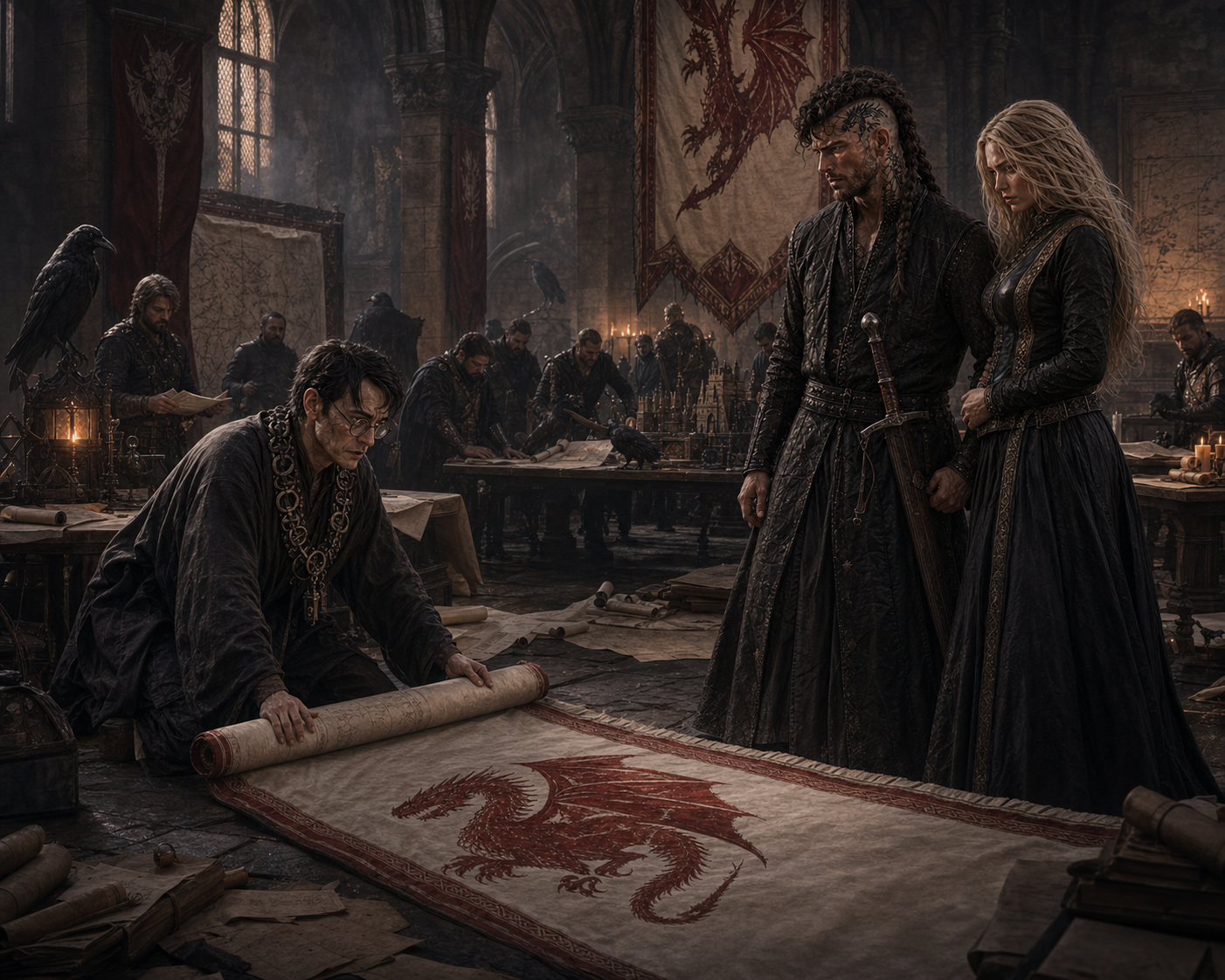
He bent and began unrolling the fabric.
White spilled across the dark floor.
Clean white, heavy and bright against old stone.
Then red.
A border first, deep crimson stitched thick along the edges.
Then the dragon.
It spread across the field in red thread and layered cloth, wings unfurled, head lifted, jaws open not in command but defiance. Not three heads. Not the dragon of Targaryen kings and dead prophecies. One dragon. Strong-lined. Fierce. Alive. Its tail curved toward the lower edge. Its claws reached as if catching wind. The red seemed darker where the wings folded, almost black in the hall's shadow, but when firelight touched it the color warmed again.
A red dragon on a white field.
With a red border.
Tom said nothing.
He could not.
The room had gone very still.
Cleyton stood beside the banner, hands clasped behind his back as if he were presenting a book to a particularly dangerous student.
"It is not Targaryen," he said.
Tom found his voice slowly.
"No."
"It is not meant to be. One head. One will. One creature free of their old blood-binding claims."
Tom looked at the dragon.
Draeghar, he thought.
Not exactly.
But near enough for the heart to answer before the mind corrected it.
Cleyton continued, quieter now.
"The red dragon is for strength. Courage. Fire that protects as well as destroys. And, yes, for the dragon you freed and refuse to claim."
"Draeghar."
"If it was not obvious, I am improving as an artist by ordering better artists."
Tom almost smiled.
Almost.
His eyes would not leave the white.
Cleyton saw.
"The field is white for purity."
Tom flinched.
"Cleyton."
"Not innocence," Cleyton said sharply. "Do not insult both of us. None of us are innocent. I mean intention. I mean the thing in you that keeps refusing thrones before others can build them beneath you. The thing that gives grain before crowns. The thing that looks at dragons and sees living creatures before weapons."
The hall seemed too warm.
"You do not know that will last."
"No," Cleyton said.
Tom looked at him.
The former maester's face was tired and serious and sad in a way that made him seem older than his years.
"That is why you need the banner."
Tom swallowed.
Cleyton stepped closer.
"Men will tell you what you are. Hero. Lord. Demon. Dragon-blooded savior. Foreign conqueror. Northern fool. King in all but name. They will not agree, but they will all try to make you useful to the story they prefer."
His eyes flicked to the banner.
"So choose one first. Choose it carefully, before less careful men choose for you. Make it plain enough that even you cannot pretend to misunderstand it when ambition comes wearing necessity's face."
Tom looked down at the red dragon.
"What house?"
Cleyton's mouth softened.
"You already carry the name."
Frostfyre hung at Tom's hip, pale and quiet.
"The sword?"
"Your northern life and your ancient blood. Cold and fire. Wound and purpose. The name was not given lightly then, and I do not offer it lightly now."
Tom closed his hand over the pommel.
House Frostfyre.
The thought should have felt absurd.
He had been just Tom.
Then a soldier.
Then a fugitive.
Then a slave.
Then a fighter.
Then a man others followed because battles had a cruel habit of leaving him alive in the center of them.
A house was a thing men were born into.
Or stole.
Or married.
Or built from blood and lies until singers pretended it had always been there.
Tom looked at the banner and felt the weight of something stranger.
A house could also be a promise.
"This is too much," he said.
"Yes."
"I did not ask for it."
"That may be the only reason you should have it."
Tom laughed once, too softly to be humor.
Around them, the hall remained silent.
Men were watching.
Women too.
Clerks. Guards. Masons. Kemal near the far wall, arms folded, expression unreadable except for the faintest line of approval at his eyes.
The banner had already begun its work.
Tom felt that and feared it.
He also understood, with sudden clarity, that refusing it would not make the need vanish. If he did not choose the symbol, others would choose one for him. If he did not name the house, the stories would name it badly. If he did not bind himself to meaning, power would bind him to convenience.
"Send for Vissenya," he said.
Cleyton's brows rose.
"Now?"
"Now."
"Volantis will complain."
"Volantis can write a letter."
That made Kemal snort from across the hall.
The raven flew before dusk.
Vissenya returned eight days later.
She arrived with twelve riders, three wagons, two clerks, one furious Volantene merchant who had apparently tried to follow her to continue an argument and been drafted into useful service instead, and Lysara, who stepped into Oros as if she had always suspected the castle needed her judgment.
Tom met Vissenya in the yard.
The banner had not yet been hung.
That mattered.
He wanted her to see it before it belonged to the walls.
She dismounted in travel clothes dark with dust, platinum hair braided tight, face composed until she saw him waiting. The courtyard was full but pretending not to be. Everyone in Oros had become very bad at pretending not to watch anything involving Tom and Vissenya.
"Your raven was brief," she said.
"Cleyton's fault."
"It was in your hand."
"He has made me worse."
"That I believe."
He held out his hand.
Her expression shifted.
Not fear.
Not yet understanding.
But she knew him well enough to know when something had changed.
She took his hand.
Tom led her into the great hall.
The banner waited there, covered in plain cloth.
Cleyton stood beside it. Aemon had returned from Elyria the night before and stood near the hearth, weary but present. Maelyra and Denyo were there too, along with Kemal, several officers, clerks, guards, and representatives from the garrison. Not a court. Not yet. But something close enough to make Tom's skin itch.
Vissenya looked at the covered shape.
Then at Tom.
"What have you done?"
"Nothing yet."
"That is rarely reassuring."
Tom nodded to Cleyton.
The cloth came away.
The red dragon opened itself across the white field.
Vissenya went still.
For once, she had no quick word.
Tom watched her face.
He saw recognition.
Not of the dragon alone.
Of the choice.
Of the danger.
Of the need.
"It is beautiful," she said softly.
Cleyton looked relieved enough to be ridiculous.
"It is a banner," he said, as if he had not been waiting to breathe.
"It is more than that."
"Unfortunately," Tom said.
Her eyes came to him.
Tom stepped before the banner.
Frostfyre hung at his side. The red dragon rose behind him. He felt foolish. He felt trapped. He felt, beneath both, a steadiness that did not come from certainty.
No man was certain at beginnings.
Only liars and corpses.
"I was born with no house worth naming here," Tom said.
His voice carried strangely in the hall.
"The name I had was mine, and that was enough. For a long time, I thought it would always be enough. Mayhaps it should have been."
He looked at Cleyton.
Then Kemal.
Then Aemon, Maelyra, Denyo, Lysara, and the others gathered under old stone and new hope.
"But men need to know what they follow. Enemies need to know what stands against them. The people under our protection need more than rumors, more than a sword, more than my temper arriving late on a tired horse."
A few quiet smiles moved through the hall.
Tom looked back at Vissenya.
"Cleyton named my sword Frostfyre because it carried both parts of what I am. The North that shaped me. The old Valyrian blood I did not ask for but cannot pretend away. Cold and fire. Restraint and wrath. Memory and change."
He drew a breath.
"I take that name now. Not as king. Not as emperor. Not above the republic we are trying to build. As a promise to serve it, defend it, and remember what this banner is meant to demand of me."
The hall seemed to lean in.
"From this day, House Frostfyre begins."
No one cheered at first.
That was good.
Cheers would have made it smaller.
The silence held the weight better.
Tom stepped down from the low dais and stopped before Vissenya.
Her eyes had brightened.
He had seen her face before assassins, slavers, soldiers, merchants, and men who thought power made them clever.
He had not seen this.
Not quite.
"Vissenya Rosedragon," he said.
Her breath caught.
Somewhere behind him, Cleyton made a very small sound that might have been panic or satisfaction.
"You have stood beside me when I was no one. You have argued with me when I needed it and when you merely enjoyed it. You have saved cities with words I would have wasted with steel. You have reminded me that love does not make you helpless and power does not make me right."
Her mouth trembled.
Only a little.
Enough.
"I do not want a throne," Tom said. "I do not want worship. I do not want songs turning me into someone easier to follow and harder to correct. I want you beside me when I forget myself. I want your mind, your courage, your fury, and your hand, if you will give it."
He went to one knee.
The hall disappeared.
Or nearly did.
"Will you marry me?"
Vissenya stared down at him.
For half a heartbeat, Tom wondered whether he had done this terribly.
Then she laughed.
It broke out of her bright and disbelieving, and her hands covered her mouth as if she could catch it after the fact.
"You summoned me from Volantis for a banner and a proposal?"
"Aye."
"You impossible northern man."
"Is that yes?"
"That is me trying not to cry in front of half a government."
"Should I stay kneeling?"
"Only if you enjoy it."
"I do not."
"Then stand up, Tom Frostfyre."
He did.
She took his face in both hands.
"Yes," she said.
This time the hall did cheer.
Not elegantly.
Oros did very little elegantly.
Men shouted. Someone slammed a fist against a table. A clerk began weeping with no dignity at all. Kemal looked toward the rafters as if asking patience from whatever military virtue governed emotional disorder. Cleyton wiped his eyes and pretended he had not.
Aemon Vezos bowed his head.
Maelyra Otherys smiled like a woman watching history become inconvenient.
Denyo Prestayn murmured, "Well. That will simplify some letters and complicate all others."
Within two days, the banners were everywhere that mattered.
One above the main gate, red dragon on white catching the sea wind.
One in the great hall behind the long table where laws were argued into shape.
One in the war room, smaller but finely made, hanging above the map that still looked like a stitched wound across half the known world.
More were commissioned for troops: field banners, pennants, square standards for companies still learning to march without stepping on one another. The first time a line of recruits formed beneath the red dragon, Tom felt the old fear return.
Kemal stood beside him.
"Still think symbols do not hold shields?"
Tom watched a Mantarys youth straighten when the banner lifted.
"I think they had better hold the right things."
"Then make sure they do."
The wedding was held beneath Oros.
Not in the hall.
Not before the gate.
Not beneath the open sky where men could turn it into spectacle before the vows had cooled.
In the dragon caverns.
That had been Vissenya's choice as much as Tom's.
"Old Valyria honored fire," she said.
"Old Valyria also ruined half the world."
"Then we will take what is worth taking and leave the rot in the grave."
No priests presided.
No gods were invoked.
Cleyton approved of the first and worried about the second, then decided aloud that any gods offended by being ignored at a wedding in a dragon cave were welcome to file a written complaint.
The witnesses were few.
Cleyton. Kemal. Aemon. Maelyra. Denyo. Lysara. Several of Vissenya's closest Volantene followers. Two officers from the new garrison. Jory could not leave Mantarys, but he sent a letter, a cloak clasp of plain iron, and a line that made Tom stare at the page for a long while.
Tor would have said she is too pretty for you. He would have been right. Marry her anyway.
Tom carried the letter with him into the caverns.
The lower chamber glowed with heat.
No dragon came close.
But they were not alone.
Far above on a black shelf, a long green shape watched with one open eye. Deeper in shadow, something copper shifted and settled. From an unseen tunnel came the slow scrape of scales against stone.
Witness enough.
Vissenya wore white.
Not maiden white.
Not innocence.
The white of the banner. The white of chosen intention. The white of a field where the dragon could be seen clearly.
Her hair fell loose down her back, platinum bright in firelight. Around her shoulders she wore a cloak lined in red, fastened with Jory's iron clasp until Tom replaced it with one made in the shape of the new sigil.
Tom wore dark wool and the sword at his hip.
Frostfyre looked pale as moonlit ice beside the cavern fires.
The old Valyrian vows Cleyton had found did not speak of ownership.
Vissenya had rejected three versions that did.
They spoke of joining flame to flame without devouring, of standing as two names under one roof, of guarding blood not for purity but for memory, of counsel before command, of loyalty without blindness.
Tom liked that last part best.
Cleyton read the words first in High Valyrian.
Then in the Common Tongue, because Tom insisted vows mattered less if half the people present could only admire their sound.
Tom and Vissenya stood facing each other beside a shallow basin of heated stone. No blood was offered. No cut palms. No drops into flame. That had been Tom's condition, and Vissenya's before he finished saying it.
Instead, each placed one hand over the warmth rising from the basin, close enough to feel heat, not close enough to burn.
Choice, not sacrifice.
That too mattered.
Vissenya spoke first.
Her voice did not shake.
"I stand with you by fire and memory. I give counsel before obedience, loyalty without blindness, love without surrender, and my name beside yours so long as we both keep faith."
Tom had faced lions, sellswords, assassins, and a monstrous champion outside Mantarys.
None of them frightened him like answering.
"I stand with you by fire and memory," he said. "I give protection without possession, honor without command, love without chains, and my name beside yours so long as we both keep faith."
Cleyton's eyes shone.
Kemal looked away with fierce concentration.
Vissenya smiled.
Then they spoke together.
"Two flames. One hearth. Two wills. One house."
The cavern answered in silence.
Then the unseen dragon in the dark exhaled, long and hot, and the basin flame bent toward them as if a wind had passed through the deep earth.
No one moved.
Tom looked upward.
The green dragon's eye closed.
Cleyton whispered, "Well."
Vissenya laughed softly.
Tom kissed her there, in the heat beneath Oros, with the new banner folded nearby and the old world waiting above them.
House Frostfyre was born without crown, priest, or throne.
Only vows.
Only witnesses.
Only dragons who did not object.
After, life did what life always did.
It resumed before anyone was ready.
Jory needed grain figures confirmed. Aemon had to return to Elyria. Setzuko required guidance on whether fishermen counted as a district if half of them lived on boats. Denyo wanted three copies of the proposed law structure. Maelyra wanted ships paid for before they became patriotic. Kemal wanted officers who could read maps. Cleyton wanted sleep and received none.
The red dragon banners remained.
Above the gate.
In the hall.
In the war room.
Folded in the armory.
Carried in the yard by men learning to march beneath something larger than survival.
Weeks later, Vissenya found Tom in the lower cavern.
He sat alone on the familiar stone ledge, watching an empty stretch of heated sand where dragons sometimes slept. Frostfyre lay across his knees. The distant sea muttered through cracks in the rock. Above them, the republic argued itself into being one exhausted page at a time.
She came without guards.
He knew her footsteps by then.
"Volantis again?" he asked without turning.
"Soon."
"I hate Volantis."
"You hate that it has claims on my time."
"I can hate both."
She sat beside him.
For a while, neither spoke.
The caverns breathed around them.
Then Vissenya took his hand and placed it against her belly.
Tom went still.
The world became very quiet.
Not truly.
The vents still hissed. Stone still ticked with heat. Somewhere far below, water struck rock in patient drops.
But inside him, everything stopped.
He looked at her.
Vissenya's face was softer than he had ever seen it. Frightened too. Happy. Wary of happiness. Fierce in defense of it already.
"Are you certain?" he whispered.
"Yes."
His hand trembled.
She covered it with hers.
"Our house begins in earnest," she said.
Tom could not speak at first.
He thought of the banner.
The red dragon.
The white field.
Purity of intention, Cleyton had said.
Something to remember when ambition came wearing necessity's face.
Now there was another thing to remember.
Not a symbol.
Not a story.
A life.
Small as breath.
Large as the world.
Tom bowed his head until his brow touched her hand.
Above them, Oros held its banners against the wind.
Beyond the walls, cities argued, assassins hunted, clans waited, dragons ranged, and the first laws of a fragile republic dried in ink that could still be smeared by any careless hand.
The future had not become kinder.
It had only become theirs.
For one quiet moment in the heat beneath the old Valyrian stones, Tom let that be enough.
Previous Chapter | Chapter List | Next Chapter
Disclaimer: Frostfyre is a non-commercial fan fiction project inspired by a Realm of Thrones campaign for Mount & Blade II: Bannerlord and set in the world of A Song of Ice and Fire. All rights to those original settings and characters remain with their respective owners.
Join the Forge
Receive new Frostfyre chapters and Aodh Forge updates as they are released.