Redemption of the Dragon
Act 2 – Prophesy or Conspiracy · Chapter 22: The Lady of Tolos
Tom rode as if speed could answer fear.
It could not.
Fear rode better horses.
It kept pace through black hills and broken roads, through villages that looked away when armed men passed, through nights where the six Ghiscari escorts slept in turns and Tom barely slept at all. It sat behind his ribs, the same heavy thing that had driven him from Mantarys before the city had even learned how to breathe without masters.
Vissenya.
The name became a hoofbeat.
Vissenya.
The Ghiscari riders did not complain. Hazghan had chosen them well. They were hard men with hard faces, mounted on horses too fine for the hungry streets they had left behind. They ate in silence, rode in silence, watched Tom in silence, and never once asked why a northern swordsman with a meteor blade looked more afraid of arriving late than of arriving outnumbered.
By the second day, the road widened.
By the third, traffic appeared.
That was the first wrong thing.
Not soldiers.
Not refugees.
Traffic.
A mule train came from the east with dyed cloth bundled beneath waxed covers. Two wagons followed, heavy with amphorae and guarded by men in polished mail who looked bored rather than frightened. A line of fishermen passed with baskets of dried catch. Three merchants argued at a roadside well about tariffs, weather, and whether Volantene coinage was being clipped again.
Tom slowed.
One of the Ghiscari riders looked at him.
Tom said nothing.
The nearer they came to Tolos, the less sense the world made.
The city rose from the road in clean layers of pale stone and old black Valyrian foundations, ringed by walls that looked repaired, watched, and very much open. Its towers were square, practical things with banners snapping in the wind. Beyond the gates, Tom saw rooftops stepping down toward a bright harbor where masts crowded together like winter reeds. Smoke rose from cook fires and smithies. Bells rang for some ordinary city purpose that did not sound like alarm.
The gates stood open.
Caravans moved in.
Caravans moved out.
Men at the gate inspected cargo, took marks on wax tablets, shouted for wagons to move faster, and threatened to fine a driver whose cart wheel blocked half the road. A pair of guards laughed at something one of the traders said. A woman carrying bread under a cloth pushed past a sailor and cursed him in three languages for stepping on her sandal.
There were no starving slaves pressed against the stones.
No mobs.
No smoke from burned granaries.
No bodies hanging as warnings.
No city ready to eat itself.
Tom reined in hard enough that his horse tossed its head.
"This is Tolos?" he asked.
The nearest Ghiscari rider glanced at the walls as if wondering whether the question hid some northern trick.
"Yes."
Tom stared.
"Are you certain?"
This time the rider did look at him.
"The city with Tolos written above the gate is usually Tolos."
Tom was too tired to decide whether that was insolence or humor.
Mayhaps both.
He rode forward anyway.
The guards at the gate noticed Frostfyre first.
Then the tattoo.
Then the Ghiscari.
Hands moved toward weapons, not with panic, but with the practiced caution of men who did not wish to make an expensive mistake near witnesses. One of them opened his mouth to challenge Tom.
A woman's voice cut through the road noise.
"Tom."
He turned.
A pretty Volantene woman stood beneath the shadow of the gate arch, dressed in deep green silk cut for travel rather than court. She was young, though not a girl, with dark hair braided in gold cord and eyes sharp enough to make beauty feel like the least useful thing about her. Two men stood behind her in plain cloaks, both carrying themselves like servants who could become knives without changing clothes.
Tom did not know her.
She smiled as if that were his failing.
"You have been expected."
Tom's hand settled near Frostfyre.
"By whom?"
"My lady."
The fear behind his ribs changed shape.
"Vissenya?"
The woman's smile warmed slightly.
"Yes."
Tom swung down from the saddle before he had decided to.
"Where is she?"
"Safe."
"Where?"
"Resting, last I saw." She glanced at the gate guards, the caravans, the Ghiscari, and the growing number of curious eyes. "And less likely to remain pleased if I keep you standing in the road. I am Lysara. I serve your lady. Follow me, if you please."
Tom hated how much the words safe and resting loosened something in him.
He also hated how much he did not believe them until he saw her.
"My men come with me."
"Of course."
Lysara turned without asking the gate's permission.
The guards let her pass.
That told Tom more than any explanation she could have given.
Tolos unfolded around him in clean streets, crowded markets, and the ordinary arrogance of a city convinced that profit excused most sins so long as it kept the lamps lit. It was not gentle. He saw slaves carrying amphorae, saw children in collars sweeping shop fronts, saw guards watching the poor more closely than the rich. But he did not see panic. He did not see famine. Bread sat in stalls. Fish hung from hooks. Fruit lay in neat pyramids beneath awnings. Spices stung the air beside pitch, salt, horse dung, and roasting meat.
The city was not saved.
But it was not burning.
That confused him more than fire would have.
Lysara led them through a district where the streets widened and the stone grew cleaner. Houses rose behind painted walls. Traders in fine linen sat beneath shade screens, counting coin and pretending not to stare at Tom's sword. At last they reached a tavern that did not look like any tavern Tom had known.
It looked like a merchant prince had become tired of walking home.
The front was open to a small courtyard shaded by striped cloth. A fountain murmured in the center, spilling water over blue tiles. Servants moved with trays of wine, lemons, olives, small pastries, and meats cut so thin Tom wondered whether they were meant to feed men or decorate plates. The patrons wore wealth carelessly, which meant they had enough of it to forget what weight it carried.
Lysara spoke to the keeper.
The keeper bowed.
To her.
Not to Tom.
Good.
Tom preferred the world when it announced who mattered honestly.
"Your escort may eat in the lower room," Lysara said. "They will be watched and treated well."
One of the Ghiscari riders stiffened.
Tom said, "They eat armed."
Lysara looked at him for the first time as if he had said something charmingly simple.
"In Tolos, everyone who matters eats armed."
Before Tom could answer, footsteps sounded on the stairs.
He turned.
Vissenya descended from the upper floor with one hand on the rail.
The room changed.
Not because others noticed her, though they did. Men and women looked up, measured her, remembered whatever debt, favor, bargain, threat, or desire tied them to her name, and looked away again with care.
The room changed because Tom could breathe.
She wore pale silver-blue silk belted at the waist, fine enough for power and loose enough to hide healing wounds from fools. Her platinum hair was pinned high with two black needles. Her skin still held some of the pallor of recovery, but her eyes were bright.
Then she saw him.
The councilor vanished.
Only for a heartbeat.
Only enough.
Her face opened with such plain relief that Tom nearly crossed the room at a run.
He managed three dignified steps before giving that up.
Vissenya came the rest of the way.
She did not throw herself into his arms. Too many eyes. Too much pride. Too many wounds still reminding her body that joy could be rough.
But she took both his hands.
And for one breath, her fingers held hard enough to hurt.
"You are alive," she said.
"You are safe."
"I asked first in spirit."
"That is not how questions work."
"It is when I ask them."
He laughed because he could not do anything else with the relief.
She looked past him at the Ghiscari.
"Six riders?"
"Hazghan insisted."
"Wise man."
"You are standing in a tavern."
"I am."
"In silk."
"Yes."
"The gates are open."
"Also yes."
"There are merchants arguing about fines."
"Tolos is very proud of its fines."
Tom stared at her.
Vissenya's mouth curved.
"You look disappointed."
"I thought you were about to die."
The smile softened and became something gentler.
"I know."
That made him angry.
Not at her.
At fear.
At distance.
At cities that might burn and cities that might not and the terrible exhaustion of never knowing until one arrived.
"What happened?" he asked. "The warnings said unrest. Starving smallfolk. Lords hoarding goods. Slaves near revolt."
"All true when we arrived." She touched his wrist lightly. "Come upstairs."
"Now?"
"Unless you wish to discuss near-civil disorder beside the olives."
He followed.
Her rooms overlooked the courtyard and, beyond it, a strip of harbor bright beneath the afternoon sun. It was not the largest suite in the tavern. Tom had learned enough of rich places by then to know that the truly powerful often chose the room with the best exits rather than the most gilding. This one had a balcony, two doors, windows that could be barred, and enough comfort to remind a man what peace might look like if it ever stopped moving.
Lysara brought wine, water, bread, fruit, and a plate of spiced fish.
Vissenya dismissed her with a glance.
Tom waited until the door closed.
"Tell me."
Vissenya poured water first, not wine, and handed it to him.
"Drink."
"Vissenya."
"Drink, or I explain slowly."
He drank.
She nodded approval and sat near the balcony doors.
"Tolos was near breaking when we arrived," she said. "Not from one cause. That would have been easier. Grain had been held back by three families. Slave masters were arming private guards because they feared revolt. Harbor merchants were refusing inland contracts because of rumors from Slaver's Bay. Several lesser houses thought chaos might be an opportunity. Two temples began preaching omens. The city guard had not been paid properly in weeks."
"That sounds like a fire."
"It was tinder."
"And now?"
"Now everyone has remembered how much coin can be lost in a fire."
Tom looked toward the street below.
"You bought peace?"
"Partly. My people arrived with food, trade goods, and letters of credit from Volantis. We opened a market at controlled prices before the hoarders could decide whether to stop us. Then we made it very clear that anyone interfering with the market would find their harbor contracts suddenly cursed by paperwork, debt calls, missing ships, and rivals with excellent timing."
Tom blinked.
"That sounds less like buying peace and more like threatening accountants."
"Never underestimate accountants. They know where the bodies are buried because they know who paid for shovels."
Despite himself, Tom smiled.
She continued, "We did not fix Tolos. Do not mistake delay for salvation. Slavery still sits in the walls. The ruling houses still hate one another. The poor are still poor. The lords chose coin over blood because I made coin easier today and blood more expensive tomorrow."
"And that worked?"
"For now."
"No battle?"
"A little shouting. One private guard captain considered drawing steel during a conversation."
"Considered?"
"He was helped toward wisdom."
"By you?"
"By the man behind him with a knife."
Tom stared at her.
She lifted one shoulder.
"Pointed conversations."
He sat slowly.
For three days, he had imagined walls, arrows, fire, screams, Vissenya cornered in some palace hall with blood on her hands and too many men between them. He had ridden from Mantarys carrying fear sharpened into certainty.
And here she was.
Alive.
Unburned.
Victorious without a sword drawn in her name where a city could see it.
He felt foolish.
Then grateful.
Then foolish again for needing the lesson.
"I would have tried to break something," he said.
"I know."
"That is not admiration in your voice."
"It is some admiration." She leaned forward, eyes warm and amused. "Breaking things is very useful when something must be broken."
"But not everything must be."
"No."
Tom looked down at his hands.
There was still dirt from the road beneath his nails.
Blood too, mayhaps.
Old by then.
Mantarys blood.
"I thought if I was not there, you would die."
Vissenya's expression changed.
"Tom."
"I know."
"Do you?"
He looked up.
She was not angry.
Not exactly.
"I am not helpless because you love me," she said.
The words struck cleaner than anger would have.
"I did not mean–"
"I know what you meant. That is why I am not offended."
"Only correcting me."
"Yes."
"Gently?"
"Do not become greedy."
He laughed softly.
The tension in the room eased, though it did not leave. Some truths stayed because they were useful.
Vissenya rose and crossed to him. She touched the left side of his head where the Ibbenese tattoo curved over shaved scalp and darkening stubble.
"You survived Mantarys."
"Aye."
"Tell me."
So he did.
Not all of it.
Not yet.
He told her of the closed gates. The champion. Jory's shield. The boy Pallo. The night gate. The masters chained. The sellswords turning. Hazghan's men waiting behind them because Kemal had thought three moves farther than anyone gave him credit for aloud.
Vissenya listened without interrupting, though her fingers tightened when he described the crossbows.
When he finished, she said, "You left Jory in command?"
"Aye."
"Good."
"You do not think that strange?"
"I think Mantarys will trust him before it trusts you."
Tom frowned.
"Why?"
"Because he did not arrive with a sword made from the sky and stories already growing around his feet. He can become practical in their eyes. You are becoming something else."
He disliked that.
She saw it and did not spare him.
"People need stories, Tom. You can hate it, but they will make them. Better that Jory gives them bread while you give them distance."
"That sounds like something Cleyton would say if he were less irritating."
"Cleyton is precisely as irritating as required."
"No one requires that much."
Vissenya smiled.
Then she surprised him.
"Stay."
He blinked.
"What?"
"One day."
"We need to return to Oros."
"Tomorrow."
"Aemon may have sent word. Kemal will need reports. Jory is holding Mantarys. There are councilors missing. Tolos is only delayed, you said it yourself."
"All of that will remain true tomorrow."
"That is not comforting."
"It is not meant to be. It is meant to be accurate."
Tom stood, restless at once.
"We cannot just–"
"Live?" she asked.
He stopped.
Vissenya came closer.
"One day," she said. "No war room. No council. No city burning behind the next hill. No pretending the world is not waiting, but no feeding ourselves to it before we must. We will walk through the city. Eat food someone else cooked. Look at useless beautiful things. Argue about nothing important. Sleep in a bed that is not inside a fortress preparing for siege."
"And if something happens?"
"Then it happens to people who have eaten."
"That is your argument?"
"One of them."
"What is the other?"
She lifted his hand and pressed it lightly against her waist.
"I missed you."
That should not have been enough.
It was.
Tom exhaled.
"One day."
"One day."
"If Cleyton scolds me–"
"I will tell him it was my fault."
"He will believe that."
"Of course he will. I am very persuasive."
For one day, Tolos belonged to someone else.
Tom let it.
Not easily.
At first, he walked like a man expecting an ambush in every spice stall. Vissenya noticed and made no comment, which was somehow worse than mockery. She led him through markets where Qartheen glass caught sunlight, where Myrish lenses sat in velvet-lined cases, where bolts of cloth from Lys and Volantis hung in rippling walls of color. He saw bronze lamps shaped like sea creatures, knives too delicate for war, carved ivory dice, painted cups, inkstones, combs, little wooden toys, and a merchant who swore a chipped green statue had once belonged to a Valyrian dragonlord until Vissenya laughed him into lowering the price out of shame.
Tom bought nothing.
Vissenya bought a small silver pin shaped like a leaf, then fastened it to his cloak because she said he needed at least one possession not meant to kill anyone.
"It is sharp," he said.
"Do not ruin this for me."
They ate at a harbor stall where fish was grilled over coals and covered in lemon, salt, and herbs. Tom burned his tongue because Vissenya told him it was not too hot with a face too innocent to trust. She looked delighted when he glared.
They watched ships unload.
They listened to a singer with a voice like warm honey and lyrics Tom understood only in pieces.
They passed a slave market, and the day nearly broke.
Tom stopped.
So did Vissenya.
Men and women stood beneath awnings, inspected like animals by buyers who pinched arms, checked teeth, argued ages, and complained about prices. The collars were polished. The platform was swept. The cruelty wore clean clothes.
Tom's hand went to Frostfyre.
Vissenya put her hand over his.
"Not today," she said quietly.
His jaw tightened.
"That is cowardice."
"No. It is numbers. Guards. Contracts. City law. Foreign merchants. Hostages you cannot see. A riot we cannot control. Dead slaves before sunset if we begin without a plan."
He hated every word because every word was true.
"Then what is the point of one day?" he asked.
Her grip tightened.
"To remember why tomorrow matters."
They left the market.
The day did not become light again.
But it became honest.
That was better.
By sunset, they stood on a terrace above the harbor as the water turned red-gold and the city lit its lamps one by one. Tom leaned on the stone rail. Vissenya stood beside him, shoulder against his arm.
"You did this without battle," he said.
"I delayed this without battle."
"Still."
"Still," she agreed.
"I need to learn it."
"You are learning."
"Slowly."
"Most men do not learn at all."
"That is a low wall to climb."
"Then climb higher."
He looked at her.
She smiled faintly.
"Tomorrow."
They returned to her room after dark.
No one stopped them.
No one was foolish enough.
The night was theirs in the way stolen things sometimes became precious because they could not last. They spoke first. Of Mantarys. Of Tolos. Of Oros. Of nothing. Of the places they had known before the world became roads and blood and impossible choices. She told him a story about a Volantene banquet where three men had tried to impress her with the same poem in three different languages. He told her about a village harvest dance where Tor had fallen into a trough and blamed the mud for attacking him.
They laughed.
That felt dangerous too.
Later, words became less necessary.
The world could wait outside the door.
For once, it did.
Morning found them still tangled beneath thin sheets, sunlight brightening the room by degrees. Vissenya woke first. Tom knew because her fingers traced the edge of the tattoo above his ear with idle care.
"You are staring," he murmured.
"Studying."
"That sounds worse."
"It is."
He opened one eye.
She looked rested.
Not healed.
Not safe from the world.
But rested.
He wished for a thousand impossible things and settled for kissing her hand.
They left Tolos before the city fully woke.
Lysara met them in the courtyard with horses, letters, supplies, and a knowing expression Tom chose not to examine. Vissenya's Volantene followers had already begun arranging the return. The Ghiscari looked better fed and less suspicious of the tavern than they had on arrival, which meant the lower room had served them well and watched them better.
The road back to Oros was uneventful.
This time, Tom trusted it a little more.
He and Vissenya rode together when the road allowed. When it narrowed, she moved ahead or behind with her guards and he found himself listening for her horse like a man listening for a heartbeat. They spoke of practical things. Tolos. Mantarys. Jory. Hazghan. The missing councilors. The danger of stories growing faster than law. At night, they slept in guarded camps beneath hard stars, too tired for stolen tavern ease but no longer hollowed by distance.
Oros appeared after several days as a dark shape above the sea.
The gate stood open.
Men moved on the walls.
New banners snapped in the wind, not royal, not yet national, only the dark provisional signs Kemal had ordered so ships would know the castle had become a place with answers.
Tom expected reports.
He did not expect Aemon.
The older Valyrian stood in the yard when they rode in, travel-stained and sharper-eyed than when Tom had last seen him. Beside him waited two people Tom knew only from Cleyton's council list: Maelyra Otherys of Lys, graceful and silver-haired in pale violet, and Denyo Prestayn of Braavos, younger than Tom expected, lean, dark-eyed, and dressed like a man who preferred not to be recognized until too late.
Cleyton stood behind them with three books under one arm and the expression of a man whose worries had begun breeding.
Kemal looked relieved for exactly half a heartbeat.
Then he became Kemal again.
"You are late," he said.
Tom dismounted.
"We were delayed."
Vissenya stepped down beside him.
Cleyton looked from her to Tom, then wisely looked at his books.
Aemon did not waste the moment.
"Elyria is mostly under control," he said. "Mostly is not enough. I need to return before ambitious men remember their ambitions."
"Then why are you here?" Tom asked.
"Because Oros is where the trouble is becoming shape."
Maelyra Otherys smiled.
"And because no raven can carry the full weight of foolishness."
Denyo Prestayn gave a small bow.
"Or opportunity."
Tom looked toward the keep.
"War room."
No one argued.
That worried him.
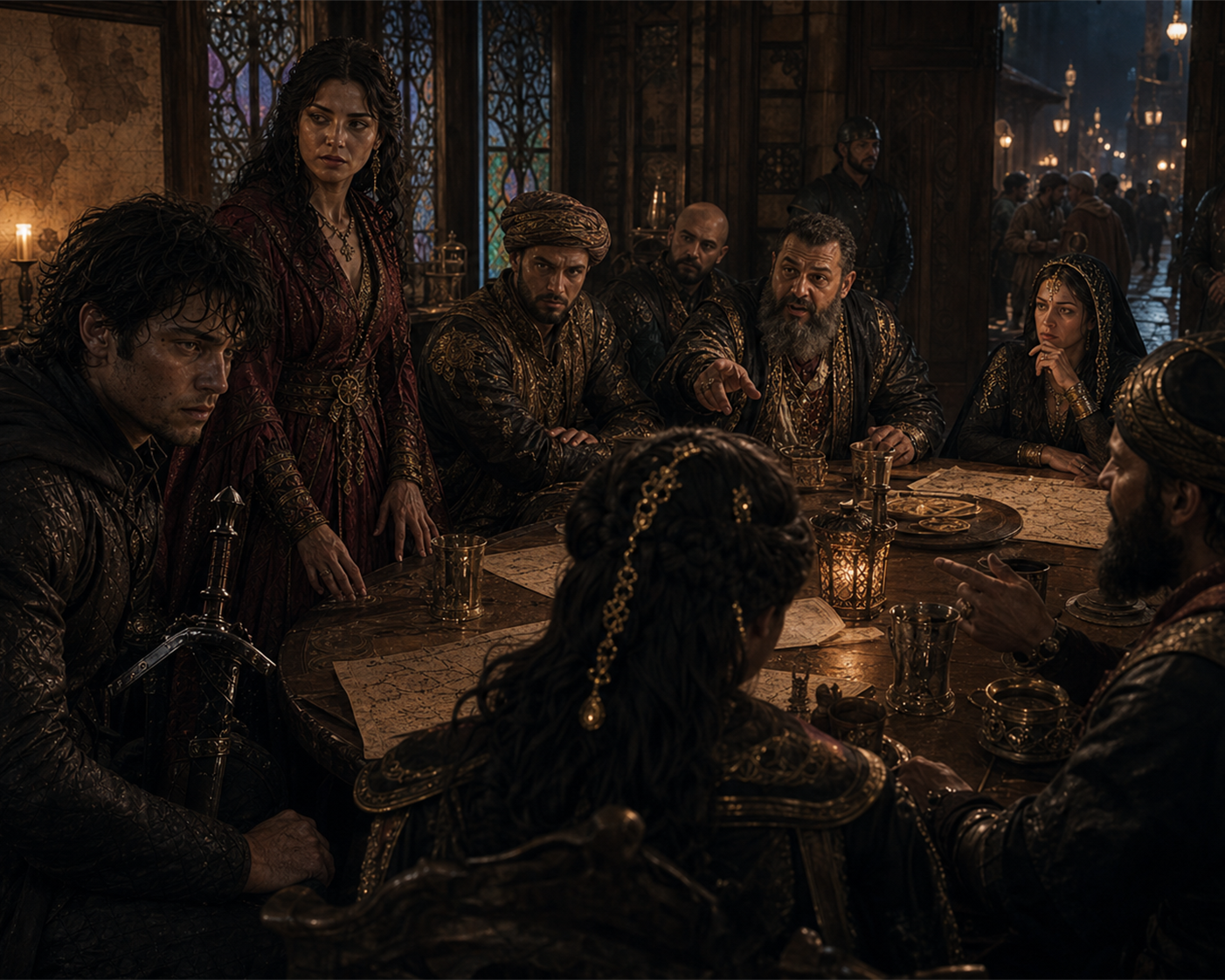
They gathered by lamplight.
Exhaustion sat at the table like another councilor.
Cleyton brought letters. Kemal brought troop counts. Aemon brought Elyria's unrest folded into neat reports that did not make it smaller. Maelyra brought Lysene caution dressed in perfume and silk. Denyo brought Braavosi practicality and a habit of listening so completely that men forgot he had not agreed with them.
Vissenya stood near Tom's right.
Not behind him.
Never behind.
Aemon began.
"Before anything else, we must reestablish contact with Myr, Qohor, and Norvos. Silence from one city is inconvenience. Silence from three is design or disaster. Either can kill us."
"Agreed," Cleyton said.
"I have ships that can put quiet hands near Myr," Maelyra said. "Not inside every door, but near enough to learn whether Rogoro Nestoris is dead, hiding, or bargaining."
Denyo folded his hands. "Braavos can reach Norvos by road if the bells do not object. Qohor is harder."
"Qohor is always harder," Cleyton said.
Vissenya touched the Tolos marker on the map.
"Reestablishing contact matters, but we cannot become a council of messengers chasing silence. We have places already tied to us that need strength. Oros. Ifequevron. Mantarys now. Omber, by influence if not rule. Elyria through Aemon. Tolos by pressure. If we do not deepen roots where we stand, every new crisis will pull us apart."
Aemon nodded reluctantly.
"Roots require time."
"Then we must stop spending all of it running."
Maelyra's smile thinned.
"A stirring sentiment. Less useful when one does not control the ground beneath one's roots."
Denyo said, "Some of us have influence, not command. In Braavos, I can move agents, coins, rumors, ships. I cannot order the Sealord's men to salute Oros because a northern swordsman has inspired three cities and a dragon."
"Four cities if one counts stories," Maelyra said.
Tom ignored that.
Kemal leaned over the map, blunt as a hammer.
"You are all discussing webs. I am discussing men. We do not have enough."
That quieted the room.
"Oros can hold," Kemal said. "Mantarys can be held if Jory does not face a proper army. Ifequevron has local guards and Tears support. Omber has agents, not a garrison. Elyria is recovering order. Tolos is delayed, not loyal. If red priests, surviving slaver powers, a Volantene faction, or one determined city decides to test us, we bleed in too many places at once."
"You want an army," Aemon said.
"I want a functional army. Training. Supply. Command. Pay. Law. Not fighters tied by gratitude, former slaves tied by hope, Ghiscari tied by discipline, and sellswords tied by the thickness of a purse."
"The sellswords are less of a problem after Mantarys," Tom said.
Maelyra glanced at him.
"Because they are loyal?"
"Because they are dead."
No one smiled.
Kemal continued, "As we attract attention, enemies will stop arriving in pieces. We need banners men recognize, officers they obey, punishments they understand, and a reason to stand that lasts longer than being inspired by Tom."
Tom had been quiet for most of the night.
He knew they noticed.
At first he had been listening because others knew more. Aemon knew cities. Vissenya knew pressure. Maelyra knew ships and manners sharp enough to cut. Denyo knew movement. Cleyton knew histories that made every proposal feel older and more dangerous. Kemal knew what held a wall when pretty ideas reached it tired and bleeding.
Then, slowly, something in Tom's mind began to take shape.
Not a battle plan.
Not a rescue.
Something larger.
That frightened him more.
"We need a government," he said.
The words came out quietly.
Too quietly.
Several people kept talking over them.
Vissenya heard.
She looked at him.
Tom placed both hands on the table.
"We need a government," he said again.
This time the room stopped.
Cleyton's brows drew together.
"Define government before I object to it."
"Clear laws," Tom said. "Clear expectations. Clear consequences. A way for people to know what we are before our riders arrive at their gates. A way for Mantarys to know what comes next. For Ifequevron. For Omber. For anyone who joins us or is freed by us."
Aemon stared.
"You are speaking of rule."
"I am speaking of order."
"Those words marry often and happily produce tyranny," Maelyra said.
"They also produce roads, courts, taxes, grain stores, and guards who know who gives orders."
Denyo leaned forward slightly.
"You want the Tears to become public."
"The Tears are already public," Tom said. "Oros is not a whisper. Mantarys is not a rumor. Ifequevron has a governor serving under our authority. Omber has leaders keeping peace because we told them to. Men are telling stories about a sword from the sky. We can pretend we are still shadows if it comforts us, but shadows do not feed cities."
Cleyton's face tightened.
"This is too soon."
"Aye."
That seemed to surprise him.
Tom continued, "It is too soon. We are tired. We are bleeding. Half the council is absent or silent. One councilor betrayed us and named himself after dead dragonlords. Another may be dead in Myr or hiding in Qohor for all we know. It is too soon."
"Then why suggest it?" Aemon asked.
Tom looked around the table.
"Because too late will kill more people."
The room held still.
He stood.
The motion quieted even the small protests beginning in Maelyra's eyes.
"For thousands of years, the Tears moved in shadows," Tom said. "You curbed the worst things where you could. Stopped a ritual here. Smuggled a family there. Killed a priest, hid a child, stole a book, bribed a guard, saved a village no one wrote songs about. Good work. Brave work."
He looked at Cleyton, then Aemon, then Vissenya.
"But the world did not change."
Cleyton looked wounded.
Tom did not soften it.
"Old Valyria burned and men still reach for chains. Dragonlords died and men still dream of becoming them. Slavers fall in one city and rise in the next. Priests lie. Masters hoard grain. Smallfolk starve. We save a few at a time, and I am not mocking that. A few matter. But if we have the chance to save more, city by city if needed, and we refuse because the old way feels safer, then what are we?"
"Alive," Maelyra said.
"Hidden," Aemon said.
"Uncorrupted," Cleyton said softly.
Tom nodded.
"Those are not small fears."
"They are not fears," Aemon said. "They are memory."
"Then remember the whole thing," Tom said. "Valyria was not wrong in every way."
That startled them more than anything else he had said.
Cleyton looked ready to object on behalf of every dead scholar he hated.
Tom raised a hand.
"Not the blood magic. Not the chains. Not the dragonlords calling themselves nearer gods because they could make fire kneel. But the freeholds. Individual freedoms. Cities with their own pride, their own customs, their own laws. Peoples that did not all have to become one village with one voice. There is something in that worth saving."
Vissenya's gaze sharpened.
She understood before the others.
Tom looked at the map.
"Where they erred was letting the wealthiest and most powerful lead because they were wealthy and powerful. That always rots. Coin protects coin. Power protects power. Eventually everyone beneath it becomes fuel."
Kemal grunted.
"Usually faster than eventually."
"Then we make something else," Tom said.
Denyo's eyes narrowed thoughtfully.
"What?"
"A republic."
The word felt strange in the room.
Old and new at once.
Cleyton went very still.
Tom pressed on before anyone could bury it beneath reasons.
"Universal laws every city must accept if it stands with us. No slavery. No hoarding food while citizens starve. No punishment without trial. Trials must be fair and follow the republic's law. Punishments too. No blood magic. No forced worship. No noble or master above the same law that binds a fisherman's son."
"And local law?" Vissenya asked.
"Each city governs itself so long as those laws are not broken. They can keep their customs. Their festivals. Their councils. Their trade rules. Their inheritance laws, if those laws do not put chains back on people. Additional laws can be city specific, but they cannot violate the higher ones."
Aemon frowned.
"Who judges that?"
"The high council."
Maelyra laughed once.
"Ah. And there it is. The Tears council becomes a crown without admitting it has a head."
"No crown," Tom said. "No king. No emperor."
"A council can still become tyrants in a circle."
"Then it must be checked."
"By whom?"
"The cities."
Denyo's fingers tapped once against the table.
"Go on."
Tom breathed in.
The shape grew clearer as he spoke.
"Each city has a councilor on the high council to oversee matters that affect the whole nation. War. Peace. Republic law. Roads between cities. Common coin, mayhaps, eventually. Relations with other powers. The things no one city should decide for all."
"And inside each city?" Aemon asked.
"Local representatives. A senate, or whatever name fits the tongue. The number chosen by the number of citizens. Not merely wealth. Not bloodline alone. Citizens."
Cleyton's mouth tightened.
"Define citizen."
"Free person under the republic's law."
"Former slaves?"
"Smallfolk," Tom said at once. "Citizens. Whatever word we use, they are not property. Not lesser. Not waiting twenty years for some master to decide freedom has been earned."
Maelyra looked at Vissenya.
"You hear how pretty this sounds."
Vissenya did not look away from Tom.
"I also hear how dangerous it is."
"Good. Then someone does."
Aemon began pacing.
"Mantarys will not know how to choose representatives. Ifequevron has never governed beyond family, craft, and survival. Omber has clan chiefs who agreed because a dragon frightened them. Elyria's merchants will smile and buy every seat before the ink dries. Volantis will laugh if we claim equal law applies to the Old Blood and a freed dockhand."
"Then we do not begin with Volantis," Tom said.
Vissenya's mouth twitched despite the tension.
"Wise."
"We begin where we must. Oros as the seat. Mantarys because it needs law now. Ifequevron because Setzuko needs authority that is not merely my name. Omber because the Ibbenese leaders must know what peace requires. Elyria if Aemon believes it can be brought in without breaking it. Others when ready. Or when forced by events."
Denyo said, "And if a city refuses?"
"Then it is not part of the republic."
"And if it keeps slaves?"
Tom looked at him.
Denyo nodded slowly.
"That answer was louder without words."
Kemal crossed his arms.
"This army. Who commands it?"
"Officers command it."
"Do not be clever."
Tom almost smiled.
Almost.
"The army answers to the high council."
Kemal's expression hardened.
"Armies answering to councils often answer to the loudest man with coin."
"Then officers swear to the law first, council second, city third. Pay comes from the republic, not private purses. No private armies inside member cities beyond limited guards under local law."
"You have thought of that quickly," Cleyton said.
"I have seen what private guards do when masters fear hungry people."
No one argued that.
Aemon stopped pacing.
"What happens when the high council disagrees?"
"They vote."
"On war?"
"Yes."
"On law?"
"Yes."
"On whether to remove a councilor?"
"Yes."
"On you?"
The room tightened.
Tom understood.
There it was.
The fear beneath every argument.
Not laws.
Not structure.
Him.
The star-sword. The dragon. The freed cities. Men kneeling after meteors. Stories moving faster than orders.
"Especially me," Tom said.
Vissenya's eyes softened.
Maelyra studied him as if seeing something she had not expected and did not entirely trust.
Tom placed one hand flat on the map between Oros and Mantarys.
"I do not want a throne."
"Men who want thrones often say that before finding better chairs," Maelyra said.
"Then build the room without one."
Silence.
Denyo smiled faintly.
"That," he said, "is almost a plan."
Cleyton sat down slowly.
"It is also madness."
"Most beginnings are," Vissenya said.
Aemon looked toward the dark window, beyond which Oros held its place over the sea.
"We have spent our lives fearing that power corrupts because we have seen it happen. Old Valyria. Volantis. Slaver's Bay. Baelys." He turned back. "You ask us to gather power anyway."
"No," Tom said. "I ask you to stop letting power gather only in the hands of people who already use it badly."
That landed.
Not as victory.
Not agreement.
But as a stone dropped into deep water.
The ripples would take time.
"It will not be perfect," Tom said. "Nothing will be. Wealthy men will still try to buy voices. Powerful families will still try to bend law. Smallfolk will still be frightened. Former slaves will not become free in their own minds because we write it on parchment. Councils will argue. Cities will hate one another. We will make mistakes."
He looked at each of them.
"But it can work."
No one spoke for a long moment.
Then Kemal said, "A government needs soldiers by morning."
Cleyton gave a tired laugh that held no amusement.
"A government needs scribes before soldiers, or the soldiers will invent the government badly."
"A government needs ships," Maelyra said.
"Coin," Denyo added.
"Food," Vissenya said.
Aemon rubbed both hands over his face.
"Gods help me, I am too tired to oppose history tonight."
Tom did not tell him the gods had no place in it.
Not yet.
Cleyton reached for a blank page.
"Fine," he said. "If we are going to found a republic before breakfast, someone should at least spell republic correctly."
That broke something.
Not tension.
Not fear.
But the room remembered how to breathe.
Tom sat slowly.
He had not won them.
Not fully.
Mayhaps not even mostly.
But they had stopped arguing about whether the world could change and begun arguing about what changing it would require.
For one night, that was enough.
Previous Chapter | Chapter List | Next Chapter
Disclaimer: Frostfyre is a non-commercial fan fiction project inspired by a Realm of Thrones campaign for Mount & Blade II: Bannerlord and set in the world of A Song of Ice and Fire. All rights to those original settings and characters remain with their respective owners.
Join the Forge
Receive new Frostfyre chapters and Aodh Forge updates as they are released.