Redemption of the Dragon
Act 2 – Prophesy or Conspiracy · Chapter 15: The Fortress
Oros learned discipline before it learned peace.
Ser Kemal saw to that.
Peace was a soft word, and soft words had little use in a castle recently taken by betrayal, blood magic, sellswords, and fear. Oros had walls with cracks still needing mortar, gates that had been forced open by men now expected to guard them, dungeons that smelled of old misery, and catacombs beneath it where dragons lived beyond any command men had yet earned.
So Kemal did not speak of peace.
He spoke of watches.
"Again," he said.
The yard answered with the scrape of boots on black stone.
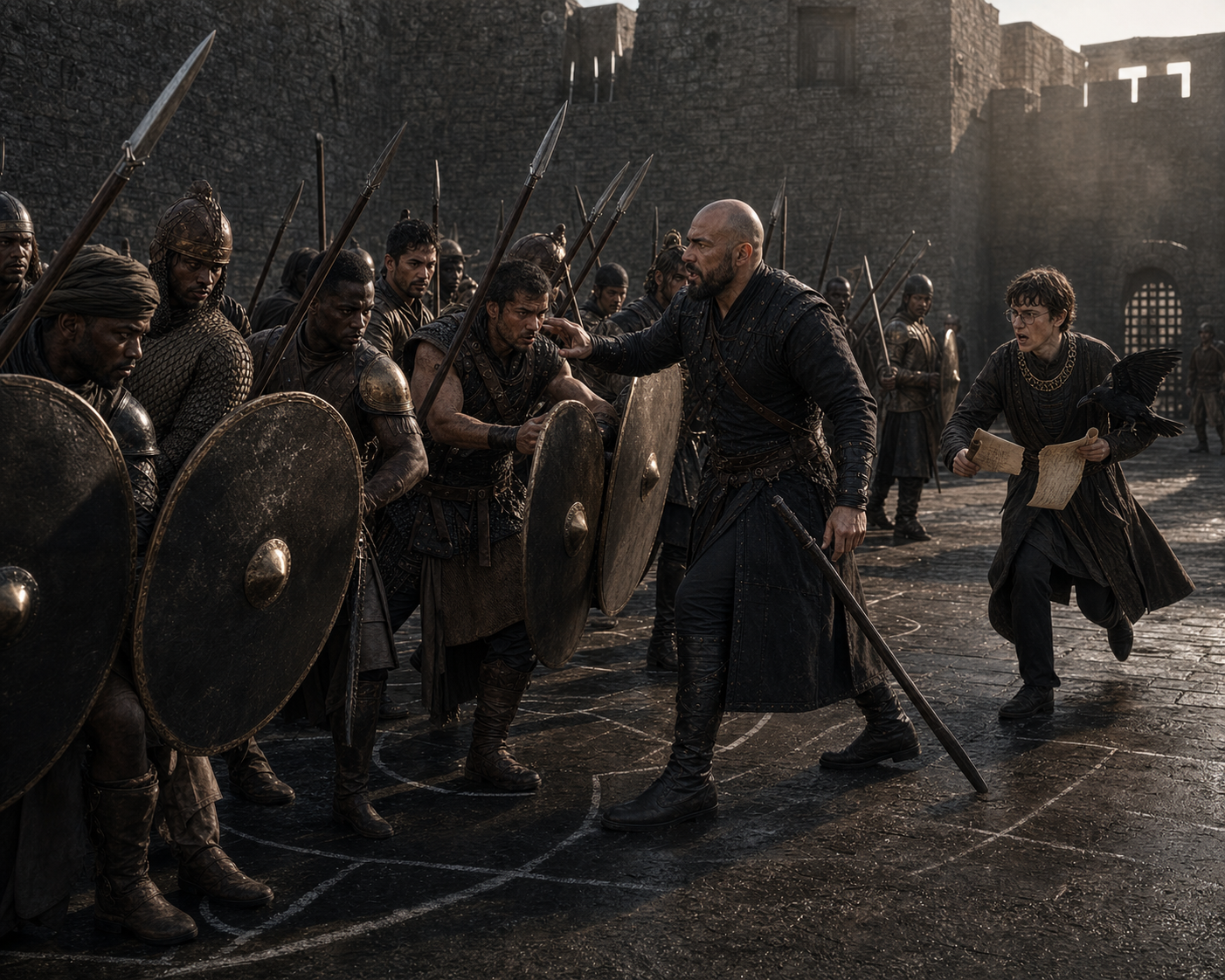
Two lines moved beneath the morning glare. Former Tears garrison beside newly sworn Ghiscari. Men who had tried to kill one another days before now turned shields on the same count, stepped on the same count, struck on the same count. Some did it well. Some did it angrily. Some did it because Kemal stood before them with his arms folded and the expression of a man who could find flaws in falling rain.
"Again."
The shield wall reset.
A Ghiscari veteran with a scarred eye moved half a beat late.
Kemal crossed the distance and struck the man's shield with the wooden practice sword hard enough to make the line flinch.
"Late."
The Ghiscari's jaw tightened. "I know."
"Then you are choosing poorly."
"I am not used to your count."
"Get used to being alive."
The man swallowed the answer that came next.
Good.
Kemal moved on.
He tested them in layers. Not trust. Trust was too expensive to spend early. Usefulness came first. Could they hold a watch without wandering? Could they obey an order from a man they had fought against? Could they surrender a knife when asked and not hide three more poorly? Could they stand beside a former enemy when the ground shook below and not remember old paymasters?
The Ghiscari were easier than the sellswords.
Soldiers understood a changed command if the command proved stronger than the one before. Sellswords understood survival, coin, appetite, insult, and the thousand small weather patterns of advantage. Kemal did not hate that. Hatred wasted attention. He simply trusted it less.
One sellsword from Lys refused to drill beside a former slave who had broken his cousin's teeth in the courtyard.
Kemal listened to the complaint.
Then he placed them together on latrine duty for the west barracks.
"That is not soldier's work," the Lysene said.
"It is now."
"I am a blade for hire."
"You are a shovel for discipline."
One of the freed garrison men, watching from the shade with his bandaged arm bound to his chest, laughed before he remembered he was meant to look solemn.
Kemal pointed at him without turning. "You can join them."
The man stopped laughing.
The yard improved.
Slowly.
Grudgingly.
That was still improvement.
From the upper arcade, Vissenya watched men learn new masters and tried not to feel as if she were watching herself.
She hated needing the wall.
Her hand rested against the stone as though casually placed there, but the truth was less graceful. If she stood too long, the world tilted. If she walked too far, the cuts along her side burned with a deep, humiliating heat. If she reached too quickly, the healing skin beneath her collarbone pulled and reminded her that Maegor had turned her blood into an argument he had not lived to finish.
She had survived worse than wounds.
That did not make wounds less irritating.
Below, Kemal broke apart the drill and sent three Ghiscari to the north wall under supervision. Two sellswords to stores. Four Tears to the lower gate. Every order carried a test inside it. Every answer became a measure.
Oros was changing.
The Tears were changing.
Vissenya was not certain she liked the shape.
Once, the order had been shadows, safehouses, whispers, knives in court sleeves, letters smuggled beneath false-bottomed wine crates, old bloodlines hidden under ordinary names. It had been movement. Secrecy. Patience. A web of people who knew how not to exist until they needed to.
Now it had walls.
A crater in the yard.
A dead traitor in a cellar.
Men kneeling for a northern boy who had wanted nothing so little as reverence.
A stolen dragon carried east.
And her, standing in a repaired Valyrian castle with bandages under her shirt, wondering whether the order she had served had become something new while she was chained to a wall.
"You look as if you are deciding whether to stab the architecture."
Vissenya did not turn.
"I might," she said.
Cleyton came to stand beside her, a stack of books under one arm and ink on two fingers. He had slept less than anyone in the castle and somehow looked more offended by consciousness than fatigue.
"The architecture is old," he said. "It has endured worse."
"So have I."
"Yes. And like the architecture, you have cracks."
She looked at him then.
"Was that meant to comfort me?"
"No. It was an observation. Comforting people is a separate discipline at which I have not excelled."
"I have noticed."
He sighed and followed her gaze to the yard.
Below, a Ghiscari line turned cleanly on Kemal's count.
Cleyton said, "They are better than yesterday."
"That frightens me more than if they were worse."
"Because men who learn quickly may choose quickly again?"
"Because men who kneel for one sign may kneel for the next."
Cleyton's expression tightened.
Vissenya saw the movement and knew she had struck near the thought that had brought him to the arcade with books when he should have been buried in them.
"You are studying the stone," she said.
"Among other things."
"Do you know what it is?"
"A stone that fell from the sky."
"The boy said nearly the same thing."
"For once, he was concise."
Her mouth moved despite herself.
The name did what it always did now. It entered the space and changed the air.
Cleyton noticed.
Of course he noticed.
He was terrible at comfort, not blind.
"You miss him," he said.
"That is not a question."
"No."
"Then I do not have to answer."
"No."
They stood in silence long enough for another drill to begin below.
Vissenya watched the shields rise.
"I have known him for months," she said at last.
"Yes."
"Depending how one counts."
"Pain makes time strange."
"So does fear."
"And affection."
She looked at him sharply.
Cleyton stared down into the yard with saintly cowardice.
"You are very bold for a man within reach of a wounded woman," she said.
"I am relying on your limited mobility."
"Unwise."
"Frequently."
She let the silence return, but it no longer felt like avoidance. It felt like choosing words carefully because careless ones might become true too quickly.
"I do not know what he is to me," she said.
Cleyton's voice was softer when he answered. "Mayhaps you do not need to know yet."
"You told him mirrors were dangerous."
"They are."
"What am I?"
This time Cleyton did look at her.
He saw more than she wanted. The spy who had lived too long by keeping exits in every room. The councilor who had known desire as tool, disguise, indulgence, danger. The woman who had been bound and bled and had woken in arms that trembled not from weakness but from fear of hurting her. The survivor trying to decide whether being loved, or nearly loved, was another kind of chain.
"You are not a mirror if you do not ask him to become your reflection," Cleyton said.
Vissenya looked away first.
Below, Kemal shouted, "Again."
This time, she almost welcomed the interruption.
Cleyton's chamber had once been a records room.
It was becoming one again by force.
Books lay open across three tables. Scrolls had been weighted with knives, cups, broken bits of stone, and one small dragonbone fragment Cleyton had found in a lower storeroom and refused to explain to anyone who might ask whether it was valuable. Maps of the lower catacombs covered one wall. Lists of garrison dead and missing covered another. A third table had been given entirely to the sky-stone.
It sat in a shallow bronze basin, dark and glassy, veined red where light struck the cracks.
Cleyton did not like it.
That was not scholarly.
Scholars were meant to like difficult things.
He found, increasingly, that he preferred difficult things that had the manners to stay in books.
The stone had fallen from the sky at the exact moment a false dragonlord lay defeated in the yard of a castle built over wild dragons, while a young man of ancient Valyrian descent rejected divine meaning loudly enough for half the survivors to hear.
Coincidence, Cleyton wrote.
Then he underlined it once and hated himself for the gesture.
He had spent the morning with dragon records.
Not Targaryen histories. Those were too easy and too poisoned by men who thought blood made truth. He read fragments from Valyrian estate ledgers, travel accounts written before the Doom, a Braavosi translation of a Qartheen bestiary, and three scraps from a ruined Asshai'i copyist whose handwriting looked as if fear had held the pen. Wild nests. Heat vents. Clutch behavior. Wing injuries. Feeding patterns. Binding horns. Blood rites. The cost of failed bindings.
Always cost.
Blood magic was accounting by other means.
He wrote that down too.
Then crossed it out because it sounded clever and therefore suspicious.
By afternoon, the dragons had led him back to the stone.
The stone led him backward through history.
Falling stars. Red omens. Black stones worshipped by men who should have known better. Swords forged from the heavens. Priests claiming judgment. Kings claiming destiny. Maesters dismissing peasant accounts as superstition, then quietly preserving the same accounts when the fallen iron proved useful.
And one sword.
Dawn.
House Dayne of Starfall.
Cleyton sat back, rubbing tired eyes beneath his thumb and forefinger.
The Daynes claimed their ancient blade had been forged from the heart of a fallen star. Pale as milkglass, alive with light in songs, unlike Valyrian steel in all the ways that made maesters uncomfortable because unlike things demanded different explanations. Dawn had cut through enough history that dismissing it as legend required more faith than accepting it as problem.
A fallen star.
A sword.
A bloodline older than most claims.
A castle named Starfall.
Cleyton laughed once into the empty room.
It was not a happy sound.
"Of course," he said to no one.
The universe, if it possessed intention, had an appalling fondness for poetry.
He pulled a different book from the stack. Westerosi lineages. Old, dry, mostly wrong in the places men cared about and accidentally useful in margins. House Dayne. Starfall. Swords of the Morning. Dornish marches. First Men arguments. Andal corrections. Rhoynar complications. Maesterly certainty laid over mysteries like a rug over a trapdoor.
He read until the light shifted.
He read until a servant brought food and took away untouched food.
He read until the letters blurred.
Then he read the meteor accounts again.
The trouble was not that he had an answer.
The trouble was that he had the outline of a question large enough to become dangerous.
If fallen stars could carry metals or powers that men did not understand…
If Dawn was truly forged from such a thing…
If the stone in the yard was more than an omen and less than a god…
If natural magic answered need through beast, root, blood, place, and mayhaps even stone…
If the old stories had preserved not truth, precisely, but the shape of truth…
Cleyton stood too quickly and nearly knocked over the bronze basin.
"No," he told the stone.
The stone, with admirable discipline, did not answer.
He needed someone in Westeros.
Not the Citadel. Never the Citadel, not for this. The Citadel would file, deny, copy, misplace, suppress, or smile politely while sending the wrong raven to the wrong man with the right poison hidden in the phrasing.
He needed a man near the right histories.
Or a woman.
Someone with access to Dornish accounts, Dayne rumors, old songs, sword lore, star-fall records, and enough independence not to run first to Oldtown.
He began pacing.
Outside his window, the yard rang again.
Kemal's voice carried upward.
"Again."
Oros was learning to stand.
Vissenya was learning to heal.
A stolen dragon was somewhere east in chains.
Elyria lay somewhere east as well, too far for answers and too close to the order's heart.
And a stone from the sky sat in a bronze basin on Cleyton's table, dragging his thoughts across the sea to a pale sword in Dorne.
He stopped pacing.
Decision, when it came, felt less like certainty than surrender to the next necessary task.
Cleyton crossed to the door and threw it open.
A young guard outside nearly dropped his spear.
"You," Cleyton said.
"Maester?"
"Raven. Quill. Ink. Now."
The guard blinked. "To Oros's ravenry?"
"Unless you keep ravens somewhere more imaginative, yes."
The guard ran.
Cleyton returned to the table and pulled a fresh sheet of parchment from beneath a book on dragon humors.
He dipped his pen before remembering he had no ink.
"Damn," he said.
Then he waited, fingers stained, mind racing toward Westeros.
Previous Chapter | Chapter List | Next Chapter
Disclaimer: Frostfyre is a non-commercial fan fiction project inspired by a Realm of Thrones campaign for Mount & Blade II: Bannerlord and set in the world of A Song of Ice and Fire. All rights to those original settings and characters remain with their respective owners.
Join the Forge
Receive new Frostfyre chapters and Aodh Forge updates as they are released.