Redemption of the Dragon
Act 2 – Prophesy or Conspiracy · Chapter 16: East Meets North
"You are already late," Setzuko said.
No one in the tent moved for three heartbeats.
Then Boro sighed.
"I am beginning to dislike people who enter tents with bad news."
Setzuko looked at him. "Then lock your tent better."
"I was outside."
"Then stand outside better."
Mera made a small sound that might have become laughter if the knife in her hand had not still been pointed toward Setzuko's ribs.
Tom touched the place beneath his jaw where the blade had rested. The skin there felt colder than the rest of him. That annoyed him more than the fear. Fear he understood. Annoyance meant he had let himself become careless.
Jory did not lower his sword.
"Explain," Tom said.
Setzuko glanced around the tent, measuring faces. Jory's caution. Mera's readiness. Boro's size. Serra's suspicion. Daxos's narrowed trader's eyes. Then she looked back at Tom as if deciding whether the northern boy she had come to find was worth the trouble of keeping alive.
"Lo Feng did not buy the dragon to keep it in a cage forever," she said. "She bought it because power is worth more when others know you have it."
Daxos frowned. "She?"
"Lo Feng is a woman."
Boro blinked. "The scroll said war captain."
"She was," Setzuko said. "And magistrate. And smuggler. And grieving widow twice before she married Lo Han, depending which story she needs men to believe. Her husband leads our people now because men from Yi Ti often prefer to bow to a man's chair, even when a woman chooses where the chair is placed."
Mera's mouth curved. "I like her less and respect her more. Irritating combination."
"Do not respect her too much," Setzuko said. "She sells anything if the price teaches her enemies fear. Fear is her preferred coin."
Tom lowered himself slowly beside the map. The movement pulled at the healing cut along his side. He ignored it as best he could.
"Where is the dragon?"
"If they followed their usual habits, in the inner keep courtyard. Steel cage. Heavy chain. Guards enough to make frightened men feel brave."
"Can we reach it?"
"With difficulty."
"Can we reach it quietly?"
Setzuko looked at the company gathered around the lantern.
Her gaze rested on Boro.
"No."
Boro spread his hands. "I have done quiet."
"In dreams?"
"Once in Volantis."
Mera said, "You were hiding from a fish seller."
"And did he find me?"
"Everyone found you."
"Eventually is not immediately."
Tom almost smiled, but the thought of a wounded dragon in a steel cage killed the expression before it lived.
"The town," he said. "Tell us."
Setzuko crouched and drew the map toward herself. She studied Cleyton's markings for a moment, then made a soft disapproving sound.
"Your maester has never been there."
"No."
"Good. Then he has excuse."
She turned the parchment and took a piece of charcoal from the lantern tray. With quick, precise marks, she changed the shape of the place they had been riding toward. Roads shifted. One hill moved. A watercourse became a dry canal. The marked walls bent inward, then outward again.
"The city sits in a hollow between three ridges," she said. "Not a true city by YiTish measure. Not even a large town by Volantene pride. But to us, here, it is a city because it has walls, gates, markets, taxes, and men who believe stone makes them important."
"What is it called?" Jory asked.
"Ifequevron," Setzuko said. "The name is older than our walls. It comes from tales of the small magical folk who lived in these lands before YiTish ships ever crossed this far west. Forest folk, root speakers, children of hidden places. Some say they were kin to the green seers of Westeros. Some say they were only stories our grandparents carried because exile needs wonder as much as bread."
The name changed her voice.
Only a little.
Enough.
Tom heard it and looked more closely at her.
Setzuko was not old. Older than him, mayhaps, but not by much. Her face had the stillness of someone who had learned not to give strangers anything they could use. Yet the word home had passed through that stillness like a lamp behind thin paper.
She tapped the map.
"Outer wall here. Main gate faces south because the old road comes from the south. Foolish. Proud. Useful for us. Market road enters there each morning with farmers, charcoal burners, goat herders, salt sellers, mushroom cutters from the damp ravines. If we reach them before dawn, I can place us among them."
"They will know we are not farmers," Serra said.
"Farmers hire guards when roads are dangerous. Roads are always dangerous. You will look tired and poor."
Boro nodded solemnly. "We have trained for this."
Setzuko ignored him. "Once inside, the market square sits here. Do not stare at the shrine. Do not speak to anyone in YiTish unless you know which court accent you are insulting. Do not touch a child's head. Do not point with one finger. Do not ask why their rice is mixed with ash millet unless you want grief for breakfast."
"Useful," Jory murmured.
"Necessary."
The charcoal moved again.
"From the market, we take the dyers' lane. It smells terrible. Guards hate it. Then the old canal road. It passes below the inner wall where the stone was never finished properly. There is a postern used by servants and kennel boys. The lock is bad, but the guard changes when the third bell sounds. If Lo Buto has not changed the pattern, there is a breath of time."
"Lo Buto?" Tom asked.
"Lo Han's younger brother. He commands the city guard."
"Loyal?"
"To himself. To family. To coin. In that order unless the coin is heavy."
Daxos leaned closer. "And Lo Han?"
"Greedy. Patient when patience pays. Cruel when cruelty is cheaper. He would rather buy a victory than bleed for one, but he will bleed others without hesitation."
"And Lo Feng?" Mera asked.
Setzuko's hand paused over the map.
"Sharper than both. She finds hungry men and feeds them with promises until they belong to her. She smiles when she lies. She smiles when she tells truth. That is worse."
Tom watched the black lines of the town grow under her hand.
"You said they lead your people."
"They do."
"But you call them greedy."
"Both can be true."
The tent fell quiet.
Outside, wind moved over the low ridges with a dry whisper. A horse stamped once, then settled. Somewhere beyond the camp, a night bird cried and was answered by nothing.
Setzuko drew a small square at the far end of the inner courtyard.
"The dragon will be here if it still lives."
Tom's jaw tightened.
"Why there?"
"Visible from the keep windows. Far from the outer gate. Close to the guard barracks. Easy to show powerful guests. Easier to keep servants afraid."
"Has Lo Feng harmed it?"
"She will have tried not to kill it. That is not the same as mercy."
Tom said nothing.
Jory finally lowered his sword, though he did not sheathe it.
"You were one of them," he said.
"Yes."
"Why leave?"
Setzuko smiled without warmth. "That is a long story."
"We have night."
"No. We have less night than we need."
Tom looked at her. "Then give us the short one."
Setzuko sat back on her heels. For the first time since she had appeared in the tent, she looked uncertain. Not afraid of them. Not afraid of blades. Afraid, mayhaps, of speaking something too plainly.
"My grandfather crossed the sea with Lo Feng's father," she said. "He believed exile could become honor if enough children survived it. He built irrigation ditches with his hands. He taught boys who mocked his accent how to read old poems. He died when Ibbenese raiders came down from the north ridge and burned three farms before the guard arrived."
Her fingers tightened around the charcoal.
"Lo Feng's father took revenge. Publicly. Loudly. He killed twelve Ibbenese prisoners in the square and raised the walls higher. People praised him. They had lost sons and fathers. They wanted blood to answer blood."
"And you did not?" Mera asked.
"I was six. I wanted my grandfather back."
No one answered that.
Setzuko looked at the map again.
"The Ibbenese clans raid because they fear us. Because they hate us. Because they need grain when their herds fail. Because their fathers raided and taught their sons the route. Because our lords pay sellswords instead of mending the old wells. Because our people are strangers in land that was not empty when they arrived. Choose whichever reason makes slaughter cleaner. Men usually do."
Tom felt that sentence settle somewhere heavy in him.
The North had taught him that smallfolk could suffer for causes they had never touched. Fields burned because lords argued. Sons died because banners rose. Villages starved because men with names decided pride was worth more than grain. The people of this exile city were not dragon thieves in silk robes. Most were farmers and carters and mothers and boys who chased chickens through market dust. Good folk, mayhaps. Honest folk. Trying to pull life from foreign ground while greedy hands counted their hunger.
Good people often suffered beneath unjust lords.
That was one lesson the world repeated until even fools learned it.
"You still care for them," Tom said.
Setzuko did not deny it.
"I left Lo Feng," she said. "Not the people."
"And joined the Tears."
"A trader from Selhorys saw me pass a message to a prisoner instead of letting Lo Buto hang him quietly. He followed. I nearly killed him. He offered me work."
"That simple?"
"No. But the rest is mine."
Tom nodded. "Fair."
That seemed to surprise her more than any threat might have.
Boro pointed at the map. "What happens after we open the cage?"
"The dragon may kill you."
"I meant if it does not."
"Then every guard in the inner court tries to kill you."
"That is more familiar."
Jory sheathed his sword at last. "How many?"
"Ordinary day? Thirty in the inner court. Another twenty close enough to answer horns quickly. If Lo Feng wants guests frightened by the dragon, more. If she expects trouble, much more."
"Does she?"
Setzuko looked at Tom.
"She expects everyone to want what she has. That is not the same as expecting you."
"Good."
"Do not sound pleased. She will adapt."
Tom looked down at the map, at the marked gate, the market, the dyers' lane, the inner court, the little square where the cage would be.
"We go before dawn," he said.
Setzuko shook her head. "We move now."
"You said farmers enter at dawn."
"And we must be with them before they become a line at the gate."
Jory rubbed tired eyes. "Of course we must."
Boro stood and reached for his axe. "I like her. She brings urgency."
"You like anyone who shortens planning," Mera said.
"Planning is where bad ideas learn manners."
Setzuko looked at him. "That is almost wise."
Boro brightened.
"Do not become proud," she added. "It was an accident."
They broke camp in darkness.
No fire to drown. No songs to silence. No sleep to mourn, since little had been found. Cloaks were tightened. Blades were wrapped. Horses were led rather than ridden over the first ridge, hooves muffled with strips of old cloth where stone might ring.
Setzuko moved at the front with Salla and Serra, guiding them through gullies Tom would not have seen as paths. The land changed as they traveled. Black ridges gave way to lower hills cut by old channels. Dry grass appeared in brittle patches. Then fields, poor and stubborn, held behind walls of piled stone. Irrigation ditches ran like dark veins through the ash-colored soil. Some carried water. Some carried only dust.
Before dawn, they saw the first farmhouse.
It was small, roofed in reed and tile, with a paper charm fluttering from the doorpost and a broken wagon wheel leaning against the wall. A boy slept beside two goats under a lean-to, spear across his lap. Not a guard. A child pretending to be one because the world had taught him pretending might matter.
Tom looked away before anger found another shape.
More farms followed.
Men bent over wet furrows before the sky had fully lightened. Women loaded baskets onto carts. Children carried bundles of green onions, rough bread, clay jars, dried mushrooms, little sacks of millet grey with ash. They looked at Tom's company and then away quickly. Strangers were dangerous. Armed strangers more so. Setzuko spoke to a bent-backed farmer in rapid YiTish, her voice changing into something softer and lower than it had been in the tent.
The farmer spat to one side, looked at Tom, then Boro, then the Valyrian riders with open mistrust.
Setzuko spoke again.
The farmer laughed once.
"What did you say?" Tom asked.
"That you are mule guards from the west and too stupid to be spies."
Boro frowned. "Why did he look at me?"
"Accuracy builds trust."
The farmer accepted three small coins from Daxos and waved them toward the rear of his line.
So they entered the morning as if they belonged to it.
Tom walked beside a cart stacked with turnips and covered baskets that smelled of fish sauce. His sword was hidden beneath a torn blanket. His cloak was dusted with flour. Jory led a mule and looked so properly miserable that no one questioned him. Boro carried a pole across his shoulders with two baskets hanging from either end and muttered darkly about turnips having no respect for warriors. Mera wore a headscarf low over her brow and kept one hand near the knife under her sleeve. Serra and the Tears riders spread themselves among the carts in pairs.
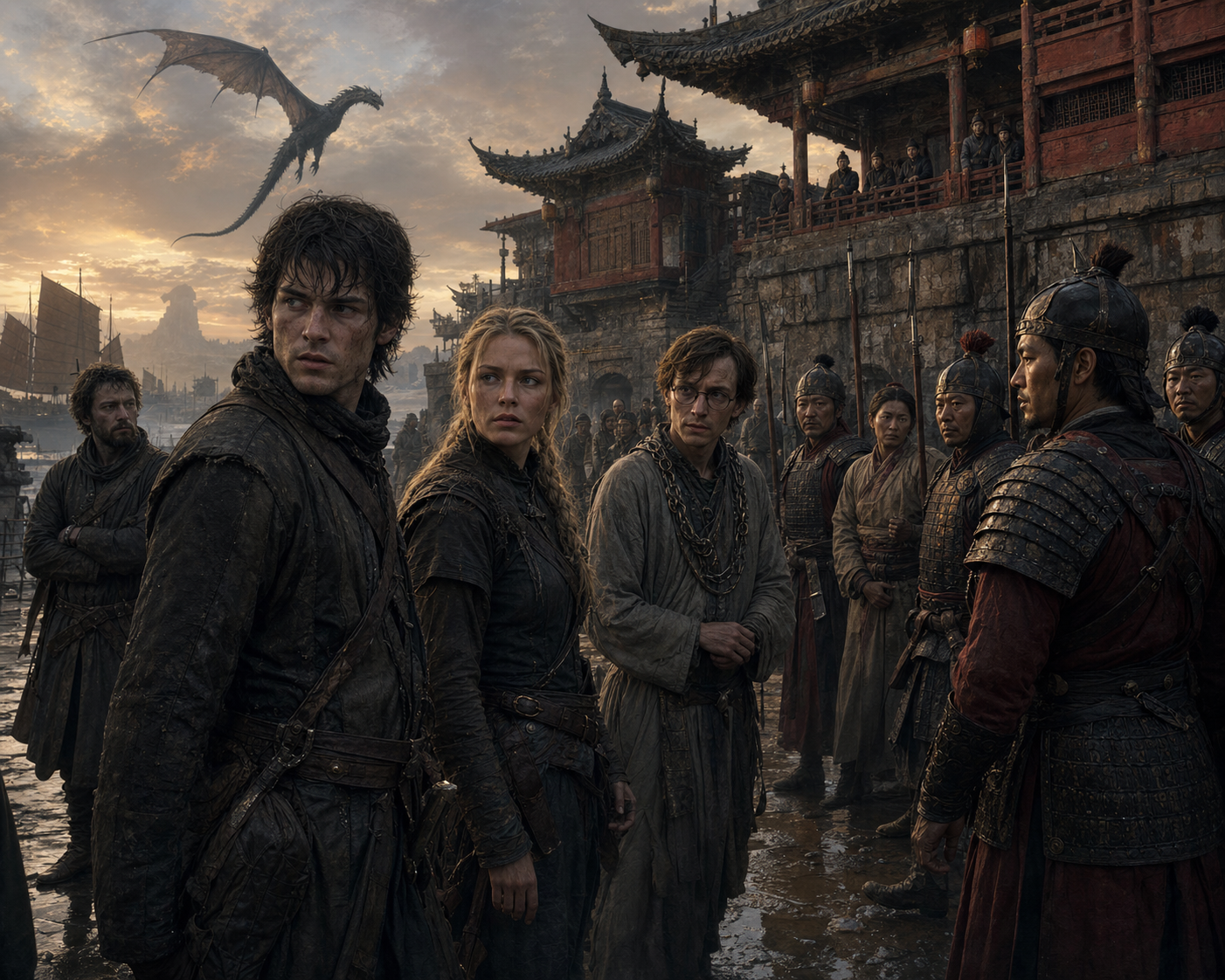
The city walls rose as the sun broke.
They were not beautiful.
They were practical in the way fear became practical when given stone. Dark foundations, pale upper courses, patched towers, wooden hoardings added where money had run out before ambition did. YiTish rooflines curved above them in places, bright paint faded by ash winds. Banners hung from the gatehouse: yellow cloth marked with a black rising sun split by a red line.
"Lo Feng's mark," Setzuko murmured.
Beyond the walls, smoke lifted in thin blue threads. Bells chimed from somewhere inside, high and uneven. The gate line smelled of animals, wet straw, garlic, sweat, old fish, and the sour steam of breakfast pots.
Home, Setzuko had called it.
Tom tried to see it that way.
Not as a target. Not as a map. Not as walls between him and the dragon.
As home.
A girl with a missing front tooth chased a chicken between cart wheels. An old woman slapped a man's hand away from a basket of pears. Two guards argued over a cup of tea while the line moved around them. A young mother sang under her breath to a baby tied against her chest.
Then Tom looked higher and saw archers along the wall.
Home, yes.
But not safe.
Setzuko passed the gate with her head bowed just enough to seem ordinary. The guard glanced at her, at the farmer, at Jory's mule, then waved them through with the impatience of a man already bored by his own authority.
They were inside.
The market swallowed them.
Noise rose on every side. YiTish, trade tongue, Ibbenese curses from a fur seller with a shaved head, Myrish bargaining, a little Valyrian from two merchants too proud of their vowels. Metal rang. Chickens screamed. Someone beat dough against a board. Someone else shouted the price of beans as if beans were a matter of kingship.
Setzuko did not slow.
One by one, under cover of carts and bodies and morning trade, Tom's people broke away from the farmer's line.
Through the dyers' lane.
Setzuko had not lied.
It smelled terrible.
Vats steamed in open sheds, staining the air with bitter indigo, sour red, boiled urine, ash lye, and wet wool. Workers stood elbow-deep in color, faces wrapped in cloth. No guard lingered there longer than duty demanded. Tom's eyes watered. Boro whispered that he had fought corpses with kinder manners.
The old canal road lay beyond, lower than the streets, its stones slick despite the lack of water. They moved quickly there, half crouched beneath hanging laundry and sagging balconies. Once, a boy looked down from a window and saw them. Setzuko lifted two fingers. The boy's eyes widened, then vanished.
"Will he call guards?" Jory asked.
"No."
"You know him?"
"I know his mother."
That was all she said.
The postern stood where she promised, tucked behind stacked firewood and a shrine to a painted household god with chipped gold eyes. The lock was bad. Setzuko opened it with a strip of bent metal and a patience Tom envied.
Inside lay a narrow service passage between walls.
Then a stair.
Then a door.
Beyond it, the inner courtyard opened beneath the hard morning light.
The dragon was there.
Tom forgot to breathe.
The cage stood at the far end of the court, built from black steel bars thicker than a man's wrist. Chains ran through rings sunk into stone. The dragon crouched within them, smaller than the beasts of old songs but large enough that the cage seemed suddenly cruel by existing. Its scales were black at first glance, but the light found crimson beneath them, a red sheen moving through the dark like banked coals under ash. Along the neck and spine, jagged horns and ridges rose in soot-black points tipped with dull fire. The torn wing membrane was red-black and veined like heated iron cooling in rain. One wing hung wrong, the membrane patched with dried blood where hooks or nets had torn it. Its head lifted as the door opened.
Its eyes were red.
Not soft.
Not grateful.
Alive.
The sound it made was low enough to enter the bones.
"Gods," Jory whispered.
"No," Tom said without thinking. "Not gods."
The dragon's gaze fixed on him.
For one impossible heartbeat, the courtyard, the guards, the cage, the city, all of it thinned. Tom felt heat without flame. Hunger without weakness. Pain like a wing folded wrong. Rage, old and immediate, pressed against iron.
Then a shout snapped the world back into place.
One of the Tears riders had pushed through the door behind him.
Hareth.
Too pale.
Too Valyrian.
A guard near the barracks saw his face, saw the silver-gold hair beneath the farmer's hood, and reached the only conclusion frightened men with horns ever needed.
"Spies!"
The horn sounded.
The courtyard exploded.
Tom drew his sword before the first guard finished turning.
The service door became a killing place. Jory took the left with shield and blade, driving the first spear wide. Mera slipped beneath another thrust and opened the man's thigh. Boro roared something that did not need translation and smashed a guard backward into two others. Serra's bow sang once, twice, and men near the cage dropped before they could loose crossbows.
"Forward!" Tom shouted.
They had no room for caution.
No time for clean plans.
They drove into the courtyard like a wedge through rotten wood.
The guards outnumbered them more than two to one. Mayhaps worse. Men came from the barracks, from the stairs, from the shaded walkway beneath the keep. Some wore quilted coats. Some wore lacquered plates. Some carried spears with red tassels beneath the blades. They were not cowards. That made everything harder.
Tom cut the first man across the forearm, kicked him aside, and turned the next spear with his guard. A sword flashed toward his ribs. He pivoted too slowly, felt steel bite shallow through leather, and answered with a cut that took the man beneath the chin.
No magic moved him.
No strange certainty guided his hand.
Only training. Pain. Breath. Fear. Skill earned by bruises and blood and men shouting again until exhaustion became memory.
That would have to be enough.
Setzuko fought like a knife thrown by thought. She was never where a blade expected her. She cut wrists, hamstrings, throats when she had to, and vanished behind larger bodies before anyone could punish the wound. Jory stayed close to Tom's right, steady as stone. Boro made space by refusing to believe men with spears had any right to occupy it.
They reached the center of the court.
Then the keep doors opened.
Lo Han descended the steps in armor of dark lacquer and brass, his long hair tied beneath a helm shaped like a snarling dog. He was broad, not fat, with a square face and a short black beard bound in two cords. Beside him came Lo Buto, leaner, younger, wearing ringmail under a yellow silk coat and carrying twin curved swords.
Behind them marched their elite guard.
Ten men.
No.
Twelve.
Each armored better than the rest, each carrying polearms with hooked blades meant for pulling riders down or dragging men apart.
Lo Han looked over the courtyard and found Setzuko.
His face hardened.
He said something in YiTish.
Setzuko answered.
Whatever she said made Lo Buto smile.
"What?" Tom asked.
"He called me a faithless daughter," Setzuko said.
"And you?"
"I corrected his memory."
The elite guard charged.
Tom met them halfway.
The first came with a hooked blade sweeping low. Tom stepped inside it, took the haft on his forearm, felt pain crack up to his shoulder, and drove his sword into the gap beneath the man's arm. He ripped free and ducked as the second blade passed where his head had been. Jory caught that man shield-first. Tom finished him with a thrust through the throat guard.
Third.
Fourth.
They were good.
Too good for haste.
But they expected a tired northern youth with wounds and anger.
They found something sharper.
Tom let the fifth man come too far, retreated two steps as if forced, then turned on the third. Ser Kemal's lessons lived in his feet. Vorys's arena lived in his timing. The Red Wedding lived in the part of him that no longer believed fair fights existed. He cut one man's hand from the haft, rammed his shoulder into another, and opened the fifth across the belly before the guard knew the pattern had broken.
When the fifth elite fell, the courtyard stilled by degrees.
Not silence.
Never silence.
Men gasped. Someone sobbed through broken teeth. The dragon rumbled behind the bars. A horn still called from some tower, unanswered now by men uncertain whether to enter the court or flee it.
But the circle around Tom widened.
Lo Han stared at the bodies between them.
Lo Buto's smile had vanished.
Tom pointed his sword at them.
"Move."
Setzuko translated.
Lo Han spat back a reply.
"He says the dragon is his by right of purchase," Setzuko said.
"Tell him I do not care."
She did.
Lo Buto laughed once and stepped down from the last stair, both swords turning in his hands.
Lo Han drew a heavy saber.
"They will fight together," Setzuko warned.
"Good."
Jory moved beside him.
Tom held out his free hand.
"No."
"Tom."
"If everyone moves, the guards move. Hold them."
Jory's jaw worked. He hated it. Tom knew he hated it because Tom would have hated it in his place.
Then Jory nodded once and turned his shield toward the watching men.
Lo Han attacked first.
He was stronger than Tom expected.
The saber crashed down, and Tom barely caught it on the upper third of his blade. The force jarred through his wrists. Lo Buto came from the right at the same instant, twin swords flashing high and low. Tom twisted away from one and took the other on his crossguard, retreating because he had to.
Two blades were difficult.
Three were ugly.
Lo Han drove him with power. Lo Buto cut off the escape, quick and clever and cruel at the edges. They had fought together before. Brothers by marriage and blood, mayhaps, but more importantly by practice. Lo Han forced the answer. Lo Buto punished it.
Tom gave ground.
The cage came closer behind him.
Heat washed over his back as the dragon growled.
Lo Buto smiled again.
Tom stumbled.
It was not entirely false.
Lo Han saw weakness and struck with both hands.
Tom dropped under the cut instead of meeting it. His knee hit stone. Lo Buto lunged for his exposed side, but Tom caught the younger man's wrist with his off hand and pulled him across Lo Han's path. The saber that would have split Tom's shoulder tore through Lo Buto's silk coat and rang against mail.
Lo Buto screamed, more anger than pain.
Tom rose into him.
His pommel broke Lo Buto's nose. His blade turned once, short and brutal, and opened the younger man's throat beneath the jaw.
Lo Buto fell choking.
Lo Han roared.
There was grief in it.
That almost made Tom sorry.
Almost.
Lo Han came like a man who had forgotten the courtyard, the dragon, the city, the cost of everything but the body at his feet. His saber struck sparks from Tom's guard. Once. Twice. A third blow numbed Tom's arm to the elbow. Tom retreated, caught the next strike at an angle, let it slide, and stepped close enough that the saber's length became a burden.
Lo Han tried to grapple.
Tom headbutted him.
Pain burst white behind his own eyes.
Lo Han staggered.
Tom drove his sword up beneath the lacquered breastplate, through the soft place armor always pretended did not exist.
Lo Han gripped Tom's shoulder as he died.
For a heartbeat they stood almost embraced.
Then the exile lord slid away and struck the stones beside his brother.
No one moved.
Setzuko stared at the bodies with an expression Tom could not read.
The dragon snarled.
That broke the spell.
Tom turned.
"Boro."
Boro was already coming.
"Axe."
The big man tossed it haft-first.
Tom caught it badly, nearly dropped it, then shifted his grip and ran to the cage. The dragon backed away as far as the chains allowed, wings half spreading in broken threat.
"Easy," Tom said.
The dragon hissed smoke.
"Aye. Fair."
The lock was enormous, iron over steel, more symbol than cleverness. Tom raised the axe and brought it down.
The first blow rang through the courtyard.
The second split something inside the lock.
The third broke it open.
The chain fell.
Tom stepped back fast.
"Move!" Jory shouted.
Everyone did.
The dragon struck the cage door with its shoulder.
Steel screamed.
For one terrible moment, Tom thought the wounded wing would not open. Then the dragon forced itself through the gap, claws tearing sparks from stone. Its head swung left, right, red eyes blazing at the men who had caged it.
No one dared lift a spear.
The dragon looked at Tom.
He lowered the axe.
"Go," he said.
Mayhaps it heard.
Mayhaps it heard only the open sky.
It leapt.
The first wingbeat was ragged and wrong. The second nearly struck the courtyard wall. The third found air. Men cried out and threw themselves flat as the dragon rose over the keep roof, trailing a thin ribbon of blood from the torn membrane. It banked badly, recovered, and vanished beyond the northern ridge.
Tom watched until the sky held nothing but sun.
For a moment, that was enough.
Then the warning horns began.
Not the inner alarm.
Not the sharp call of guards chasing spies.
This was deeper. Longer. Taken up from tower to tower until the city itself seemed to moan.
Setzuko turned toward the south gate, all color gone from her face.
"No."
Jory looked from her to the walls. "What is it?"
A second horn answered beyond the city.
Then a third.
From outside.
Men began shouting in the streets. Bells clanged. Somewhere, a woman screamed a child's name.
Setzuko ran.
Tom followed.
His people followed him because by then there was no other direction left.
They burst from the inner courtyard into the canal road, then through dyers' smoke and market panic. Stalls overturned. Farmers abandoned carts. Guards shoved through crowds toward the main gate, some without helms, some still bloody from the courtyard. No one stopped Tom's company now. The city had found a larger terror.
They reached the southern wall as the first stones struck it.
Not from catapults.
Thrown by hand.
Huge men stood beyond bowshot, broad as doors, wrapped in hides and ringmail, with round shields painted in black and white marks. More poured from the road behind them. Axes. Spears. Hooked clubs. Short bows. Ibbenese war horns made from horn and metal and bone, their notes harsh enough to set teeth on edge.
There were hundreds.
Mayhaps more.
The gate shuddered as something heavy struck from outside.
Setzuko climbed the stair two at a time and reached the wall walk.
Tom came beside her.
Below, the Ibbenese host spread before the city like a dark tide.
One of them lifted a banner showing a crude painted dragon with a red line through its throat.
Setzuko's hands closed around the parapet.
"They heard," she said.
"About the dragon."
"They would never allow Lo Feng to keep one this close. They feared us before. With a dragon, they would call us conquerors before we learned how to fly."
Boro reached the wall behind them, breathing hard but smiling without joy.
"Well," he said, looking over the army gathering below. "We solved the dragon part."
Another impact shook the gate.
In the streets beneath, the good and honest people of the exile city ran with baskets in their hands, children in their arms, terror in their throats, while their lords lay dead behind Tom and the army outside came to punish them for a threat already flown.
Tom looked at Setzuko.
Then at Jory.
Then at the gate.
The horns sounded again.
This time, every man on the wall understood what they meant.
The Ibbenese were attacking.
Previous Chapter | Chapter List | Next Chapter
Disclaimer: Frostfyre is a non-commercial fan fiction project inspired by a Realm of Thrones campaign for Mount & Blade II: Bannerlord and set in the world of A Song of Ice and Fire. All rights to those original settings and characters remain with their respective owners.
Join the Forge
Receive new Frostfyre chapters and Aodh Forge updates as they are released.