Redemption of the Dragon
Act 2 – Prophesy or Conspiracy · Chapter 20: Reluctant Command
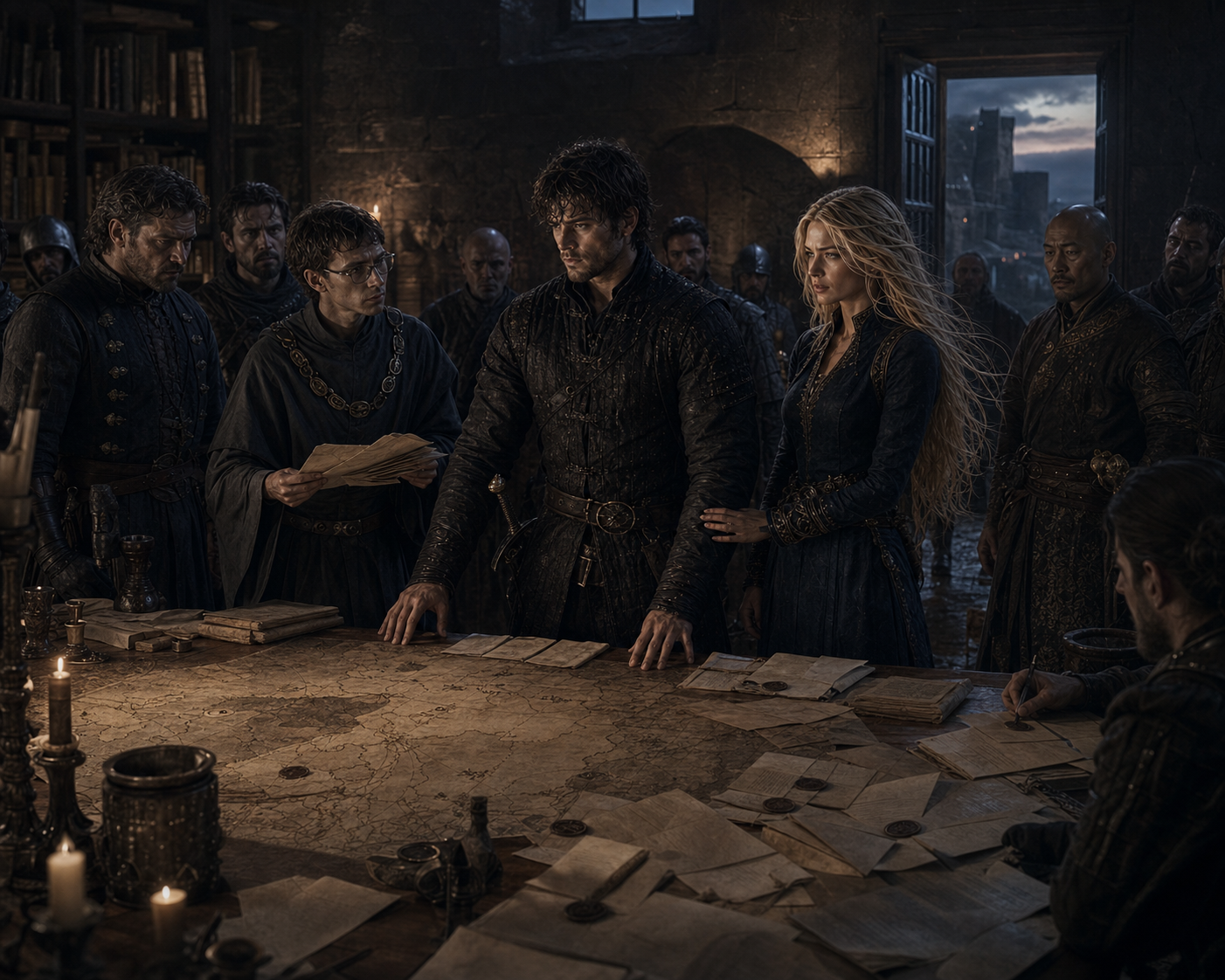
The war room was full before Tom arrived.
That was not comforting.
It meant either everyone had learned discipline in his absence or everyone had been too worried to sleep. Looking at their faces, Tom suspected the latter had carried most of the weight.
Cleyton stood near the map table with three stacks of letters arranged before him. Ser Kemal waited by the eastern wall, arms folded, expression carved from the same hard stone as the castle. Jory leaned near the hearth with a cup of something hot in both hands. He looked tired enough to fall asleep standing and stubborn enough to resent anyone noticing. Two clerks Tom did not know stood by the shelves with ink and copies ready. A guard waited outside the door.
Vissenya entered beside Tom.
That changed the room more than Frostfyre did.
At least, it changed Tom more.
She wore dark blue this morning, her platinum hair bound back in a loose braid that fell over one shoulder. She moved carefully enough that he knew the night had not healed her wounds by miracle, but there was color in her face and steadiness in her eyes. When she brushed her fingers against his wrist before letting him step ahead of her, it was small enough that no one else needed to notice.
Tom noticed.
Cleyton noticed Frostfyre.
The former maester's face lit with such unguarded satisfaction that Tom nearly smiled despite the hour. The sword hung at Tom's hip from a newly fitted belt, pale blade hidden in a dark scabbard that Ormund Sand had apparently made with the same irritated excellence he brought to metal. The dragon-wing hilt rested just below Tom's hand.
Cleyton's eyes flicked to it.
Then back to Tom.
Then down again.
"You look pleased," Tom said.
"I am enjoying rare evidence that my judgment was correct."
"Rare?" Jory asked.
"I am surrounded by exhausting people."
Vissenya moved to the table. "Before Cleyton becomes sentimental, may we begin?"
"I am never sentimental."
Kemal said, "Begin."
Tom took his place at the head of the table because no one else moved to stop him.
That still felt strange.
He put one hand on the carved edge and looked at the maps. Mantarys and Tolos remained marked with black pins. Elyria had three blue threads running from it toward the bay. Ifequevron bore a white marker and four small black stones north of it, one for each Ibbenese clan chief now tied, however uneasily, to Tom's word.
"The council," Tom said. "I want names and cities. All of them."
Cleyton seemed almost relieved to have something orderly to provide.
"The Tears council was never meant to sit like a king's council," he said. "It is a web. Each councilor keeps influence in a city or region and answers to the others when necessary. Baelys made that arrangement seem stronger than it was because he enjoyed being central to every thread."
"Names," Tom said.
Cleyton nodded.
"Vissenya Rosedragon, Volantis."
Vissenya inclined her head with faint mockery.
"Aemon Vezos, Elyria and the western holdings."
"Baelys," Tom said.
"Formerly over Slaver's Bay," Cleyton said. "Meereen, Yunkai, Astapor, and the lesser markets tied to them. Whatever remains of his network is uncertain."
"Then the others."
Cleyton drew a page from the first stack.
"Maelyra Otherys of Lys. Old blood, though not as old as she claims at dinner. Useful ships, better spies."
He moved to the next line.
"Rogoro Nestoris of Myr. A scholar of lenses, gears, and quiet poisonings, though he will deny the last two unless complimented first."
Tom looked up.
"Nestoris?"
"Not to be confused with anyone important enough to matter," Cleyton said.
Jory murmured, "That sounds like a man who has confused himself with everyone important enough to matter."
"An old guild family," Cleyton said. "Next, Ezzara Qhaedar of Qarth. Wealthy, ceremonious, and more useful when written to in flattery so thick it becomes structural."
Vissenya's mouth moved. "That is generous."
"I was being kind."
Cleyton continued.
"Nerio Sareth of Tyrosh. Practical. Loud. Fond of dyes, bribes, and pretending both are culture. Arono Terys of Pentos. More banker than lord, more lord than patriot. Vaquo Zalyne of Qohor. Severe, secretive, and tied to smiths, sorcerers, and woodsmen in ways he only admits when cornered."
"That sounds promising," Tom said.
"Or dangerous."
"Same problem wearing different boots."
Cleyton accepted that with a tilt of the head.
"Haryz Doniphos of Norvos. Religious in public, pragmatic in private, and very careful about which bells he hears. Denyo Prestayn of Braavos. Younger than most, sharper than nearly all, and currently the reason we have agents in Omber."
Tom let the names settle.
Lys.
Myr.
Qarth.
Tyrosh.
Pentos.
Qohor.
Norvos.
Braavos.
Volantis.
Elyria.
Slaver's Bay.
A web indeed.
And webs burned quickly if men lit the right corners.
"Who answered?" Tom asked.
"Volantis, obviously," Cleyton said. "Elyria through Aemon. Lys, Qarth, Tyrosh, Pentos, and Braavos. Slaver's Bay is in chaos thanks to Baelys's betrayal. The responses we do have from his former region are fragments from lower agents, not council authority."
"Who has not answered?"
Cleyton tapped three names.
"Myr, Qohor, and Norvos."
Kemal's eyes narrowed.
"Those three matter."
"All cities matter," Cleyton said.
"Some matter with sharper knives."
"Agreed."
Tom looked at the map.
Myr was behind them and still too close to old wounds. Qohor sat with its dark trees, old smiths, and stranger whispers. Norvos held bells, priests, and roads that could feed armies or starve them. Silence from any one of them might mean delay. Silence from all three felt like intention.
Or fear.
Fear and intention were often kin.
"The cities that answered?" Tom asked.
"Rising tensions," Vissenya said. "Everywhere. Prices climbing. Merchants hiding stores. Priests naming omens. Sailors carrying useful rumors faster than goods. No boiling point yet."
"Yet," Jory said.
"Yet," she agreed.
Tom rubbed at the carved edge of the table with his thumb.
"Keep trying to reach Myr, Qohor, and Norvos. Send again. Use different routes. Different hands. If they are silent because ravens are watched, find messengers who do not fly."
Cleyton made a note.
"But Mantarys and Tolos are immediate," Tom said. "We cannot wait for every councilor to decide whether starving peasants are worth their ink."
No one objected.
That was not a good sign.
It meant they had already reached the same conclusion and disliked it.
"Tell me about the cities," Tom said. "Not the short version."
Cleyton slid two marked papers forward.
"Mantarys first, then. An old Valyrian daughter city, if one believes its own records. A nightmare, if one believes travelers. Both, if one has sense. It survived the Doom poorly. The ruling families claim old descent, though much of it is ash, mutation, marriage, and invention. The city is rich in certain metals, foul in reputation, and accustomed to being feared enough that it rarely asks whether it is hated."
"Military?"
Kemal answered. "Heavy infantry. Crossbowmen. Hired cavalry when needed. They do not like fighting far from walls. They do like making examples."
Cleyton nodded. "The smallfolk outside Mantarys are tied to estates, mines, and grain levies. Not slaves in the formal market sense, not free in any honest one. Hoarding grain there will kill villages before the city misses a feast."
Tom's jaw tightened.
"Tolos?"
"Older than its pride and younger than its ruins," Cleyton said. "A fortified city with strong walls, strong harbor works, and stronger opinions of itself. It has more trade than Mantarys, more sailors, and more competing factions. Its ruling houses fear slave unrest, foreign meddling, Targaryen rumors, Volantene ambitions, and one another in roughly that order depending on breakfast."
Vissenya leaned over the map and touched the road between Volantis and Tolos.
"Tolos is also more vulnerable to pressure from Volantis," she said. "Not control. Pressure. There are families there who trade with mine. Debts, marriages, favors, rivals. If my people arrive fast enough, we may force a negotiation before the first granary burns or the first crowd is cut down."
"May," Kemal said.
"May is better than waiting."
Tom looked at the two black pins.
Two cities.
Two fires before they became wild.
"Kemal," he said. "Oros. The garrison. The Ghiscari. The sellswords. Speak plainly."
Kemal gave him a look that suggested he had never intended to speak otherwise.
"Oros is nearly finished. Not beautiful. Strong. The broken wall sections are rebuilt. The gate has new iron bracing. The lower postern is sealed unless opened from inside. The north tower still needs work, but it will stand. Stores are good. Grain, salt fish, dried beans, hard cheese, oil, arrows, quarrels, pitch. Six months at current occupancy. Longer if rationing becomes strict."
"Water?"
"Cisterns full. Two wells cleared. One lower spring is sulfurous but usable for animals if desperate."
"Garrison?"
"Better than it was. The old Tears men are steady. The freed garrison men know the walls. The Ghiscari have blended in well."
Tom looked up.
"You believe that?"
"I believe what I see. They obey. They drill. They hold watches without complaint. Some have begun correcting sellswords for sloppy work, which shows either loyalty or arrogance. Both can be useful."
"Trust?"
"Growing. Not complete."
"Sellswords?"
Kemal did not hesitate.
"I do not trust them."
Boro was not in the room to defend the profession this time.
No one else tried.
"They obey while fed, watched, and convinced we are the winning side," Kemal said. "Some may become more. Some will not. I would not leave them holding a gate behind me unless I controlled the gate behind them."
Tom nodded slowly.
"Would half the garrison hold Oros while I am gone?"
Vissenya's eyes moved to him.
Cleyton stopped writing.
Kemal's expression did not change, but the room did.
"Yes," Kemal said at last. "Against raiders, sellsail landings, a desperate force from one city, or red zealots without siege engines. If a full country comes against us, no. Against any individual city acting quickly and alone, yes. Half can hold Oros."
"Good."
"That was not permission."
"I did not ask permission."
Jory shut his eyes briefly.
Tom turned to Vissenya.
"Your people in Volantis. How long to gather, prepare, and march to Tolos?"
She studied him, and for a moment he saw the woman from the night before vanish behind the councilor of Volantis.
"A raven reaches them in a day if the wind does not spite us. Another day to gather the right people, issue orders, and prepare a force that can move fast without looking like a mob. Five days to Tolos if they march hard and partly through the night."
"Seven days total."
"If everything obeys the map, yes."
"Tolos from Oros?"
"Five days," Kemal said. "Hard march. Less if you kill the weak. More if you intend to arrive with men still able to fight."
"Mantarys?"
"Closer to us than Volantis," Cleyton said. "Not easier."
Tom looked at both pins again.
There were moments when a decision felt like choosing.
This one felt like recognizing where the road already led.
"Kemal," Tom said. "Vissenya. Prepare half the garrison to leave in two days. They march for Tolos and meet the Volantene force on the road. Kemal remains here with the other half and holds Oros."
Vissenya's face sharpened.
"And you?"
"I take the Ghiscari, the sellswords, and my pit fighters to Mantarys."
The room erupted.
Not loudly at first.
Worse.
All at once.
"No," Vissenya said.
"Absolutely not," Cleyton snapped.
Kemal spoke over both of them. "That is folly."
Jory set down his cup with great care, which meant he was angrier than if he had thrown it.
"You just heard Kemal say he does not trust the sellswords," Cleyton said.
"And you want Vissenya to march without you?" Jory asked.
"With half the garrison," Tom said.
"Against Tolos," Vissenya said.
"To prevent Tolos."
"Do not word-play with me."
Kemal stepped closer to the table. "Mantarys is not a training yard where you test unreliable men. If the Ghiscari remember old masters or the sellswords smell better coin, you will be inside enemy reach with knives at your back."
"And if we wait?" Tom asked.
"We do not wait," Kemal said. "We confer. We send to Aemon. We gather better numbers."
"From where?" Tom asked.
"Elyria. Volantis. The council."
"Elyria is not yours to strip."
"Aemon can decide what he can spare."
"Aemon needs to secure Elyria."
"You do not know what he needs better than he does."
"I know what happens if Elyria slips."
Voices rose again.
Cleyton argued routes. Vissenya argued timing. Kemal argued command. Jory argued loyalty, which was another way of arguing that Tom had become too comfortable walking toward death and expecting others to keep pace.
Tom listened for two breaths.
Three.
Then he slammed his fist into the table.
The sound cracked through the room.
The clerks flinched.
Even Kemal stopped.
Tom's hand hurt.
Good.
He leaned over the map, breathing hard through his nose.
"I do not like this."
No one spoke.
"Do you think I want Vissenya facing enemies without me? Do you think I want to march with men I cannot fully trust? Do you think I enjoy looking at two cities and deciding which risk gets which lives?"
His voice had not risen.
That made it worse.
"The longer we take to act, the more smallfolk die. The more slaves die. Granaries close. Villages starve. Men with guards decide hunger is cheaper than mercy. If we go to Mantarys first and then Tolos, Tolos burns. If we go to Tolos first and then Mantarys, Mantarys starves. We do not have time to make this comfortable."
Cleyton's jaw worked.
"You cannot fully trust the Ghiscari," he said. "You can trust the sellswords even less."
"I know."
"Then why take them?"
"Because that is why they go with me instead of Vissenya."
Vissenya's eyes flashed.
"Do not make me safer by making yourself disposable."
"I am not disposable."
"You are behaving as if you are."
The words landed harder than he expected.
Tom looked at her.
For a moment, the room fell away, and it was only the two of them again, the night before tangled in the morning's war.
Then Kemal spoke.
"This is madness. We need to confer with Aemon."
Tom stood.
The chair scraped back so sharply that everyone froze.
He had not meant to move that fast.
Frostfyre's hilt shifted at his hip, pale metal catching a line of light.
"Aemon needs to secure Elyria," Tom said. "Without it, we lose a key position near Slaver's Bay and every road tied to it. He has his task. Setzuko has hers. Kemal has his. Vissenya has hers. I have mine."
"You do not command the council," Cleyton said, but the protest sounded thinner than he likely intended.
"No," Tom said. "I command myself. And I know this: arguing about it for three days, sending ravens to men who may or may not answer, asking permission from cities already weighing which side profits them most, none of that changes the facts. It only costs lives."
He looked around the room.
"Follow my orders or do not. I will not force any person here to march. But you cannot stop me from doing my part."
His hand rested near Frostfyre without quite touching it.
"I will save the smallfolk or die trying."
The silence after that was not agreement.
It was fear wearing many faces.
Vissenya stepped closer.
Her voice was gentle, which made it harder to meet.
"Others are with you who would die too."
Tom closed his eyes once.
When he opened them, he looked around the room.
"Who among us does not fully understand and accept that risk?"
No one answered.
Jory's mouth tightened.
Cleyton looked away first.
Kemal's arms remained folded, but his anger had shifted into calculation.
Vissenya did not look away at all.
Tom nodded.
"The die is cast. I leave at dawn. Vissenya leaves the dawn after that."
"Tom–"
"Tomorrow we can argue about supply, routes, signals, and what happens if one of us fails. We are not arguing about whether we act."
He pushed away from the table.
"I need to see the castle."
No one stopped him.
Oros looked different when inspected with leaving in mind.
Walls were no longer walls.
They were promises a man made to people who would be inside them when he was gone.
Tom walked the curtain first, with Kemal at his side for the first half and then, after a few terse exchanges about mortar and watch rotations, alone. New stone sat pale against old black Valyrian work. The repairs were strong, if ugly. He liked that. Beauty had its place, but no man in a siege blessed a pretty wall for failing gracefully.
The gates had been reinforced with iron bands and fresh timbers. Murder holes cleared. Side passages blocked or trapped. The portcullis chain ran smoothly after three pulls, though the man operating it looked as if he would rather fight a dragon than demonstrate it again under Tom's stare.
He walked the barracks.
The old Tears men rose when he entered.
So did the Ghiscari.
That interested him more.
Some stood too stiffly. Some watched him with soldier's calculation. One of the older Ghiscari, the scarred-eye veteran Kemal had struck during drills, thumped his fist to his chest in a salute that was not Ghiscari and not Westerosi but something Oros had invented while Tom was gone.
Tom returned it awkwardly.
The man smiled with half his mouth.
The sellswords watched differently.
Not badly.
Not yet.
But their eyes went to Frostfyre. To the tattoo. To the men near him. To the exits. Men who had spent their lives surviving by reading rooms did not stop because someone fed them under a new banner.
Tom did not blame them.
He simply did not trust them.
He found Boro in the yard teaching two younger fighters how to survive a spear without insulting the spear's mother.
"You are leaving at dawn," Boro said before Tom spoke.
"Aye."
"Mantarys?"
"Aye."
Boro nodded. "Good enough. I hate resting."
"No one told you."
"Mera did."
Tom looked across the yard.
Mera, sitting on a low wall and cleaning her inferior Dothraki knife, lifted two fingers without looking up.
"Of course she did," Tom said.
He inspected stores next. Grain bins. Salted meat. Water. Pitch. Arrow shafts. Spare bowstrings. Medical stores that made him think of Cleyton swearing over wounds by lamplight. Everything had a number. Every number became a day. Every day became a life if measured harshly enough.
By afternoon, he descended.
The tunnels beneath Oros had changed too.
Rubble had been cleared from the lower stairs. Wooden braces held two cracked passages. Iron lantern hooks had been set into walls that sweated mineral water and heat. The air grew warmer with every turn downward, old stone breathing from somewhere deep beneath the castle.
No one followed him.
He had not asked them to.
Mayhaps someone should have refused the silence on his behalf, but no one did.
The dragon caves lay far below.
He knew them first by heat.
Then by smell.
Sulfur. Salt. Hot stone. Ash. And beneath it, faint but unmistakable, the lingering scent of beasts too old in the blood of the world to be mistaken for anything else.
Dragon.
No dragons were there.
Only the caves.
They opened beneath Oros in great uneven chambers, black rock glittering where moisture caught lantern light. Heat vents glowed faintly in narrow cracks. Old claw marks scored the stone in places. Bones lay gathered in a corner, some animal, some too large and old to name quickly. Empty nests of dark sand and broken stone marked where creatures had slept, warmed, hidden, or healed before men decided every living thing needed a master.
Tom sat on a flat shelf of rock above the nearest empty nest.
For a long while, he listened to the mountain breathe.
He thought of Ifequevron.
Not the battle.
Not the kneeling.
The dragon.
Black and crimson, wounded and furious, rising above a city that had tried to turn it into fear. Wings ragged but still vast. Red-black membrane catching sun. The heavy landing between Tom and the Ibbenese. The snarl that had turned war into silence.
Cleyton had named it Draeghar.
"A fitting name for a creature that refused every chain," he had said when Tom described it, then immediately begun muttering about etymology, dragon names, and whether giving names to wild things was the first step toward arrogance.
Draeghar.
Tom saw it again in memory, lifting into the sky above Ifequevron, hurt but free.
The memory should have filled him with worry. The dragon was loose. Men would hunt it. Others would worship it. Some would claim it as a sign, weapon, omen, or rightful prize. Tom himself had no idea whether he would ever see it again.
Instead, the memory gave him comfort.
Strange comfort.
Not gentle.
Not safe.
But real.
The dragon had been caged, wounded, bought, feared, and used. Then freed. It had returned once, not to obey, but to choose. After that, it had left because freedom meant the right to leave.
Mayhaps that was all Tom could do.
Not rule every road.
Not heal every wound.
Not become a god, king, prophecy, or answer.
Break cages where he found them.
Stand between teeth and smallfolk where he could.
Leave living things freer than he found them.
He looked down at Frostfyre, pale in the lantern light.
"No gods," he said quietly.
The caves gave the words back in a whisper.
No gods.
He rose with a steadier heart than he had carried down.
By the time Tom returned to his chamber, dusk had settled over Oros.
Vissenya was already waiting.
Of course she was.
She stood near the window, arms folded, looking out over the yard where men prepared for the orders she hated. Her hair was unbound. The last light made it silver at the edges. She did not turn when he entered.
"You are leaving at dawn," she said.
"Aye."
"I leave the dawn after."
"Aye."
"We are not finished arguing."
"No."
She turned then.
There was anger in her face.
Fear too.
Love under both, which made them harder to bear.
"I understand why," she said. "That is the worst part. If this were only foolishness, I could hate it cleanly."
Tom closed the door behind him.
"I do not want to spend tonight angry."
"Neither do I."
For a moment, they stood with the whole room between them and the morning waiting just beyond it.
Then Vissenya crossed to him.
Not running.
Not slowly with dignity.
Simply coming because there was no more room left for distance.
Tom met her halfway.
The embrace was not gentle at first. It had too much fear in it. Her fingers dug into his back. His hand found her hair. They kissed with anger still between them and turned it into something warmer because anger, like grief, sometimes only needed somewhere else to go.
Later, they spoke.
Not of routes.
Not of Mantarys.
Not of Tolos.
They spoke of smaller things because small things could be held without cutting the hands. How badly Boro would complain by the third mile. Whether Cleyton would sleep at all. Whether Frostfyre made Tom walk differently, which Vissenya claimed it did and Tom denied without hope of winning. Whether the Ibbenese tattoo looked more like a dragon or an accusation.
"Both," she decided.
"That seems unfair."
"It is on your head. Fairness has fled."
He laughed softly.
She touched his face.
The laughter faded.
"Come back," she said.
There it was.
The thing neither of them could promise and both needed said.
Tom covered her hand.
"You too."
"That was not an answer."
"It is the only honest one."
She hated that.
He saw it.
He loved her for not pretending otherwise.
The night narrowed around them.
Oros kept watch beyond the walls. Men sharpened blades. Horses stamped in the stables. Ravens slept uneasily above letters that would fly at dawn. Somewhere deep below, the empty dragon caves held their heat and their old scents and their patient dark.
In Tom's chamber, there was only the breath between two people trying not to count how few hours remained.
They took comfort in each other because comfort was not cowardice.
Because the world would return at dawn whether they welcomed it or not.
Because love, like war, sometimes demanded courage before certainty.
And when the candles burned low and the castle quieted, Tom held Vissenya as if holding could become a road back to her.
Previous Chapter | Chapter List | Next Chapter
Disclaimer: Frostfyre is a non-commercial fan fiction project inspired by a Realm of Thrones campaign for Mount & Blade II: Bannerlord and set in the world of A Song of Ice and Fire. All rights to those original settings and characters remain with their respective owners.
Join the Forge
Receive new Frostfyre chapters and Aodh Forge updates as they are released.