Redemption of the Dragon
Act 1 – Survival · Chapter 5: March of the Greatjohn
The Greatjon moved before dawn.
Tom had thought a night's rest would make men harder to wake. It did not. Not when the wake-up came from Umber throats, Tallhart horns, and a voice like a tree splitting in winter.
"Up!" Greatjon Umber roared somewhere beyond the canvas. "Up, you pretty corpses! The lions will not wait while you comb your beards!"
Tor sat upright so quickly he struck his head against the tent pole.
"I was not combing," he muttered.
Jory was already awake.
Of course he was.
Tom pushed himself onto one elbow and waited for his ribs to remind him that rest was not healing, only a pause in the argument. The pain came sharp and familiar. He breathed through it while men stirred around him in the grey dark, groaning, cursing, reaching for boots and belts and weapons that were finally their own again.
Not all their own.
The swords and axes had been returned, but the Stark quartermaster had added to them with a sour face and an efficient hand. Spears with straight shafts. Shields that still smelled of fresh hide. Knives without rust. Two mail shirts with broken rings patched badly but patched all the same. A bow for Osric with a string that did not look ready to betray him.
Tom had been given a helm.
It sat beside his bedroll now, round, plain, dented once above the brow. He looked at it for a long moment.
"You mean to court it?" Tor asked.
"Mayhaps."
"Better than some women I have known. Less likely to talk."
"More likely to save his head," Jory said.
Tor pulled on a boot. "I said better."
Tom took the helm and stood.
Outside, the camp had become movement.
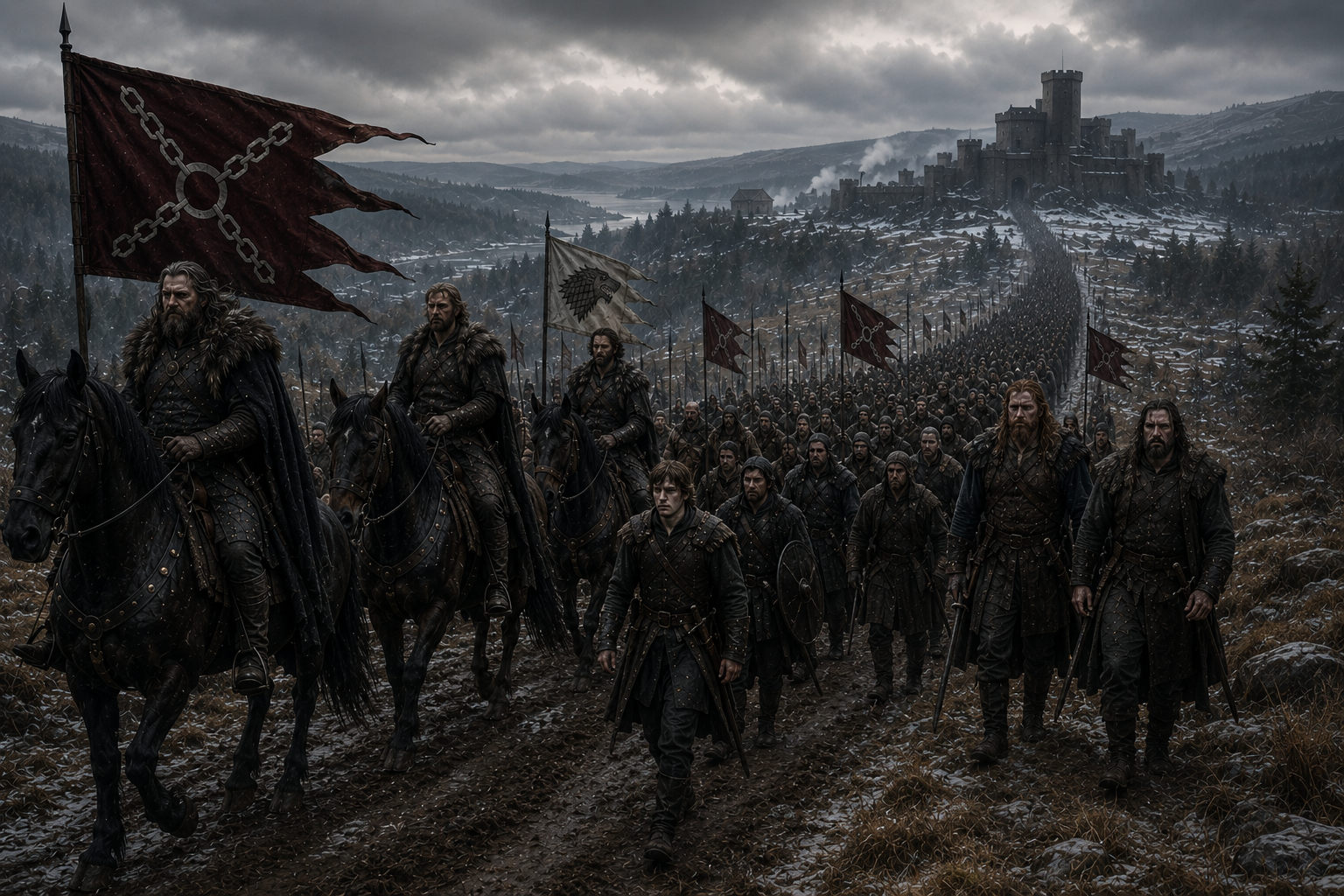
Men broke fasts with bread clenched in teeth while they rolled blankets. Horses stamped and snorted in the dark. Wagons creaked. Steel clicked and scraped. Cookfires were being smothered, their smoke crawling low across the ground like old ghosts reluctant to leave warmth behind. Above it all snapped the banners: direwolf, giant, Tallhart pine, smaller signs Tom did not know, all made dull and heavy by mist.
The Umber men were easy to find.
They were large where other men were merely grown. Not all, of course. There were lean Umbers and short Umbers and one bowlegged Umber with a beard finer than his face deserved, but even their small men seemed to take up more of the world than was polite. They laughed loudly, strapped mail loudly, complained loudly, and sharpened steel as if the whetstones had offended their mothers.
Tom's men watched them with the wary interest of dogs brought into a bear pit.
"They all that size north of Last Hearth?" Willam asked.
Ron gave him a look. "No. Not all."
Willam relaxed.
"Some are bigger," Ron finished.
Tor grinned. "I like them."
"You would," Jory said.
Harwyn Tallhart found them near the horse lines. He rode a dun gelding with one white sock and the long-suffering patience of a beast accustomed to soldiers. The captain looked no warmer in daylight than he had by candle, but he inclined his head to Tom all the same.
"Lord Umber wants you," Harwyn said.
Tom glanced at his men.
"You," Harwyn said. "The others form with the foot. Spears in the second rank if they can hold them. Shields forward. Any man who falls behind gets put on a cart if he is useful and left if he is not."
"That's kindly," Tor said.
Harwyn looked down at him. "I am a kindly man."
No one believed him.
Tom followed Harwyn through the waking army.
He had marched among men before. He had stood in ranks at the Green Fork with thousands around him, all sweat and fear and iron. This was different. Smaller, tighter, quicker. Robb Stark's host had been a river in flood. Greatjon Umber's column was an axe already raised.
There were perhaps four hundred men, though Tom was no good judge. Some rode ahead as outriders. Some guarded wagons. Most marched on foot in companies sorted by banner and by habit, not neatly enough to please a master-at-arms but neatly enough to kill. At their head waited the Greatjon on a horse black as wet stone and nearly large enough to make sense beneath him.
Three other mounted men waited with him.
Harwyn rode to the Greatjon's right. That, it seemed, made one.
The second was a young Umber with shoulders almost as broad as his lord's and a beard that was trying hard to become a threat. His helm hung from his saddle, and his hair stood in damp red-brown tangles. He smiled at Tom with open curiosity.
"Hother Umber," the Greatjon said, jabbing a thumb at him. "My sister's boy. He commands the left when he remembers which hand is which."
Hother slapped his own left gauntlet. "This one, uncle."
"Aye, today."
The third was a woman in a scale shirt and a dark green cloak pinned with a bear. She was not tall, but she sat her horse like height was a thing other people needed. Her hair had been braided tight against her head, and a narrow scar cut through one eyebrow without troubling her expression.
"Dacey Mormont," Greatjon said. "She has fifty spears and more sense than most men here, which is not difficult."
"My lord is generous with insults," Dacey said dryly.
The fourth was older, spare and long-faced, with a grey beard trimmed close and a helm shaped like an acorn. His horse was rangy, his cloak patched, his eyes sharp as frost.
"Maron Locke," said Greatjon. "He watches the rear and complains if anyone breathes too loudly."
"Only when they do it poorly," Locke said.
Greatjon leaned down toward Tom. Even mounted, he somehow made the distance feel smaller by force of will.
"And this is Tom," he said. "From Forrester mud, Green Fork bones, and wherever else the Stranger forgot to collect him. He leads the ragged dozen."
Tom bowed his head because it seemed safer than answering.
"Eleven, my lord," Harwyn said. "Twelve with him."
"Then he leads twelve, and we shall see if twelve is enough" Greatjon said. "Do not correct me before breakfast, Tallhart. It makes me want a second breakfast."
Hother looked Tom over. Not unkindly. Not gently either. "You have no horse?"
"No, milord."
"Can you ride?"
"I have stayed on a plow horse twice."
Hother considered that. "Did it mean to be ridden?"
"No."
"Then you can ride better than some."
Dacey Mormont's mouth twitched.
Greatjon barked a laugh. "He marches with the foot. Let him see what the men see. Let the men see him seeing it. If I need him, I will send a boy to drag him up."
Tom felt all four of them watching him. Mounted men. Commanders. People who could look over a field and see shapes where Tom saw mud and fear and men with names.
"You will come when called," Greatjon said.
"Aye, milord."
"You will speak plain."
"Aye."
"You will not turn shy because the rest of us have horses and prettier scars."
Tom thought of Gregor Clegane's blow and the pain under his bindings.
"I have no pretty scars, milord."
Greatjon grinned. "Good. Pretty scars are for southron knights and fools who do not duck."
"That explains Tor," Tom said before he could stop himself.
Harwyn's eyes flicked to him.
Hother laughed. Dacey did not, but the scar through her brow shifted.
Greatjon slapped one great hand against his thigh. "There, you see? Teeth."
The march began.
For the first few miles, Tom thought only of keeping pace.
The road bent south and west through fields cut empty by war. Some were black with old fire. Some had been trampled by hooves and wheels until no farmer would know where to put seed if spring ever came again. Streams crossed the track in cold brown threads. Men splashed through them without slowing, boots filling, curses rising.
Tom marched near the front of the foot, where Harwyn had placed his company. Not first. Not honored. Not hidden. Jory kept to his right, Tor to his left until a sergeant told him to stop drifting like a drunk goose. Willam limped behind them with Pate beside him. Ron carried the heaviest shield among them as if daring the road to complain. Donnel Hill marched at the outside of the file, where men could look at him if they wished and he could look back.
They did.
At first the looks were the old ones. Suspicion for mismatched armor. Curiosity for wounds. Dislike for Donnel's westerman face. Then the whispers began to catch up.
"Those the ones from the scouts?"
"Green Fork men."
"Heard they fought Clegane."
"No one fights the Mountain and walks."
"That big one did."
"Which big one? Half of them are big."
Tom pretended not to hear.
Tor did not.
"Did you hear?" he said. "I fought the Mountain."
"You did not," Jory said.
"Someone said I did."
"Someone is an idiot."
"Mayhaps. But he has a generous heart."
Donnel snorted. It was the closest thing to laughter Tom had heard from him since the Stark camp.
By midday, the tale had changed. Tom had struck Gregor Clegane in the helm and broken his axe. By late afternoon, he had knocked the Mountain to one knee. Before dusk, according to a Tallhart boy with ears too eager for his head, Tom had buried a spear in the Mountain's horse, cut his way through twenty lions, carried three wounded men on his back, and killed a Lannister captain with a thrown boot.
"A boot?" Tor said, delighted.
"No," Tom said.
"We should not deny it too quickly. A man who kills with boots is feared in all weather."
"No," Tom said again.
Jory looked at the Tallhart boy. "He hit Clegane once and was near killed for it. The rest is piss."
The boy blinked.
Tor sighed. "You murder joy wherever you find it."
"Saves time."
Yet the whispers did not turn cruel.
Men who had laughed at their rags in the morning made space by afternoon when Tom's company came near the water cart. A cook with an Umber badge gave Willam an extra heel of bread and pretended it had fallen. Two spearmen asked Osric about the night attack, and when Osric answered with five words instead of one, they listened as if he were a maester reading doom from a book.
Envy came with it too.
Tom saw that in the tight mouths, the sideways glances, the way some men looked at him when Harwyn's runner came before sunset and said Lord Umber wanted him at council.
Council.
The word sat strangely on Tom's shoulders.
"Go on, then," Tor said. "Try not to become a lord before supper."
"If I do, you are not invited indoors."
Tor placed a hand over his heart. "Cruelty from my own captain."
Tom stopped.
Tor's grin faded a little.
Captain.
The word had been a jest, mayhaps. Tor tossed words like knives and watched where they stuck. But Jory had heard it. So had Willam. So had Donnel, who looked away first.
Tom said nothing.
That seemed safest.
The first council took place beside a broken milestone where the road split around a stand of beech trees. Greatjon sat his horse at the center with Harwyn, Hother, Dacey, and Locke around him. Tom stood in the mud below them, helm under one arm, trying not to feel like a child brought among grown folk.
A scout had found old tracks along the southern fork. Wagons, perhaps. Horses. Too old for a fresh threat, too many to ignore.
"Could be smallfolk fleeing," Hother said.
"Could be lions pulling stores," Harwyn answered.
"Could be both, and likely is," Dacey said. "Lions make smallfolk pull whatever feeds lions."
Greatjon looked down at Tom. "You came through the roads east of here. What did the filth do when they had wagons?"
Tom thought of the broken wheel. The wall. The bandits at the inn. Men taking what could move and burning what could not.
"They stayed near forks," he said. "Near water. Places where fear brings folk to them."
Locke's eyes narrowed. "Ambush?"
"Mayhaps. Or a camp. If they had stores, they would not want to move them far."
Harwyn studied the fork. "We lose time searching."
"We lose more dearly if they come at our rear," Dacey said.
Greatjon grunted. "Mormont takes twenty and checks the southern track. Hother rides a mile north and makes certain no one thinks us blind. Tallhart keeps the foot moving. Locke, stop glaring at the trees and watch behind us."
"The trees deserve it," Locke said.
Greatjon grinned. "Aye, and they fear you."
The column split and reformed without fuss. Tom returned to the foot with mud on his boots and the odd feeling that some part of his opinion had remained behind among the mounted captains.
They made camp near dark in a meadow with a stream on one side and low earthworks from some older war on the other. No tents were raised for the foot beyond what could be put up quickly. Men ate in lines, sharpened steel, checked bowstrings, and slept where they could.
Tom had just settled with a bowl of barley thick enough to insult stew when a runner found him again.
"Lord Umber says bring your men."
Tor looked up at once. "All of us?"
"He said the ragged dozen."
"That's us," Tor said proudly.
Jory gave him a look.
"It is," Tor said. "We have been called worse by better men."
Greatjon's command tent was larger than the others and smelled better, though not by much. Inside, a brazier glowed red. A trestle table had been covered in bread, onions, roasted mutton, beans, cheese, and three jugs of ale. Maps occupied one end. Food held the rest by conquest.
The mounted leaders were already there. Harwyn Tallhart stood with a cup in hand. Hother Umber had grease in his beard. Dacey Mormont carved meat with a knife that looked sharp enough to settle arguments. Locke watched the entrance as if expecting betrayal from the tent flap.
Tom's men stopped just inside.
For a moment they looked like what they were: tired, muddy, hungry men suddenly unsure whether food laid before them was meant to be eaten or admired from a respectful distance.
Greatjon solved that.
"Sit, unless your knees have sworn vows," he said. "Eat, unless your bellies have died."
Tor moved first.
Of course he did.
But he did not take the best piece. Tom noticed that. Tor grabbed bread and beans and only then tore a strip of mutton, leaving the thickest cuts untouched until Willam and Pate had taken some. Ron placed himself where he could reach more food than any man should and then began passing it to others. Jory sat with his back near a tent pole, eyes on the entrance and hands free. Donnel hesitated until Dacey Mormont pointed at an empty bench with her knife.
"You too, Hill."
Donnel's jaw moved once. "My lady."
He sat.
Greatjon watched all of it.
That was when Tom understood.
The meal was not kindness.
Not only kindness.
Greatjon Umber measured men the way other men measured timber: by weight, grain, hidden rot, and whether they would split clean when struck. He watched who reached first, who held back, who shared, who laughed too loudly, who would not laugh at all. He watched Willam's hands shake and Pate nudge the ale away from him. He watched Osric choose a place where he could see every shadow. He watched Garrel Reed smile at every man and trust none of them.
Then he began asking questions.
"You," he said, pointing a rib bone at Ron. "Flint's Finger. How many men did you kill at the fork?"
Ron chewed, swallowed, and considered. "Which fork?"
Greatjon laughed so hard ale spilled from his cup.
Ron had not meant it as a jest.
"The one with the outlaws," Tom said quietly.
"Two," Ron said. "Mayhaps three. One died later."
"That counts," Hother said.
"Only to him," Jory said.
Greatjon pointed next at Pate. "And you, White Harbor. Can you still hold a shield with that hand?"
Pate lifted his maimed left hand and flexed what remained of it. "I can hold a rope, my lord. Shield if tied. Better with knife."
"Better tied than dead," Greatjon said. "We will find leather."
He turned to Willam. "You look young enough to need milk."
Willam went red. "I have killed a man, my lord."
"So have children when war is foul enough." Greatjon leaned back. "Did you like it?"
The tent quieted.
Willam stared into his bowl.
"No," he said.
"Good," Dacey Mormont said.
Greatjon nodded, as if the answer had mattered more than any number.
He asked Eddyn about causeways. Osric about night eyes. Mikken about stone and whether a broken wall could be pulled down faster than climbed. Garrel about marsh paths and where a man hid when dogs were used. Cley about fletching. Donnel about Lannister foragers.
That last question tightened the tent.
Donnel felt it. His shoulders settled as if beneath a yoke he had carried too often.
"They move proud when they have numbers," he said. "Quiet when they do not. Westermen like wagons guarded close, coin counted twice, scouts sent ahead if the captain is worth spit. Poor captains burn first and look second."
Harwyn's gaze sharpened. "And good captains?"
"Take the food, leave the fire until after. Smoke calls wolves."
Hother grinned. "We are the wolves."
Donnel looked at him. "Aye. So they would burn after they were gone."
Greatjon's grin faded into something more useful.
"Hear that?" he said to the tent. "A lion's bastard talks sense. Strange war."
Donnel's face closed.
Tom felt the old anger rise, quick and hot.
"He is no lion," Tom said.
Everyone looked at him.
The brazier popped.
Greatjon's eyes rested on Tom, bright beneath heavy brows. "No?"
"No, milord."
"What is he, then?"
Tom looked at Donnel. The man had gone still in the way men did when they expected a blow and meant to pretend it had not hurt.
"Ours," Tom said.
For a heartbeat, no one spoke.
Then Dacey Mormont lifted her cup. "A better answer than most lords manage."
Greatjon studied Tom another moment, then nodded once.
"Ours, then," he said. "Eat, Donnel Hill. You are too thin for a dangerous man."
Donnel looked down at his bowl.
"Aye, my lord."
After the food, there was another council.
This time Tom remained.
He stood with the others at the map end of the table while Greatjon laid out the march with a sausage because the map weights were beneath someone's plate. The destination lay beyond two more days' hard travel: the approaches to Raventree Hall, where Lannister men had been squeezing the roads and taking Blackwood stores. Scouts had not found a host. That did not comfort anyone. Hosts were not the only things that killed.
"We strike what is there," Greatjon said. "If it is raiders, we break them. If it is a strong camp, we break it harder. If it is nothing, I will be cross and find something else to break."
"We should expect more than raiders," Harwyn said.
"Aye."
"Reports said horse as well as foot," Dacey added.
Locke tapped the map near a thin black line. "Old mill road here. If they know we come, they could pull back along it and avoid our main force."
Tom looked at the line.
He thought of the bandits at the fork. The scouts in the dark. The way fear moved ahead of armies faster than banners.
"They may not pull back," he said.
Harwyn turned to him. "Why?"
Tom wished, suddenly, that he were outside with the foot and a simple ache in his legs.
"If they have been taking from the roads, they have smallfolk," he said. "Prisoners, drivers, women for washing, boys for mules. Men like that do not give up what makes them feel like lords unless a sword is at their throat."
Dacey's face hardened.
Greatjon's hand closed around the sausage until it split.
"Then we put a sword there," he said.
The second day was worse.
Rain came before sunrise and stayed. It did not fall hard enough to wash anything clean. It only soaked wool, softened roads, filled boots, and made every man smell like wet dog and old iron. The column stretched thin when the wagons bogged. Men pushed and cursed. Horses slipped. Twice the foot had to leave the road and march along the field edges, where the mud tried to keep them as tribute.
Tom's wounds burned and then dulled and then burned again. The helm made his neck ache. His shield strap rubbed the skin raw at his shoulder. By noon he had stopped thinking in miles and begun thinking in steps.
One more to that stone.
One more to that puddle.
One more because Jory was watching.
One more because Willam was.
The rumors marched faster than they did.
By the second afternoon, Tom's company had become the men who had carried a dying comrade five leagues. That was not true. They had carried many men over shorter distances and failed to carry others far enough. Someone said they had fed smallfolk from their own wounds. Someone else said they had rebuilt a house while fighting lions off with hammers. The broken wall became a holdfast. The wagon became a siege engine. Benjen Holt became three brothers avenged in a single night.
Respect grew from the lies.
So did resentment.
At a halt near a line of drowned willows, an Umber spearman with a nose broken sideways stared at Tom's men and said loudly, "If the Young Wolf likes them so much, mayhaps they'll win the war by supper."
Tor brightened. "Will there be supper?"
The spearman scowled.
Ron stepped closer, slow as a hill deciding to move.
Tom caught his arm. "Leave it."
"He has a face that wants leaving," Ron said.
"Aye. So leave it."
The spearman looked from Ron to Tom and found something in Tom's face he disliked. He spat into the mud and turned away.
That was a victory of sorts.
Tom hated that it felt like one.
Dacey Mormont called him to council that evening when the column stopped in the shelter of a burned orchard. Half the trees were black poles. The rest still bore pale cuts where branches had been hacked away for firewood. No fruit remained. No birds sang.
This council had no tent. The captains stood under a dead apple tree while rain ticked against helms and shoulders. A scout had found a farm three miles ahead, stripped but not burned. Tracks around it were fresh. Too many for one family. Not enough for an army.
"Bait," Harwyn said.
"Mayhaps," Tom said.
Locke looked irritated. "That word does little work."
"It is an honest word," Tom said.
Greatjon snorted.
Dacey asked, "What would you do?"
Tom looked at the road, the orchard, the grey fields beyond. He could feel the foot behind him, hundreds of men waiting for mounted decisions. Waiting in rain. Waiting hungry. Waiting because someone else had a horse and a map.
"Send men who look hungry," Tom said.
Hother laughed. "We have many."
"No banners. No good mail. Let them seem careless. If eyes are watching, they may show themselves."
"And if they do not?" Harwyn asked.
"Then hungry men find an empty farm."
Greatjon grinned. "Now that's an Umber plan: food at both ends."
They sent Garrel Reed with six men and two Tallhart archers who looked rough enough for the lie. They found no ambush, but they found a boy in the root cellar with a broken wrist and terror enough for ten. He had been hiding two days. Lannister men had taken his mother and sisters west with the stores.
After that, no one complained about the delay.
Not where Tom could hear.
The third day dawned clear and cold.
Mist lay low on the fields. The rain had left the world sharp-edged, every branch black, every puddle bright with a hard white sky. Men moved quietly that morning. Rumor had finally run ahead to the destination and come back wearing a different face.
Raventree was near.
Battle was nearer.
Scouts rode out before first light and returned in pairs. Smoke to the west. Fresh hoofprints. A broken cart on the mill road. Dead smallfolk in a ditch, not old. Lannister colors seen beyond a stand of elm. Maybe fifty men. Maybe two hundred. Maybe more hidden. Maybe less fleeing.
Mayhaps.
An honest word, Tom thought. A useless one, unless a man did something after saying it.
Greatjon called council at midday behind a low ridge. The men ate cold, watered ale and hard bread while the captains studied the land ahead. This time Tom was sent for before he had taken three bites.
He arrived with bread still in hand and mud up to his knees.
The mounted leaders did not dismount. Greatjon, Harwyn, Hother, Dacey, and Locke sat their horses along the ridge line, looking west over fields that sloped toward a road and a dark smudge of trees beyond. Tom climbed up beside them on foot and saw only pieces: smoke, ravens lifting, a pale tower far off that might have been part of Raventree Hall or might have been his mind making shapes from hope.
"There," Harwyn said, pointing. "They have men near the road."
Tom squinted. He saw movement. Steel flickering. A wagon.
"Not enough," Dacey said.
"Enough to bloody outriders," Locke answered.
Greatjon looked pleased in the way some men looked at feasts.
"We camp short of them tonight," he said. "No fires after moonrise. At dawn we move. If they stand, we break them. If they run, we catch them. If there are prisoners, we cut them loose before some frightened lion starts killing what he cannot keep."
Hother rolled his shoulders. "About time."
Tom said nothing.
Greatjon looked down. "You are quiet, Forrester mud."
"Thinking, milord."
"Dangerous. Say it before it breeds."
Tom looked again at the road.
The enemy was there. Somewhere beyond sight, men who had burned fields and taken stores and dragged boys from cellars were eating, laughing, sharpening steel. Men who may have stood at the Green Fork across from him. Men who may have followed Clegane. Men who may have never heard his name and would kill him just the same.
"My men should not be in the first rush," Tom said.
Hother frowned, disappointed.
Harwyn watched without speaking.
Greatjon's grin thinned. "No?"
"No, milord. They will go if ordered. But half are still carrying wounds. Put us with the foot that clears what the riders pass. Wagons. Ditches. Prisoners. Men pretending to be dead. That is work we know."
Dacey Mormont nodded once.
Locke's expression changed by a finger's width, which might have been approval in his country.
Greatjon studied Tom for a long moment.
"You want less glory," he said.
Tom thought of Hullen and Edric beneath the ash tree. Ben with an oatcake in his cloak. The girl with the kitchen knife. The boy in the root cellar.
"I want more of them alive at sundown."
The Greatjon threw back his head and laughed, loud enough for men below the ridge to look up.
"Hear him," he said. "A captain by accident and a miser with blood. Good. Blood spends quickly."
Tom did not know what to do with that, so he bowed his head.
"Tallhart," Greatjon said. "Place his dozen behind Dacey's first foot. If the road turns foul, send them where foulness hides."
"Aye, my lord."
That evening, they made their last camp before Raventree.
No one called it that.
Men disliked saying such things aloud. Last camp. Last meal. Last sleep. Words had ears, and war listened.
The army settled in a hollow screened by low trees. Fires were kept small, then killed early. Horses were rubbed down and fed. Blades were checked until they could be checked no more. Archers waxed strings. Spearmen tested points. Men wrote names on scraps for friends to carry north if friends survived and they did not.
Tom's company lay near the edge of the foot lines.
They had eaten better than they had in days: barley, salt pork, half an onion each, and a mouthful of ale that Tor described as horse sorrow in a cup. No one laughed much. Even Tor's jests came softly and went nowhere.
Willam sharpened the kitchen knife he still carried.
"You have a spear now," Pate said.
"I know."
"And a sword."
"I know."
Pate nodded toward the knife. "That one lucky?"
Willam looked at the small blade. "No."
Pate said nothing after that.
Jory sat with his axe across his knees, oiling the head with careful strokes. Ron slept already, or pretended to, shield under one arm. Osric watched the tree line. Garrel had vanished until Donnel quietly pointed to a shadow ten yards away, where the crannogman sat with his back against a stump and his knife in hand.
Mikken Slate was turning a smooth stone over in his palm.
Tor lay on his back, staring at the stars through bare branches.
"I had a horse once," he said.
"No, you did not," Jory said.
"I saw one close enough to feel attached."
"It kicked you."
"A passionate creature."
No one answered.
Tor turned his head toward Tom. "You think there will be many?"
Tom could have said yes. He could have said no. He could have said mayhaps and given the honest word more work than it deserved.
"Enough," he said.
Jory looked at him across the low dark.
Enough for fear.
Enough for death.
Enough for men to learn whether the road had hardened them or only worn them thin.
Tom lowered himself onto his bedroll. The ground was cold beneath his hip. His ribs hurt. His shoulder hurt. His feet throbbed inside damp boots. Around him, men shifted and breathed and tried to make sleep come by pretending they had not invited it.
Beyond the hollow, somewhere west, Raventree waited.
So did the lions.
Tom looked at the helm beside him, its dent catching a pale thread of moonlight.
Tomorrow, he would put it on.
Tonight, he lay awake with the rest, listening to the small army settle into anxious silence and wondering how many names the dawn would demand.
Previous Chapter | Chapter List | Next Chapter
Disclaimer: Frostfyre is a non-commercial fan fiction project inspired by a Realm of Thrones campaign for Mount & Blade II: Bannerlord and set in the world of A Song of Ice and Fire. All rights to those original settings and characters remain with their respective owners.
Join the Forge
Receive new Frostfyre chapters and Aodh Forge updates as they are released.