Redemption of the Dragon
Act 1 – Survival · Chapter 2: Smallfolk – Big Hearts
By the third morning, the road had become a thing to endure rather than follow.
It wound west through mist and wet fields, past burned hedges and ditches choked with black leaves. The rain had stopped, but the land still held it. Every step pulled at boots. Every cart rut glistened. Every low place had become a brown mirror for the grey sky.
Tom's men moved slower than they had the day before.
No one said so.
That was how men lied to one another on a march. They did not say, I am hurting. They said, My boot's gone soft. They did not say, I fear I cannot go much farther. They said, We should stop before the light fails. They did not say, Hullen and Edric are dead because we followed you. They only looked at the road, and kept walking.
Tom heard all of it anyway.
Thirteen men followed him now. Thirteen, where fifteen had left the widow's hovel. The number sat in his head like a stone in a shoe. Small enough to count. Small enough to know when one was missing.
Tor walked as if the world had wronged him and he meant to collect payment. The cut on his cheek had clotted dark beneath one eye, making his grin uglier than before. Jory kept pace beside him, quiet as ever, axe balanced over one shoulder. Willam limped near the middle, one hand resting often on the knife at his belt, as though afraid it might vanish and take his courage with it.
There were others Tom knew less well.
That needed changing.
A man could not lead shadows.
The first was Cley Cerwyn, though he was no kin to the lordly Cerwyns except in the way all poor men near a castle claimed some drop of noble blood when drunk enough. He was narrow-faced, sharp-nosed, and quick with his hands. His hair was the pale brown of old straw, and he had a habit of squinting even when there was no sun. He had been a trapper before the war, ranging the woods south of Castle Cerwyn for fox, hare, and squirrel. He could find a dry path through a wet field and hear a branch break at twice the distance of other men.
He also complained like an old woman with bad ale.
"Road's wrong underfoot," Cley muttered.
Tom glanced over. "Roads don't go wrong."
"This one does."
Tor snorted. "You hear that, Jory? The road's turned traitor."
Cley pointed with the tip of his spear. "It drops there. See the reeds and the black water? Ground's soft as rot. We keep on, we'll be knee-deep before noon."
Jory looked. Tom looked too.
Cley was right.
They left the road for higher ground and lost half an hour, which was better than losing a boot, or a man.
The second was Pate Locke, a broad, red-handed fellow from the lands around White Harbor. He had a fisherman's shoulders and a farmer's patience, with sandy hair tied at the nape of his neck and a beard that never seemed fully grown or fully shaved. He spoke with the softer edge of men who had heard traders from across the Narrow Sea shouting on the docks. Before marching south, he had hauled barrels, mended nets, and helped his uncle keep a little ferry on one of the rivers that fed the White Knife.
Pate had lost three fingers from his left hand years before to a rope and a bad current. He still tied knots faster than any whole-handed man Tom had ever seen.
"River folk are all mad," Tor told him after watching Pate bind a pack with one hand and half the other.
Pate only smiled. "That's why harbor folk float. Madness weighs less than sense."
The third was Eddyn Marsh, who had been a guard at Moat Cailin before the call came to ride south with Stark men. He was older than Tom by near ten years and looked older still, with a weathered face, a black beard cut close, and eyes that had spent too long watching causeways, bogs, and dead stone towers. He carried a spear with the comfort of a man who trusted distance more than glory.
Eddyn did not laugh often.
When he did, it was brief and surprising, like sunlight through a broken roof.
He had a deep scar along his right calf from a lizard-lion bite taken in the swamps near the Moat. Tor had asked if the beast had tasted good after Eddyn killed it.
"Didn't kill it," Eddyn said.
Tor blinked. "You let it go?"
"It let me go."
No one asked him more about that.
The fourth was Ronnel of Flint's Finger, called Ron by most and Flint by those who wished to annoy him. He was a mountain clansman by birth, though not from the high clans anyone sang about. Shorter than Tom, thick as a stump, with black hair, heavy brows, and a temper that moved slowly until it arrived all at once. He carried a battered round shield and a wood axe he claimed had split more skulls than logs, though Cley said the shield looked more dangerous than the axe.
Ron had a laugh that started in his belly and shook mud from his cloak.
He also had a gentleness with wounded men that made Tom look twice.
When Willam's limp worsened, Ron noticed first. He said nothing, only took the boy's pack and slung it over his own shoulder.
Willam flushed. "I can carry it. I can."
"Aye," Ron said. "And I can carry two."
"That isn't the point."
"No," Ron said. "The point is we keep walking."
That ended it.
Tom watched them from the front of the line and wondered how many such things he had missed. Men were not made only in battle. Sometimes they showed themselves in how they stepped around a puddle so the man behind them could see the stone. Sometimes in who took the heavier bundle. Sometimes in who noticed another man's hands shaking and pretended not to.
Near midday, Cley raised a hand.
The column stopped.
Ahead, beyond a stand of wet alder trees, came voices. Not soldiers' voices. No barked orders, no laughter sharpened by cruelty. These were strained, frightened sounds, with a child crying under them and a woman calling for someone to hold steady.
Tom motioned for quiet.
They moved forward carefully, weapons loose but ready.
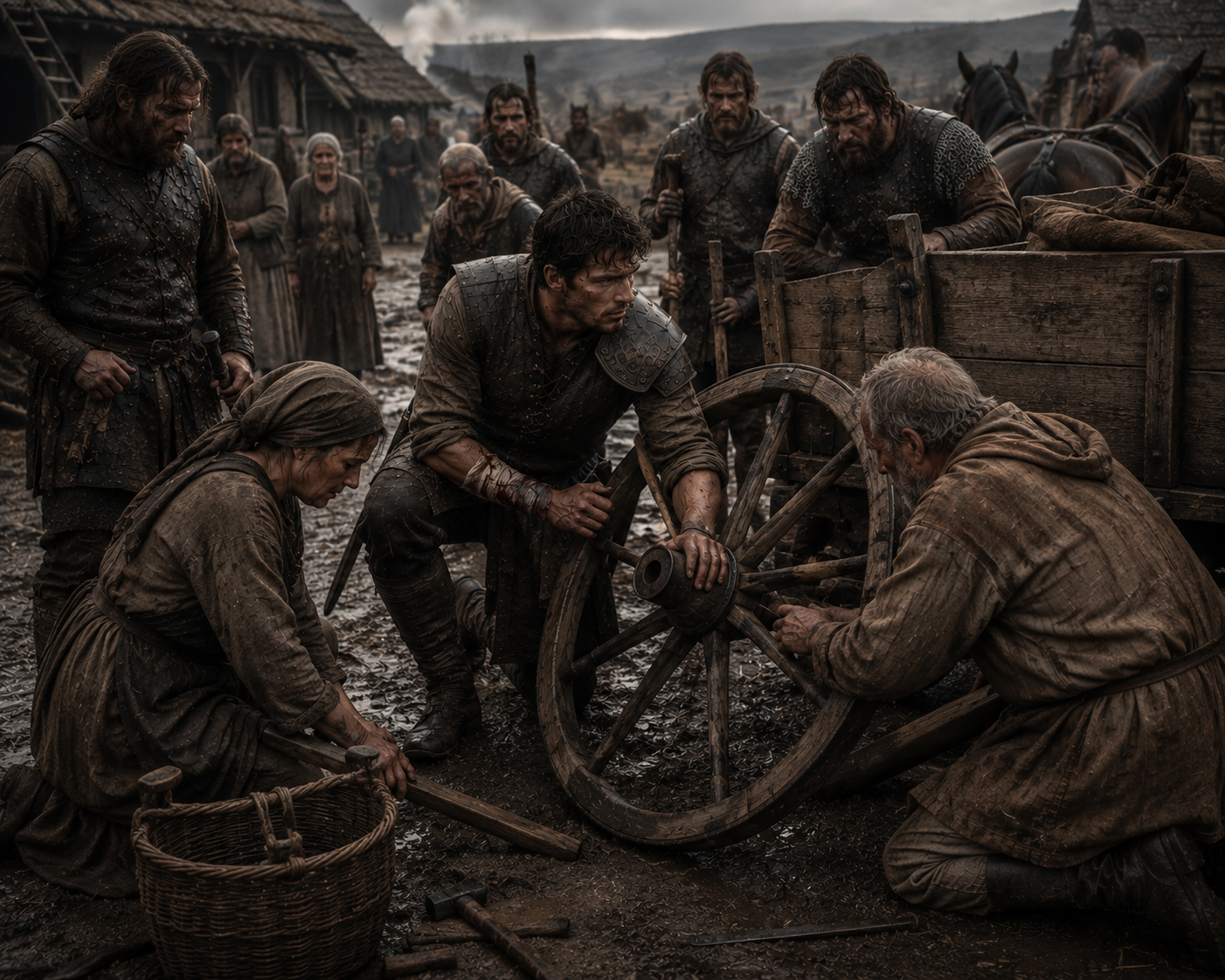
The source proved to be a wagon sunk crooked in the mud beside the road. One wheel had broken, its rim split, spokes jutting like snapped fingers. The wagon bed leaned hard to one side, and sacks of meal had spilled into the muck. An old woman stood beside it with both hands on her head. A man with a bloody bandage around one ear tried uselessly to lift the axle. Two children watched from the ditch, faces pale with cold.
A younger woman turned at the sight of them and snatched up a pitchfork.
"Back," she said.
Tom stopped at once. So did the men behind him.
"We mean no harm," he said.
The woman's laugh was sharp and afraid. "Men with blades always say that before the harm."
Pate stepped forward slowly and held up his maimed left hand. "Wheel's split clean through. You'll not move it by lifting."
The woman pointed the pitchfork at him.
Pate looked down at the tines. "That won't mend it either."
Tor gave a quiet snort.
Tom shot him a look. Tor found something else to look at.
The old woman lowered her hands. "Can you make it go, master?"
Pate crouched near the wheel, careful not to move too quickly. He pressed the wood, tested the axle, then spat into the mud. "Fix her? Nay. Teach her to limp? Aye."
"We need to reach my brother's farm," said the bandaged man. "Half a day west if the road holds."
"The road won't," Cley muttered.
Tom looked at the wagon. Then at his men.
They were tired. Wounded. Hungry. Every hour spent here was an hour not spent reaching Riverrun. Robb Stark was west. War was west. Duty was west.
So was this.
"Pate," Tom said, "tell us what you need."
The White Harbor man smiled faintly. "Wood that bends, rope that doesn't, and someone stronger than sense."
Tor spread his arms. "At last, my moment."
It took the better part of an hour.
Cley found a young ash with the right curve. Ron and Tor cut it down and trimmed it while Jory watched the road. Pate stripped broken pieces from the wheel and bound the split rim with green wood, leather, and rope. Eddyn used his spear haft as a lever to raise the wagon enough for Tom and Ron to wedge stones beneath the axle.
Tom's ribs screamed at him for that.
He ignored them until the wagon settled upright again. Then he stepped aside and bent over with both hands on his knees, breathing through his teeth.
The younger woman saw.
"You're hurt."
"So's the wagon," Tom said.
"That wagon didn't choose to be foolish."
"No," said Jory from behind him. "It had help."
Tor laughed. Even the woman's mouth twitched.
When they were done, the wheel looked like a drunk lord dressed for court, but it turned.
Pate wiped his hands on his cloak. "Slowly, and keep her out of deep ruts. If it starts clacking like teeth, stop."
The bandaged man gripped Pate's arm. "Thank you."
Pate looked embarrassed by the weight of it. "Just rope and wood."
"No," the old woman said. "It isn't."
They gave Tom's men two turnips, a heel of cheese, and a clay jar of honey so small Tor accused it of being a thimble in disguise. Tom tried to refuse. The old woman threatened to curse him with southron gods and northern ones both until he took it.
They left the wagon moving west behind them, slow but alive.
That should have been the day's kindness done.
It was not.
Late in the afternoon, they came upon a house with one side fallen inward.
Not burned. Not looted. Fallen. The sort of small house raised by hands that had little coin but much need: stone base, timber frame, mud daubing, thatch roof patched with reed. One whole wall had sagged loose, leaving the interior open to the weather. A family stood around it in despair: two men, three women, and more children than Tom could count at first glance.
A girl no older than ten held a baby under her cloak. An older boy stood with a hammer in his hand, trying not to cry.
One of the men stepped forward when he saw the northmen.
"We have nothing," he said.
Tom believed him.
The family had dragged what they owned into the yard: a chest, two stools, a cracked pot, blankets, a little shrine of the Seven with three faces broken off. Their hens scratched near the collapsed wall as if ruin were only another sort of weather.
"What happened?" Eddyn asked.
"Storm loosened it last night," the man said. "Or war did before that. Hard to tell which shakes a house worse."
Cley walked around the side, squinted, and prodded the frame with his spear butt. "Post has slipped. Beam's sound enough, if men pull true."
The man stared. "Can it be raised?"
Cley looked at Tom.
That was becoming a habit.
Tom did not answer at once. The light was already thinning. They needed food. They needed rest. They needed to keep moving, always moving, west to the river, west to Stark, west to the war that would not wait because one poor house had lost a wall.
Then the boy with the hammer wiped his face with his sleeve and tried again to lift a beam twice his weight.
Tom sighed. "Ron."
The mountain man grinned. "Aye."
This work took all of them.
Pate found rope from the broken wagon family's gift and knotted it around the leaning frame. Cley and Eddyn argued over where the pressure should go until Jory told them both to shut up and prove it. Tor gathered stones for bracing and complained loudly that houses should learn to stand without help if they meant to be houses.
Ron lifted like a man born under a mountain and angry about it.
Tom stood with the rope wrapped around his good shoulder, feet planted in the mud.
"On three," Eddyn said.
Tor frowned. "Whose three?"
"The only three."
"I've known bad threes."
"One," Eddyn said.
The men leaned in.
"Two."
The rope tightened.
"Three."
They hauled.
The wall groaned.
A woman cried out.
For one terrible heartbeat Tom thought the whole frame would come down on them. The beam shifted, dropped, caught, and then rose inch by grudging inch. Ron bellowed something wordless. Pate cursed in a White Harbor dockside tongue. Cley shouted for wedges. Willam scrambled forward with stones. Jory drove them into place with the back of his axe.
"Again. Put your backs in it!" Eddyn called.
They hauled again.
This time the wall came up.
Not straight. Not pretty. But standing.
The family surged forward with braces, nails, rope, and hope. Tom's men held the weight until the posts were secured and the beam tied off. By the end, everyone was streaked with mud, sweat, and old blood. Tom's hands shook so badly he had to tuck them beneath his arms.
The boy with the hammer approached him.
"You're a lord?" the boy asked.
Tor burst out laughing.
Tom shook his head. "No."
"A knight?"
"No."
The boy looked confused. "Then why'd you help?"
No one laughed at that.
Tom looked at the raised wall. Through the gaps, he could see the inside of the house: a low hearth, a straw pallet, a little wooden horse on the floor much like the one he had taken from the bandits' stolen goods. Poor things. Precious things.
"Because someone should," Tom said.
The boy considered this with great seriousness. Then he held out the hammer.
"You can have it."
Tom looked at the tool. It had a split handle wrapped in cord, and the iron head was pitted with rust. It was worth almost nothing.
Which meant it was worth too much.
"Keep it," Tom said. "You'll need it when the wall argues again."
The boy nodded, satisfied by that.
They camped that night in the family's yard.
There was not enough food, but there was warm broth. Not enough blankets, but there was a roof beside them that still stood against the wind. The children stared at the northmen as if they were heroes from some tale, which made Tor sit taller and Jory look profoundly uncomfortable.
Pate repaired a broken stool by firelight.
Cley vanished for half an hour and returned with two rabbits, pretending he had found them already dead so no one would praise him.
Eddyn sat apart, cleaning mud from his spearhead. Tom lowered himself beside him with care.
"You were at the Moat long?" Tom asked.
"Seven years."
"Hard place?"
Eddyn gave him a look. "You've never seen it?"
"No."
"Then yes."
Tom waited.
After a while, Eddyn said, "Moat Cailin teaches a man that roads matter. Causeways. Stones. Little dry places in a world trying to swallow you. Hold the road, and an army breaks against you. Lose it, and everything north lies open."
He nodded toward the house. "Same with this."
"A wall?"
"A wall. A wagon. A boy with a hammer. Little things that keep larger things from falling in."
Tom looked across the yard.
Tor was showing the children how to hold a wooden stick like a sword. Jory corrected him twice before taking the stick and demonstrating properly. Willam laughed for the first time since the hovel. Ron sat with the baby asleep against his broad chest, looking trapped and terrified in equal measure.
The sight struck Tom harder than he expected.
These were not lordly deeds. No songs would be made for a mended wheel or a raised wall. Robb Stark would not hear of it. No banners would fly because a family slept dry tonight.
Yet Tom felt, deep in the sore and battered places of him, that they had done something worth doing.
Maybe war was this too: a road, a wall, a wagon, a choice.
The next morning, the family fed them oatcakes wrapped in cloth and refused payment. The old mother pressed a small pouch of salt into Tom's hand and closed his fingers around it.
"For the road," she said.
"We can't take all this."
"You can," she said. "And you will. My son says you're bound for Stark."
"Aye."
"Then tell him the Riverlands still has folk in it."
Tom nodded. "I will."
As they left, the boy with the hammer stood by the raised wall and lifted the tool in farewell.
Tor waved back with great solemnity. "There goes a future terror."
"He's only ten," Willam said.
"All terrors start somewhere."
Jory glanced at Tom. "So do leaders."
Tom pretended not to hear.
They took the western road once more. Their pace was no faster. If anything, they moved slower, burdened now with oatcakes, salt, and the strange heaviness of gratitude. But the men walked differently.
Not stronger.
Not healed.
Only steadier.
Cley ranged ahead, complaining at the mud. Pate hummed some harbor tune under his breath. Eddyn watched every bend in the road as if it were a causeway through the Neck. Ron carried Willam's pack again and dared the boy to object.
Tor dropped back beside Tom.
"Smallfolk," he said.
Tom looked at him. "What of them?"
Tor glanced back toward the house, now hidden by mist and trees. "Big hearts."
Tom thought of the widow. The old man in the ditch. The girl with the knife. The boy with the hammer. The dead septon. The burned fields. Hullen and Edric beneath the ash tree.
"Aye," he said. "Bigger than most lords know."
The road bent west.
This time, when pain whispered for him to stop, Tom thought of a crooked wagon still rolling and a broken wall standing against the wind.
He kept walking.
Previous Chapter | Chapter List | Next Chapter
Disclaimer: Frostfyre is a non-commercial fan fiction project inspired by a Realm of Thrones campaign for Mount & Blade II: Bannerlord and set in the world of A Song of Ice and Fire. All rights to those original settings and characters remain with their respective owners.
Join the Forge
Receive new Frostfyre chapters and Aodh Forge updates as they are released.