Redemption of the Dragon
Act 2 – Prophesy or Conspiracy · Chapter 9: The Road Ahead
By morning, the camp remembered how to move.
That was not the same as healing.
Men limped. Horses tossed their heads at shadows. Cleyton's eyes were red from too little sleep, and Jory's shoulder had stiffened badly enough that he needed both hands to buckle his sword belt. Boro cursed at his bandage until Mera told him the cloth was not the source of his pain, only the witness to it. Darro's arm hung in a sling. Corren watched Tom too often. Salla watched everyone.
But packs were tied.
Water skins were filled.
The dead were named quietly by those who knew their names and carried silently by those who did not.
Then they rode.
The first hours passed under a hard blue sky. The hills east of Selhorys broke slowly into rough country, scrub and pale stone and dry washes where the rain had left dark threads of mud. The air smelled of wet earth giving itself back to heat. Behind them lay the valley and the red priests. Ahead, Aemon promised, lay safer ground.
"You say that as if ground can be trusted," Jory said.
Aemon rode near the front, cloak pulled close, one hand loose on the reins. "Ground is like men. Some is less treacherous than the rest."
"High praise."
"I am known for warmth."
Boro snorted from behind them. "Vezos means sun, he said."
"It does," Aemon replied without turning.
"Still waiting."
"Then your expectations are poorly managed."
The exchange pulled a few tired smiles from the company.
Tom felt the change as much as heard it. The night before, everyone had moved carefully around him. By midday, Boro had complained about his pace, Mera had told him he rode like a man trying to apologize to the horse, and Kemal had ordered him to practice left-handed grip work while mounted because apparently survival left no room for mercy.
Normal, Tom thought.
Or something wearing normal's cloak.
He accepted it anyway.
They did not travel as fast as Aemon wished. The wounded would not allow it, and the hills refused easy passage. Vissenya rode forward often, disappearing beyond rises with two scouts and returning by paths Tom had not noticed existed. Each time she came back, she somehow ended nearer him.
At first he thought it chance.
On the second day, he stopped believing in chance.
She rode beside him through a shallow ravine where tamarisk branches scraped at their cloaks. Her hood was down, platinum hair braided tight against the heat, pale skin warmed by sun but not browned by it. Dust clung to her sleeves. A bruise colored one cheekbone faintly, making her beauty look less polished and more real.
"You are staring at the horse's ears," she said.
Tom blinked. "Am I?"
"For some time."
"They are interesting ears."
"They are not."
"You know this horse well?"
"I know ears."
He looked at her then and found her smiling.
It was not the smile she used on Aemon when needling him, or the sharp one she used on men who mistook beauty for invitation. This one was smaller. Almost private. It made Tom suddenly aware of his own hands on the reins, of the dust on his face, of the fact that he had not known what to do with women even before slavery, prophecy, and mysterious magic had made everything worse.
"What should I look at?" he asked.
"The path, ideally."
"I was trying."
"You were avoiding."
"That too."
Vissenya studied the line of his face. "Do I make you uneasy?"
"Yes."
Her eyebrows rose.
Tom winced. "That sounded worse than I meant."
"Did it?"
"You ask questions like knives."
"And you answer like a man who thinks honesty is a shield."
"Is it?"
"Sometimes. Usually it is a bare throat."
He thought about that. "Then yes. You make me uneasy."
She laughed, warm and surprised enough that two riders ahead glanced back.
Tom felt heat rise in his face.
"Not because of that," he said quickly.
"No?"
"Because you see too much. And because you keep appearing where I am."
Her smile faded into something softer and more dangerous. "Perhaps I like where you are."
The horse took that moment to stumble over a loose stone.
Tom caught himself badly.
Vissenya's laughter returned, low and bright.
"Ser Kemal should train you against conversation," she said.
"He would make it painful."
"All useful lessons are, according to him."
"You sound as if you agree."
"I agree with many unpleasant things."
They rode in companionable silence after that, which unsettled Tom more than the teasing had. Silence with Vissenya did not feel empty. It felt like something being allowed to grow roots under stone.
The days settled into a pattern.
At dawn, Kemal trained them if there was room and punished them with smaller exercises if there was not. Footwork in dew-wet grass. Knife counters beside cold ashes. Shield turns while walking uphill. He made Tom repeat cuts slowly until the muscles in his shoulders trembled.
"Slow teaches truth," Kemal said.
"Fast keeps men alive."
"Only if slow taught them first."
Boro, attempting a turn with his injured leg, said, "I hate wisdom before breakfast."
"You hate it after breakfast too," Mera said.
"Because I am consistent."
After the morning miles, Cleyton reclaimed Tom.
The lessons were stranger on horseback.
High Valyrian verbs became something Tom muttered under his breath while riding through scrub. Cleyton corrected him from a mule that looked as offended by scholarship as Tom felt. Myrish phrases attached themselves to road signs, trader curses, and the names of plants Cleyton insisted might matter if they needed medicine. History came in fragments: the Freehold's roads, the cities that fed it, the families that fled it, and the way empires left marks on stones long after men stopped remembering which banners had cast the shadows.
"You are doing it again," Cleyton said on the third afternoon.
Tom looked over. "What?"
"Pretending not to be interested."
"I am not pretending."
"You asked two questions about drainage channels and one about why Valyrians built watch stations above dry beds."
"That was practical."
"History often is, despite scholars' best efforts."
Tom grudgingly allowed that mayhaps some knowledge was less useless than it first appeared.
In the evenings, Aemon and Vissenya spread maps.
Not always real maps. Sometimes scratches in dirt. Sometimes thread laid across a saddle blanket. Once, Aemon used olives, a knife, and Boro's cup until Boro accused him of militarizing supper.
They spoke of routes, watchers, false trails, river crossings, the reach of red temples, and what news might have gone ahead of them. Tom listened more than he spoke. Jory listened with him. Mera pretended not to and remembered everything. Tall Spear asked precise questions about choke points. Salla knew which villages would hide strangers for coin and which would sell them for less.
Vissenya, increasingly, sat beside Tom during these councils.
Not always close.
Closer than before.
Once her knee brushed his when she leaned to point at a line of hills. Neither moved for a breath too long. Aemon noticed. His face gave nothing away. Cleyton noticed and looked briefly toward the sky, as if asking some god he did not trust for patience. Jory noticed because Jory noticed everything, and afterward said nothing with great emphasis.
Tom preferred Boro's method.
"Pretty councilor likes your horse's ears," Boro said while they were unrolling blankets.
Tom nearly dropped his pack. "What?"
"I am old, wounded, and often irritated. I am not blind."
"You are not old."
"I accept the rest."
"There is nothing."
Boro looked toward Vissenya, who was speaking with Salla beneath a low tree. "There is always nothing before there is something."
"That means nothing."
"Exactly."
Tom gave up and went to fetch water.
By the fourth day, the land began to change.
The hills lowered. The air grew damp. They passed through villages where fishermen mended nets beside irrigation ditches and children stared at the company from doorways. Salt crept into the wind by evening, faint at first, then stronger beneath the smell of mud and horses. Birds wheeled overhead in white flashes. The road widened, then broke into several tracks leading toward low country.
"Bay country," Vissenya said.
Tom looked toward the horizon, though he saw only reeds and late light. "Elyria is close?"
"Closer."
"That is not an answer."
"It is the answer scouts give when they do not want tired men to start counting."
"You are fond of not answering."
"I answer beautifully. You want different answers."
She rode nearer as she said it, close enough that their horses' shoulders nearly aligned. Tom had begun to notice that she did this when the road allowed it. Not always. Not obviously. Just enough that he would look up and find her there, as if she had drifted into his weather.
He liked it.
That was the problem.
He liked the way she challenged him without making him feel foolish for not knowing things. He liked the way her laughter appeared suddenly and vanished before he could decide what he had done to earn it. He liked that she did not soften her danger for him, but neither did she perform it when they were alone.
He liked too much.
So, naturally, he said nothing useful.
That evening, Aemon finally told them about Oros.
They had camped among low ruins near a brackish creek. The stones were old, half swallowed by grass, carved with patterns worn too faint to name. No fires were lit because they were closer now to roads that mattered. The sky glowed with a dull red band over the west, and the first stars stood pale above it.
Aemon waited until the horses were settled and the outer watches placed. Then he unrolled a map of the western Valyrian peninsula, weighted the corners with stones, and looked at Cleyton as if finishing an argument that had lasted days.
"Enough," he said.
Cleyton blinked. "Are you asking my permission?"
"No."
"Then why look at me?"
"To make certain you understood I had considered your objections."
"That is not the same as valuing them."
"Often, no."
Vissenya sat opposite them, arms resting on her knees. "Tell them."
Tom looked from one to another. "Tell us what?"
Aemon tapped the map.
"Oros."
The name quieted even Boro.
Tom had heard it from Cleyton in lessons. One of the old Valyrian cities. Not Valyria itself, not the heart of the Freehold, but near enough to share in its glory and its death. Ruins, Cleyton had said. Ash, stone, cursed roads, and places men avoided unless coin or madness pushed them there.
"The ruined castle?" Jory asked.
"No longer entirely ruined," Aemon said.
Cleyton sighed.
Aemon continued. "For three years, the Tears have been reclaiming it quietly. The work began as a survey. Then a watch post. Then a storehouse. Then, against my better judgment and Baelys's considerable enthusiasm, a fortress."
"You rebuilt a Valyrian castle," Mera said.
"Partly."
"In the demon lands," Boro said.
"The Lands of the Long Summer are not demon lands."
"Stone men."
"There were stone men," Aemon allowed.
The words settled heavily.
Tom had heard of them too. Men afflicted with greyscale, exiled to ruins, feared as much for the touch of their skin as the madness that often followed. The thought of clearing them from any place made his stomach tighten.
"Were?" Jory asked.
Vissenya's face hardened. "Cleared."
"Killed?"
"Some," Aemon said. "Some driven off. Some trapped by old walls and made to choose exits that led away from the work. Some already too far gone to understand mercy, if mercy was ever possible there."
Cleyton looked down at his hands.
"We lost people," Vissenya said quietly. "Good people. Before anyone asks whether it was easy."
No one did.
Aemon tapped the map again. "Oros had advantages no city safe enough for ordinary men could offer. Old foundations. Deep cisterns. A harbor half choked but defensible. Walls broken, yes, but not erased. Distance from polite politics. Fear enough around it to keep fools away."
"And you repaired it," Tom said.
"We rebuilt the broken wall sections," Aemon said. "Reinforced almost all the masonry throughout the castle. Cleared the main keep, the lower yard, two cisterns, the inner store chambers, and the old sea gate. A garrison is already stationed there. Supplies are arriving by careful routes. Grain, salted fish, lamp oil, timber, quarrels, spare bowstrings, spearheads, healing stores, water barrels, smithing tools."
Boro stared at him. "That is more than a storehouse."
"Yes."
"That is a lord's seat."
Aemon's mouth tightened. "It will be the first sovereign holding fully under our ownership and control."
The silence after that felt different.
Not fear.
Scale.
Until that moment, the Tears had been safehouses, spies, books, hidden riders, men in borrowed clothes. Dangerous, yes. Old, yes. But a secret order was still smoke if it owned no ground.
A castle changed that.
"Sovereign," Jory said slowly.
"No magistrate. No merchant prince. No temple. No Volantene tiger or elephant with a quiet claim hidden in a ledger," Aemon said. "Ours. Held by our men. Supplied by our coin. Defended by our walls."
"And Baelys was meant to command it," Cleyton said.
Aemon looked at him, annoyed but not surprised. "Yes. And quickly, before disorder mistakes itself for politics."
Vissenya's jaw tightened.
Tom noticed both reactions.
"As lord?" he asked.
"Not a word the Tears enjoy," Aemon said.
"That means yes," Mera murmured.
Boro nodded. "Useful phrase."
Aemon ignored them. "Baelys was the obvious choice. He drove the plan. Found the engineers willing to work where sane men would not. Negotiated stone, lime, timber, ships, and silence. He understands what the castle could become."
"A refuge?" Tom asked.
"A refuge. An arsenal. A school. A treasury. A port. A place where we do not need to ask permission to breathe."
Cleyton said, "A temptation."
Aemon looked at him sharply.
Cleyton did not look away. "Name things fully."
Vissenya rubbed one hand across her brow. "It was easier when Baelys was merely impossible."
"He remains impossible," Aemon said.
"He is changing."
"We do not know that."
"You said it yourself on the road," Tom said.
Aemon's eyes turned to him.
Tom regretted speaking for about half a heartbeat, then decided he had survived worse than Aemon's displeasure.
"You said his reports had grown warmer," Tom continued. "About Daenerys."
"Admiration is not betrayal."
"No," Cleyton said. "But bitterness can make admiration hungry."
The older man's chain shifted softly as he leaned forward.
"Baelys has lost much," Cleyton said. "More than most know. He believes in the Tears because he has nothing else left that has not been burned, buried, or lied about. That makes him formidable. It also makes him vulnerable to strength that looks clean."
Vissenya's voice was quiet. "Daenerys looks clean from a distance."
"Breaking chains," Jory said. "Hard thing to dislike."
"Harder if you have worn them," Tom said.
That brought the others' eyes to him.
He looked at the map instead.
Slaver's Bay lay somewhere far beyond its edge in Aemon's telling, but Tom could feel it there all the same. A girl with dragons. Slaves calling her mother. Fire used against masters instead of servants. It would be easy, he thought, for a wounded man to see only that part. Easy to decide blood did not matter if the hand wielding it struck the right enemies.
That was how hooks stayed in.
Cleyton had said that.
"If Baelys commands Oros," Tom said, "and then decides Daenerys is not the danger you think she is?"
No one answered quickly.
The creek moved softly in the dark.
Finally Aemon said, "Then our first true holding may become the road by which old Valyria walks back into the world wearing a kinder face."
That answer chilled the camp more than night had.
"Who else could command it?" Jory asked.
Aemon folded the map's edge, then smoothed it again. "That is the question no one wanted to ask aloud."
"You?" Mera asked.
"Elyria is mine to hold together."
"Vissenya?"
Vissenya gave a dry smile. "Put me in a castle and half my usefulness dies of boredom."
"Cleyton?"
Boro laughed. "The castle would surrender to books."
"I would be a terrible lord," Cleyton said.
"You would explain surrender terms thoroughly," Boro said.
Despite everything, a few people smiled.
Tom looked at the inked mark for Oros. "Why tell us now?"
Aemon's gaze settled on him with a weight Tom did not like.
"Because the red priests know you are not in Myr. They know we took you. They will keep coming. Because Baelys is away and perhaps not the man we believed he was. Because Oros is nearly ready, and decisions delayed too long become decisions made by enemies."
Tom did not ask the next question.
He felt it standing there anyway.
Vissenya looked at him, and the warmth he had begun to recognize in her eyes was tangled now with worry.
"No," Tom said.
Aemon's brow lifted. "I did not ask."
"You were circling."
"Was I?"
"Like Vissenya when she wants to know if I am avoiding something."
Vissenya's mouth twitched.
Aemon looked between them and chose, mercifully, not to touch that.
"You have no desire to be lord of a half-ruined Valyrian castle?" he asked.
"I have no desire to be lord of anything."
"Desire is not always consulted."
"It should be."
Cleyton looked at Tom with an expression almost too gentle for the conversation. "Hold to that as long as you can."
The map was rolled away soon after.
The conversation did not end so much as sink beneath other tasks. Watches were assigned. Horses checked. Wounds redressed. Men lay down with Oros in their thoughts and salt in the wind.
Vissenya found Tom near the creek.
Of course she did.
He crouched at the water's edge, rinsing dust from his hands. The creek tasted brackish when he touched wet fingers to his mouth. He spat and heard her laugh behind him.
"That was unwise."
"I have made a life of small mistakes."
"Only small ones?"
"Recently the large ones found me without help."
She came to stand beside him. For once, she did not tease immediately. Moonlight silvered her hair and softened the hard lines travel had drawn around her eyes.
"You meant what you said," she said. "About not wanting lordship."
"Aye."
"Most men would want a castle."
"Most men have not spent this much time being owned, bought, watched, hunted, and explained."
She looked at him for a long moment. "That is why they look at you the way they do."
"Because I am tired?"
"Because power keeps finding you, and you keep looking for somewhere else to put it down."
Tom dried his hands on his cloak. "That sounds foolish."
"It sounds rare."
The air between them changed again.
Not sharply. Not like a blade. More like a drawn breath neither of them had decided to release.
Vissenya stood close enough that he could smell leather, dust, and some faint oil in her hair. Her face was turned toward the water, but her shoulder nearly touched his. Tom wondered what would happen if he moved. If he did not. If wanting something in a world this crowded with danger was bravery or stupidity.
He decided, unhelpfully, that it was likely both.
"We should sleep," he said.
Her lips curved. "Northern strategy?"
"Cowardice, mayhaps."
"No." She looked at him then. "Not that."
For a heartbeat, neither moved.
Then she stepped back.
"Sleep, Tom."
He watched her return to camp and felt, with some alarm, that he was smiling.
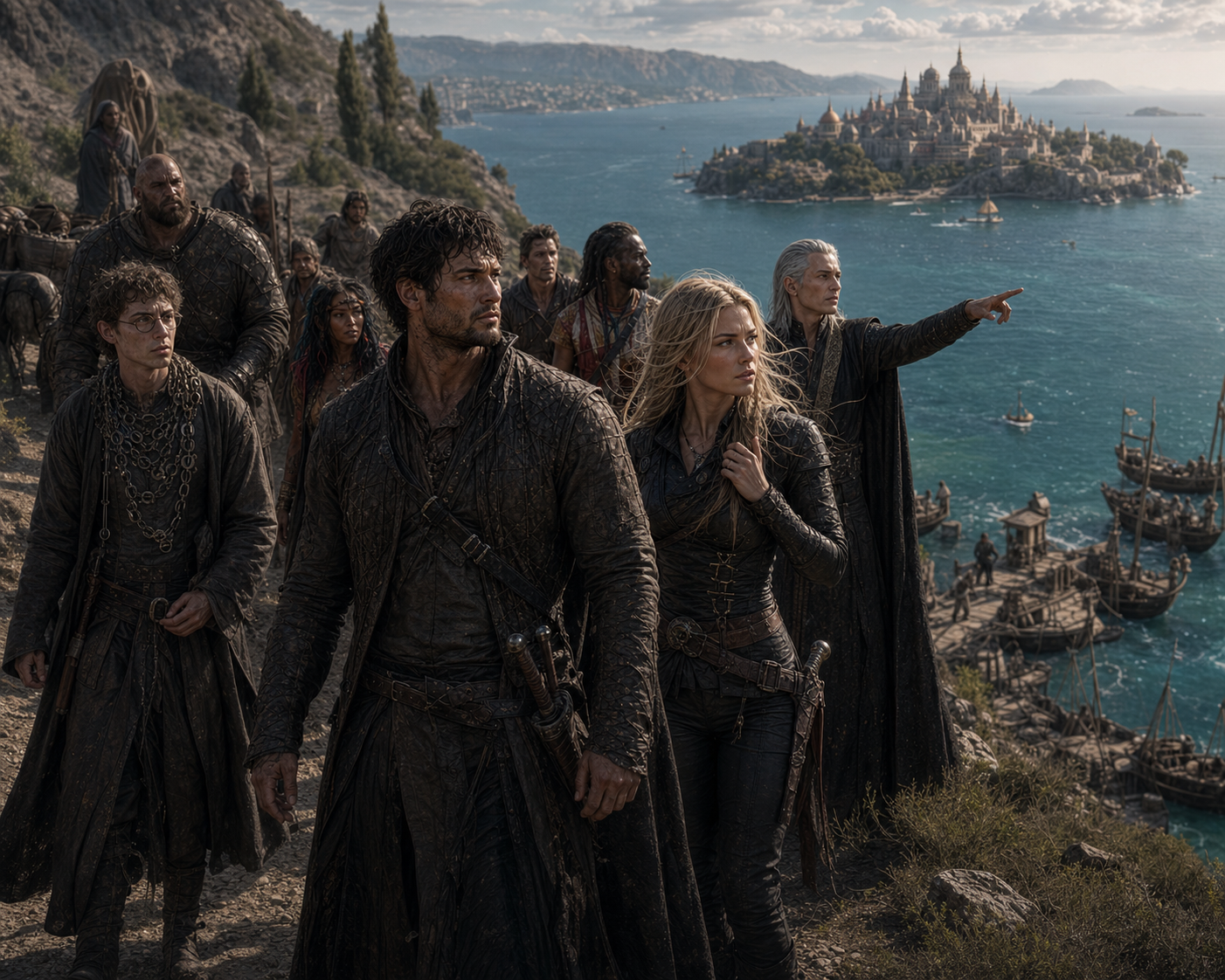
On the sixth day after the battle, they reached the bay.
The road ended in reeds and weathered posts, where flat-bottomed boats waited beneath grey sailcloth. The water beyond was broad and green under the morning light, dotted with fishing craft and low islands. Farther out, set within the bay like a dark jewel, rose Elyria.
Tom had expected walls.
He had not expected beauty.
The city stood on an island of pale stone, its outer quays curving around the harbor like open arms. White towers rose above red-tiled roofs. Cypress trees climbed terraces cut into the slope. Bridges linked smaller rock islets to the main harbor, and gulls wheeled over masts packed so closely they seemed like a winter forest stripped of leaves. Sun flashed on domes, water stairs, painted shutters, bronze roof tiles, and the slow movement of ships turning with the tide.
Behind it all, on the highest ridge of the island, stood older walls.
Not grand like Valyria in songs.
Older than the songs, mayhaps.
Weathered, repaired, and watchful.
Aemon reined in beside Tom. For the first time since Tom had met him, the man looked almost openly fond of something.
"Elyria," he said.
Boro shifted in his saddle. "Island city."
"Yes."
"You did not mention boats."
Vissenya rode up on Tom's other side. "Would that have changed your mind?"
"No. I prefer to complain with preparation."
Mera looked out over the bay. "Pretty."
"Pretty places sell knives too," Jory said.
"You are all poets," Cleyton muttered.
The boats rocked gently at the posts.
Tom looked from them to the island city, then farther east, though Oros lay beyond sight and salt haze and secrets still waiting to be named. Elyria was not safety. He knew better than that now. It was another threshold. Another hand opening another door.
Vissenya's horse stepped nearer his.
This time, Tom did not pretend not to notice.
Together, they rode down toward the waiting boats.
Previous Chapter | Chapter List | Next Chapter
Disclaimer: Frostfyre is a non-commercial fan fiction project inspired by a Realm of Thrones campaign for Mount & Blade II: Bannerlord and set in the world of A Song of Ice and Fire. All rights to those original settings and characters remain with their respective owners.
Join the Forge
Receive new Frostfyre chapters and Aodh Forge updates as they are released.