Redemption of the Dragon
Act 2 – Prophesy or Conspiracy · Chapter 5: New World
The gate did not open all at once.
It complained first.
Chains clanked somewhere ahead of the wagons, heavy links dragged through iron rings. Men called down from a wall in a language Tom did not know well enough to name, though some words had the rounded shape of the speech he had heard in Myr. Horses stamped. A driver answered too softly for Tom to hear, and the wagon beneath him gave a little lurch as the team shifted against the traces.
Then the gate groaned inward.
Stone swallowed the sound of the road.
The wagon rolled forward slowly, wheels changing from packed earth to fitted blocks. The boards beneath Tom's shoulder rattled in a steadier rhythm. He could smell water nearby, not the open salt stink of Myr's harbor, but river water and mud and wet rope. Under it lay other smells: smoke, dung, oil, fish, warm stone, too many people packed behind walls.
"City," Jory murmured.
Tom had already guessed it. He still asked, "Which?"
Jory leaned as far as his bound hands allowed and looked through a split in the sideboard. His face was grey with pain. Bruises had darkened one eye until it seemed half shut. The old soldier watched the passing wall, the shadows of men above, the flash of painted plaster beyond the gate.
"Not Myr," he said.
"Helpful."
"You asked."
Boro grunted from the wagon floor. "Selhorys."
Tom turned his head. "You know that?"
"Smells like the river."
Mera, sitting with her back against the opposite board and her wrists tied in front of her now instead of behind, gave him a flat look. "Every river smells."
"This one smells expensive."
"That is not a scent."
"You have not known enough rich men."
The wagon rolled under the shadow of the gatehouse. For a breath the world narrowed to darkness, hooves, stone, and the scrape of iron. Then light returned in hot white pieces through the canvas.
Tom saw a street.
Only in fragments at first. A line of shops beneath striped awnings. A donkey cart stacked high with clay jars. Women in bright veils stepping back from the wagons, eyes lowered until curiosity won and lifted them again. A boy with a basket of figs on his hip staring at the goat-helmed riders as if fear and wonder had tangled together in his throat.
The riders did not stay goat-helmed long.
That was the first thing that told Tom the city was not their home, whatever Boro said of rivers.
The wagons turned into a narrow service lane between a dye house and a high wall grown thick with flowering vines. The smell there was sharp enough to sting the eyes. Men dismounted. Orders passed in low voices. The goat-headed helms came off one by one.
Under them were ordinary faces.
Sweating faces. Tired faces. A young man with a blood crusted cut along his hairline. An older one with a nose broken badly long before this night. Another with silver at his temples and the calm, narrow stare of a man used to being obeyed.
They did not pray to the Black Goat. They did not mark their brows with blood or kiss their horned iron. They shoved the helms into sacks and passed the sacks to two hooded men already stripping off black robes. Beneath the black, the men wore tunics cut in the Volantene fashion, loose at the shoulder and belted at the waist, dyed in blue, green, yellow, and river brown. Cloaks appeared from bundles. Sandals replaced riding boots. A few tied bright scarves over their hair.
In less than a hundred heartbeats, the silent goat-men became merchants' guards, porters, drovers, and servants on an errand no one in the lane cared to question too closely.
Jory watched it with a soldier's attention.
"Costumes," he said.
"Seems so."
"Men who dress one way to kill and another way to pass a gate are worth worrying over."
"Only them?"
Jory looked at Tom. "Fair."
One of the men without a helm came to the wagon. He had been among those who carried ropes at the ludis. Tom remembered the shape of him by the way his left shoulder sat lower than the right. He cut the rope between Tom's ankles, then Jory's, then Boro's. He did not cut their wrists.
"Stand when told," he said in Myrish.
Tom flexed his legs. Pins of pain woke from knee to ankle.
"Where are we?" he asked.
The man moved to Mera without answering.
Boro smiled without warmth. "They love questions."
"They love not answering them," Jory said.
"That too."
The wagons moved again after the disguises were finished. Not far. Through a covered passage that smelled of old grain, across a broader street where Tom glimpsed towers beyond the rooftops, then into a district where the walls grew higher and the street quieter. Selhorys did not rise like Myr. It spread low and broad along the river, all sun-washed plaster, carved wooden screens, flat roofs, gardens hidden behind walls, and canals bridged by pale stone. Yet there was wealth in its quiet. Brass lamps at gates. Painted doors. Servants carrying baskets without looking at the wagons. Guards in private colors pretending not to count how many armed men had passed.
Beyond the roofs, far off, Tom saw the river.
It was wide enough to look like a road made of dull silver, crowded with barges and river galleys and poleboats with striped canopies. The air above it shimmered. East of the city, low green country stretched away under heat. Southward, the road bent toward lands Tom had only heard named by men who spoke of Essos as if every place in it were a wager.
The wagons stopped before a manor set behind a high white wall.
No banner hung above the gate.
That troubled Tom more than a false one would have.
The gate opened inward onto a courtyard paved in red tile. A fountain stood dry at its center. Date palms rose above the walls. A shaded gallery ran along three sides of the house, its arches painted with curling vines and small birds picked out in blue. It looked like the sort of place where men drank sweet wine and argued over trade.
It did not look like a prison.
That meant nothing.
"Out," said the man with the low shoulder.
They were helped down only in the sense that no one shoved them hard enough to break a neck. Tom's legs nearly folded when his boots struck tile. Jory caught him with bound hands and nearly fell with him.
"Easy," Jory muttered.
"I am."
"Lie better."
Boro came down last, cursing in three languages and inventing pieces of a fourth. His wounded leg would not bear his full weight. Two of the disguised guards moved to support him. He snarled at them until one stepped back. The other did not. Boro glared, then allowed it with the dignity of a king forgiving a chair.
Mera looked around the courtyard like she was memorizing every exit. Tall Spear stood near her, hands bound, eyes moving from roof to gallery to gate. The Norvoshi had to be half carried. Two other fighters Tom knew by face but not name leaned against each other, too tired to pretend they were not.
There were fewer of them than had left the ludis.
That count settled over the courtyard without anyone speaking it.
Water was brought. Bread. Olives. A bowl of lentils thick with garlic. No knives. No cups that could break into useful edges. The bonds on their wrists were loosened enough to eat, then retied with the knots in front. Guards watched from the shade.
"That is not slaver behavior," Jory said quietly.
Tom chewed bread because his body cared less about mysteries than hunger. "What is it?"
"I do not know."
"You always say that like it offends you."
"It does."
They were not put in cells. That offended Tom more.
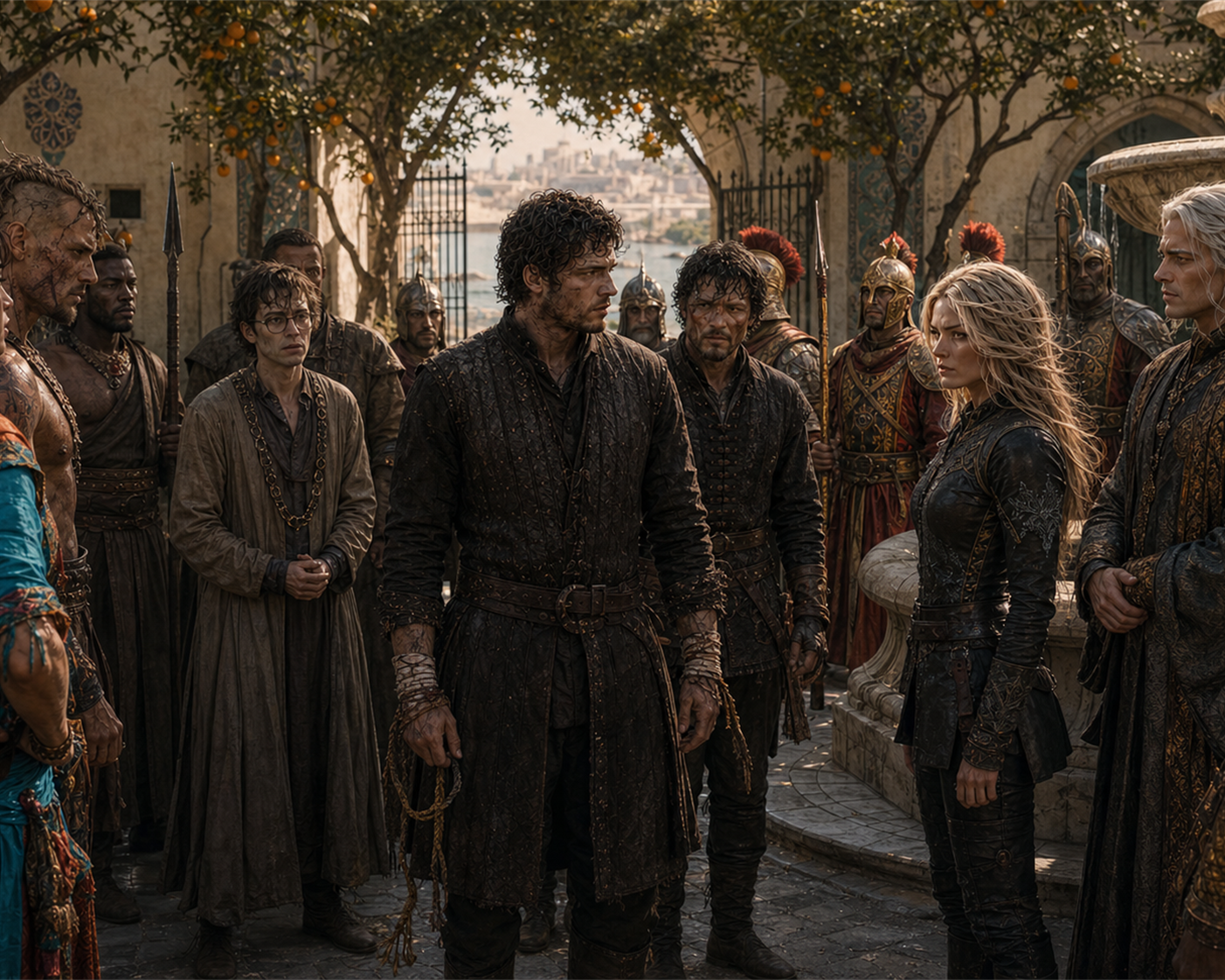
After they had eaten, the prisoners were moved through the courtyard into a walled garden at the back of the manor. There was grass there, real grass, green and soft beneath Tom's boots. Orange trees lined the walls. A tiled pool reflected the white heat of the sky. Guards closed the gate behind them and stood outside it.
The captives were bound, watched, and trapped.
They were also allowed to sit in shade, drink clean water, and wash blood from their hands.
Kindness, Tom had learned, could be a sharper hook than cruelty.
Mera knelt by the pool and splashed water over her face. Red-brown streaks fell away from her skin.
"If they wanted to sell us," she said, "we would be in chains."
"We are tied," Tall Spear said.
"Tied is not chained."
Boro lowered himself beneath an orange tree with a groan. "If they wanted us dead, we would be dead."
"Also not comforting," Tom said.
"I am not a comforting man."
Jory sat beside Tom with his back to the wall. He had chosen the place for the view of both gates. Tom had chosen it because Jory had. Some habits needed no discussion.
"They took us alive from men trying to take us alive," Tom said.
"Aye."
"That priest called us marked."
"Aye."
"Then these men came for us."
"Aye."
"You could add something."
"I am adding agreement."
"It is thin stew."
Jory's mouth moved almost into a smile. Almost.
The sun had crossed half the garden before anyone came to explain anything.
The man who entered did not look like a jailer, a slaver, or a warrior. He was small, narrow through the chest, and sunburned in patches as if Essos had not yet decided whether to claim him. His hair had once been brown and was now retreating from his forehead in wisps of grey. He wore plain robes the color of undyed wool, too heavy for the heat, and around his neck hung a chain made from many metals.
Tom's back straightened before he meant it to.
Jory saw the chain too.
"Maester," he said.
The little man inclined his head. "Once."
His voice was Westerosi. The sound of it struck Tom harder than he expected. Not northern, not quite reachman, not quite anything he could place cleanly, but from home. From the other side of the sea. From a place that had already taken so much and still had the power to ache.
"You are far from a castle," Jory said.
"So are you."
"We were dragged."
"As was I, in a manner of speaking." The man looked at their bound hands and winced slightly. "I am called Cleyton."
"Called by whom?" Tom asked.
"By those who still care to call me anything kind."
Boro snorted. "I dislike him already."
Cleyton looked at Boro's bandaged leg. "You should. I helped choose the route that worsened that wound, a fact I offer before anyone less precise weaponizes it."
That took the edge off Boro's sneer, but only because surprise made room for it.
Tom stood, slowly. The guards beyond the garden gate shifted, hands near weapons. Cleyton did not step back.
"You were with them," Tom said. "The men in black."
"Yes."
"Then you took us."
"Yes."
"From men who were trying to take us."
"Also yes."
"You see how that does not make you better."
"I do."
Tom waited.
Cleyton sighed. "I was told you would prefer bluntness. I see now that may have been optimism dressed as intelligence."
"Try it."
"The red priests wanted you alive. We could not let them have you."
"Why?"
"Because they fear what you may become."
Mera stood behind Tom. Tall Spear rose too. Jory did not move, which meant he was ready to move quickly.
Tom looked at the little man in maester's robes, at the chain glinting against wool, at the careful hands folded before him. "I have had enough of men in robes telling me what fires have seen."
"Good," Cleyton said.
That answer landed oddly.
Tom frowned. "Good?"
"A man who believes the first prophecy offered to him is easy to lead. A man who rejects all warnings because the word prophecy has been misused is easy to kill. I would rather you be difficult."
Boro leaned his head back against the tree. "He talks like a book that got lost."
"I was a maester," Cleyton said. "It is our second chain, and usually the heavier one."
Jory's eyes narrowed. "You said once."
"Yes."
"A maester does not stop being a maester."
"No. The Citadel stops admitting what he is."
For the first time, something hard showed through Cleyton's mild face. Not anger exactly. Older than anger. Disgust worn smooth by years of handling.
He crossed the garden and sat on the stone edge of the pool without being invited. The guards beyond the gate watched him with the uneasy respect men gave to someone who held authority without carrying steel.
"I served at a minor house in the riverlands," Cleyton said. "Before that I forged links at the Citadel with more pride than sense. I believed what I was taught. That knowledge was light. That reason was a wall against fear. That magic was either superstition or danger, and usually both."
"You learned otherwise," Jory said.
"Slowly. Then all at once."
Cleyton looked at the water. A fallen orange blossom floated near his knee.
"There are books in Oldtown that are not listed in any catalogue. Letters copied and recopied with missing names. Raven records where dates do not fit. Accounts of dragons sickening after maesters arrived. Children with gifts dismissed as fevers until they died of treatments meant to quiet them. Whole villages convinced to burn their own wise women because some chain-wearing man found herbs and old songs untidy."
Tom felt the word burn in his throat before he spoke. "You are saying maesters killed magic."
"No," Cleyton said. "Magic is not so easily killed. I am saying many tried. Some still try. We call it guidance when we steer lords away from what we cannot measure. We call it peace when we weaken powers we fear. We call it history when the last surviving account happens to be ours."
Jory watched him closely. "And the Dance?"
Cleyton's gaze lifted.
"You know that story?"
"Every man who has served near a lord's hall knows some version of it."
"Then you know princes and princesses tore the realm apart over succession."
"Aye."
"That is the version that survives best." Cleyton folded his hands together. "I found letters from maesters who encouraged suspicion in one court, then carried selected truths to the other. Advice given at just the right hour. Warnings withheld. Ravens delayed. Grief sharpened. Pride fed. Dragons were not the only beasts guided toward flame."
The garden had gone very still.
Tom heard water drip from Mera's sleeve into the grass.
"Why?" he asked.
"Because dragons answered to blood, not chains. Because those who advise kings have less power when kings ride fire and listen to dreams. Because men who cannot control a thing often decide the world is safer without it."
"And you expect us to believe you because you wear the same chain?"
Cleyton touched the links at his throat. "No. I wear it because I helped do harm under its weight, and I prefer not to forget."
That silenced Tom for longer than he liked.
Boro broke it. "This is a fine confession. Still waiting for the part where we are not tied in a stranger's garden."
"Fair." Cleyton rose. "The men who brought you here belong to an order older than most cities along this river. Older than Volantis in anything like its present form. Its founders were Valyrians."
Mera laughed once, harshly. "Valyrians founded everything in these lands, if Valyrians tell it."
"These founders would have objected to being remembered by Valyria at all."
Cleyton turned toward Tom when he said it.
"Before the Freehold became what the world remembers, there were noble families among the Valyrians who opposed the first great blood workings. Not out of kindness alone. Some out of fear. Some out of faith. Some because they had older gifts of their own, quieter gifts, tied to earth and beast and growing things. Closer in nature, perhaps, to what the children of the forest practiced in Westeros, though that comparison is imperfect."
Jory's face gave nothing away. Tom knew him well enough now to see the concern in the absence of expression.
"Children of the forest," Tom said.
"You have heard of them."
"Stories."
"Stories survive for reasons."
"So do lies."
Cleyton gave a small nod. "Yes."
Tom hated that the man kept agreeing at the wrong times. It made him harder to dismiss.
"What happened to these families?" Mera asked.
Cleyton's mouth tightened. "Most died."
No flourish. No bard's sorrow. Just the words.
"The dragonlords learned quickly that blood could open doors other magic would not. They used prisoners first, if the oldest accounts are true. Then rivals. Then servants. Then kin. There was a ritual in the Fourteen Flames, or beneath them. The record is damaged. Perhaps deliberately. Perhaps by time. It killed whole households who stood against the work. Children. Wives. Household guards. Singers. Stableboys. Anyone whose blood could be claimed as part of the line."
Tom saw the Twins for a breath.
Tables. Music. A door closing.
Kin and guests. Blood used to make a point.
His hand closed without meaning to, rope biting into his wrists.
Cleyton noticed and softened his voice. "Some escaped. Not many. Enough. They scattered through Essos and beyond it. Some hid among lesser Valyrian houses. Some took foreign names. Some crossed the sea. They founded an association to preserve what they believed magic should have been: protection, healing, harvest, memory, warning. A shield for common folk when lords and priests and sorcerers reached too greedily."
Boro snorted. "Secret heroes. Always useful after the killing is finished."
"Often useless before it," Cleyton said. "They would admit that."
"Would they?"
"The honest ones."
"Are you one?"
Cleyton looked at him. "I am trying to become one."
Tom glanced toward the gate. The guards there had not moved, but they were listening. Not with confusion. With recognition. This was not Cleyton's private tale. It was theirs too, or the tale they had chosen to live inside.
"And the Black Goat?" Jory asked.
"A mask."
"For what?"
"For red eyes."
Cleyton turned his attention back to Tom. "The priests of R'hllor have searched for this order before. Sometimes knowingly, sometimes only sensing an enemy in the dark and calling it by whatever name frightened the faithful best. Qohor's Black Goat offered a convenient shadow. Men already fear goat helms in the wrong street at the wrong hour. Let the red priests chase that fear, and they miss the hands beneath it."
"You used the followers of the Black Goat as cover," Tom said.
"Yes."
"And left your own men to die in those helms."
"Yes."
No comfort there. No denial.
Mera stepped closer. "The red guards cut many down after the wagons left."
"I know."
"You ordered that?"
"I ordered the rescue. Men chose whether to stand in the rear guard."
"Easy choice when someone else lives from it."
Cleyton accepted that like a blow he had expected. "Yes."
Tom did not know what to do with him.
Cruel men were simple when they enjoyed cruelty. Liars were simple when they needed belief too badly. Cleyton stood in a garden in old robes and told the worst parts plainly, which might have been honesty or a better class of trap.
"Why us?" Tom asked.
Cleyton looked relieved, as if that was the question he had been waiting to answer and dreading at the same time.
"Our watchers in Myr saw the red priests gather after your first days in Vorys's ludis. They came separately, but they left messages in the same hands. One of our agents serves a merchant who supplies oil to a red temple. Another copies ledgers for a man who thinks coin makes servants blind. A third heard a priest speak after too much dreamwine. Then, during your fight with the lion, the priests saw something that frightened them."
"We killed a lion," Jory said. "That would frighten sensible men."
"These were not sensible men."
"That too."
Cleyton drew a breath.
"They saw your blood in the flames, Tom."
The use of his name felt like a hand at the back of his neck.
"I did not give you my name."
"No."
Jory stood then. The guards at the gate reached for swords.
Cleyton lifted one hand without looking at them. They stopped, but not happily.
"Careful," Jory said.
"I am trying to be."
"Try harder."
Cleyton nodded again. "You are Tom. You were taken at the Twins after the slaughter there. The Freys sold you unconscious to men who sold you again before you were properly awake. Your companion is Jory, once sworn to House Stark. Boro trained fighters for Vorys. Mera of Tyrosh killed three red guards before she was netted. Tall Spear's name is not Tall Spear, but he permits no one here to use the other."
Tall Spear's jaw tightened.
Tom's skin went cold despite the heat.
"Spies," he said.
"Yes."
"Everywhere?"
"No. In enough places to make enemies nervous."
"You know too much."
"Far less than the red priests want to know."
Jory had not sat down. "What did they see?"
Cleyton looked from Jory to Tom, and for the first time he seemed truly uncertain how to continue.
"They believe Tom descends from one of the Valyrian families that escaped the first blood rites. Not dragonlord blood as they worship it. Not the line they understand. Something older. Something they thought had thinned into nothing or hidden too well to matter."
Tom laughed because the other choice was worse.
It came out ugly.
"I am northman stock."
"Mostly."
"Mostly?"
"Blood travels more quietly than banners."
"My family is not Valyrian."
"No. But houses marry, daughters disappear into lesser names, bastards become stewards, sailors become husbands, captives become grandmothers, and a thousand years is a wide river. The red priests do not know the path. Only the taste of the fire when your blood was shown to it."
Tom looked at Jory, wanting him to scoff, to cut the whole thing apart with one dry sentence.
Jory did not.
That frightened him more than Cleyton had.
"Say I believe any of this," Tom said. "What threat am I meant to be?"
"We do not know."
"Convenient."
"Terribly inconvenient, actually."
Boro barked a laugh, then winced and gripped his side.
Cleyton continued. "The priests argued over it. Some wanted you taken to Volantis. Some wanted you killed in the arena in a way that looked accidental. Some wanted your blood for a rite. The men beside Vorys after the lion died were not asking him to reward you. They were demanding he sell you. He refused, or delayed, or tried to raise the price. We have not yet learned which. By sunset he was dead."
Tom thought of Vorys's severed head rolling through sand.
He had not liked the man. Had owed him nothing clean. Yet Vorys had shouted for Boro to break into the arena. Vorys had, for reasons of profit or pride or something stranger, kept them alive one time too many.
"And you brought us here," Tom said.
"Yes."
"To use us first."
Cleyton did not answer quickly enough.
Jory's hand tightened.
At last Cleyton said, "Some in the order would like to. I will not insult you by pretending otherwise. A man the red priests fear is a tempting thing to place on a board. But that is not why I came to this garden."
"Why did you?"
"To untie you before I ask anything."
He turned and spoke to the guards in fluent Volantene. One hesitated. The older man with silver at his temples, now wearing a blue cloak instead of black mail, entered the garden and argued in a low voice. Cleyton answered softly. The older man's expression hardened. Cleyton touched the chain at his throat and said something that made the guard look away first.
Knives were brought.
No one moved as the first bonds were cut.
Tom expected a trick. A test. Crossbows from the gallery if anyone lunged. Mayhaps there were. He did not lunge. Neither did Jory, though Tom could feel the effort it cost him.
The rope fell from Tom's wrists.
Blood returned in hot needles.
Jory was freed next. Then Mera. Tall Spear. Boro, who rubbed his wrists and looked almost disappointed no one gave him an excuse to start killing.
The others followed.
When the last rope was cut, the garden seemed to breathe.
Cleyton stepped back so no freed man or woman stood within arm's reach of him by accident. That was either wisdom or fear. Tom supposed both could live in the same body.
"You are not slaves here," Cleyton said. "You are not prisoners, if you choose not to be. There is coin enough to put any of you on a riverboat by morning. Food for the road. False names, if needed. Those who wish to vanish into Selhorys may do so. Those who wish to return to Myr will be called fools, but not stopped."
"Generous," Mera said.
"Late," Cleyton answered.
She had no reply for that.
"And the other choice?" Jory asked.
Cleyton looked toward Tom. Not at the group. At Tom.
"Stay. Learn what the red priests saw. Help us learn why it frightened them. Fight them, if you choose, when fighting becomes necessary."
"And if I do not choose?"
"Then I hope you live long enough to curse us for our poor manners."
Tom wanted to hate him.
It would have been simpler.
He looked around the garden at the people who had been dragged from one cage to another until even mercy had begun to look suspicious. Boro beneath the orange tree, leg ruined and eyes bright. Mera with water drying on her face, one hand already resting near a knife she did not have. Tall Spear standing straight despite exhaustion. The Norvoshi sitting with his tattooed arms across his knees. Jory beside him, free hands loose and ready.
All of them had been bought once.
Some more than once.
Tom flexed his fingers and felt rope burns pull.
"I need to speak with Jory," he said.
"Of course," Cleyton answered.
"Alone."
The small man nodded and withdrew to the far end of the garden. The guards stayed at the gate. Tom had expected that.
Jory stepped close enough that their words could hide under the fountain's dry whisper of wind.
"What do you think?" Tom asked.
"I think every man who claims to save you has a use for you."
"Aye."
"I think he told enough truth to make the lies harder to find."
"Aye."
"I think the red priests want you. That part rings clean."
Tom looked toward the white wall where orange leaves trembled in the heat. "And the Valyrian blood?"
Jory's mouth twisted. "I have seen stranger things than old blood waking when men start killing over it."
"That is not an answer."
"It is the only one I have."
Tom nodded slowly.
Jory studied him. "You are thinking of leaving."
"I am thinking of every road ending with someone waiting."
"That is not the same."
"No."
"Then?"
Tom looked at Cleyton. The maester who was not a maester. The little man in a heavy robe beneath an Essosi sun, carrying a chain like penance.
"If they are lying, I want to know why," Tom said. "If they are telling the truth, I want to know that more."
Jory gave a tired nod. "Then we stay until staying becomes foolish."
"And when is that?"
"Usually just after we notice."
"Comforting."
"I learned from Boro."
They turned back.
Tom did not get to speak first.
Boro pushed himself upright with the help of the orange tree and glared at the whole garden as if it had personally offended him.
"I am staying," he said.
Tom blinked. "I did not ask."
"You were going to."
"Was I?"
"Eventually. You are slow with obvious things."
Mera crossed her arms. "If the red priests want him, they will come again."
"That is a reason to leave," Tom said.
"No," she said. "That is a reason to stand where I can see them coming."
Tall Spear nodded once.
The Norvoshi lifted his bruised face. "I go where she goes."
Mera looked at him. "Since when?"
"Since I am concussed and wise."
One of the unnamed fighters laughed, brief and broken and real. The sound passed through the group like a hand loosening a knot.
Boro pointed at Tom. "You killed a lion badly."
"Badly?"
"Messy. Wasteful. Impressive despite yourself. Men like that attract trouble. I prefer trouble I know."
"You know me?"
"Enough."
Jory looked at the others. "No one owes him this."
"We know," Mera said.
"No vows," Jory said. "No chains with softer names."
"We know," Tall Spear said.
Tom swallowed. It hurt more than it should have.
He had not led them out of the ludis. He had not saved them from the red guards. He had not cut their ropes or chosen their road. Yet they were looking at him as if the choice had already taken shape around his shadow.
He did not know whether that was trust or desperation.
Mayhaps trust was desperation that had decided where to stand.
Cleyton returned only when Tom looked his way.
"Well?" the little man asked.
Tom glanced once at Jory, then at the others.
"We stay," he said.
Cleyton's relief was small and quickly hidden. "All of you?"
"Seems so."
"You understand I cannot promise safety."
Boro laughed. "Good enough. I would not know what to do with it."
Tom rubbed at the raw skin around his wrists. Beyond the manor walls, Selhorys moved in heat and trade and river light, unaware or pretending to be. Somewhere far behind them, Myr's red temples would be counting losses. Somewhere ahead, men who had worn goat heads in the dark waited to explain what they had truly brought him into.
Tom looked at the maester's chain, at the guards in bright Volantene clothes, at the freed fighters gathered beneath orange trees.
"Start with names," he said.
Cleyton tilted his head. "Names?"
"Your order. Your captain. The men who died buying us time. The ones who will be giving orders if we stay."
The little man considered him for a moment.
Then he smiled, not warmly, exactly, but with something like approval.
"Yes," he said. "That is where we should have begun."
Previous Chapter | Chapter List | Next Chapter
Disclaimer: Frostfyre is a non-commercial fan fiction project inspired by a Realm of Thrones campaign for Mount & Blade II: Bannerlord and set in the world of A Song of Ice and Fire. All rights to those original settings and characters remain with their respective owners.
Join the Forge
Receive new Frostfyre chapters and Aodh Forge updates as they are released.